Table of Contents
Toggle9 Hypertrophy Training Methods Explained (Size + Symmetry)
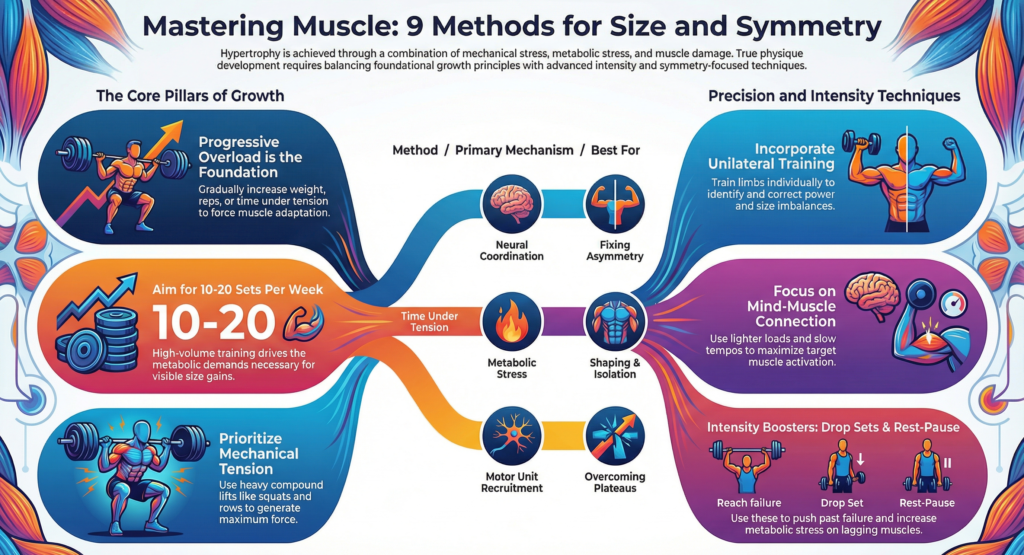
This infographic, titled “Mastering Muscle: 9 Methods for Size and Symmetry,” provides a clear and structured roadmap to hypertrophy training. It highlights the core pillars of muscle growth, including progressive overload, optimal weekly volume of 10–20 sets, and prioritizing mechanical tension for maximum strength and size. The visual also explains key mechanisms like metabolic stress, time under tension, and motor unit recruitment, helping lifters understand how muscles truly grow. Additionally, it emphasizes precision techniques such as unilateral training and mind-muscle connection to correct imbalances and improve symmetry. Overall, this guide simplifies advanced training concepts into a practical system for building a balanced, aesthetic, and powerful physique.
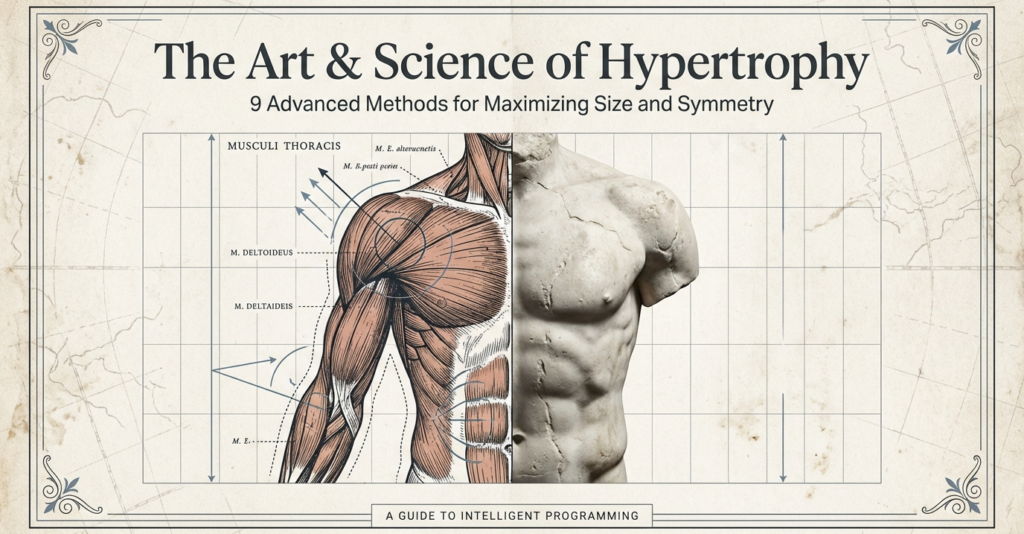
The Art & Science of Hypertrophy
This blog is about 9 advanced methods for maximizing size and symmetry. The ideal combination of art and science in the hypertrophy training, which is directed by the processes of muscle development through the guiding anatomy and intelligent programming. Detailed muscle structure, on the one hand, shows the mechanism of functioning of fibers, their alignment and the occurrence of force. Conversely, the classical physique form is a representation of balance, proportions, and symmetry.
Real hypertrophy is not just going out and lifting, but a planned exercise that is a result of mechanical tension, volume, recovery, and quality of execution. Once the science determines the load, tempo, and frequency, and the art influences the beautiful and the beautiful one forms a predictable and sustainable muscle development. This image is reminding us that to achieve an elite body structure, one must not rush, be inaccurate, or ignore human anatomy, but must be patient, accurate, and respectful of it.
Muscle Building Is Fatigue Management
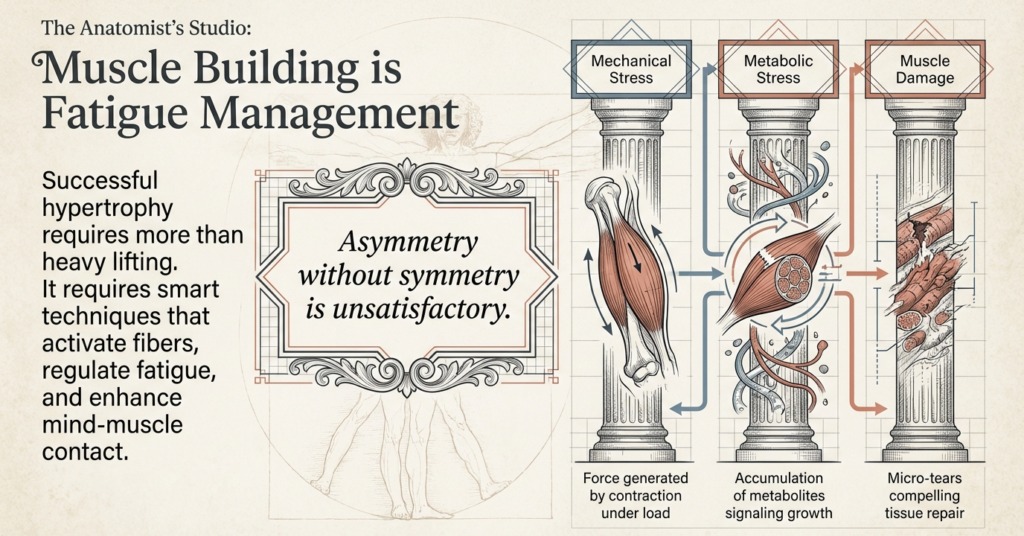
This picture indicates the most important reality of hypertrophy training: hypertrophy is developed with the help of fatigue control and not necessarily heavy lifting. Mechanical stress, metabolic stress and planned muscle destruction combined to promote growth, however, only when recovery is observed. Unregulated surplus burden causes stagnated growth and imbalance. Smart training enables the activation of the correct muscle fibers, manages the volume, and maintains the balance between intensity and rest.
The management of fatigue enables the muscles to accommodate, repair micro-tears and become stronger with time. When the fatigue is controlled and the mind muscle connection refined, hypertrophy would be long-term, symmetrical and sustainable as opposed to short-term and prone to injury.
The Hierarchy of Hypertrophy Training
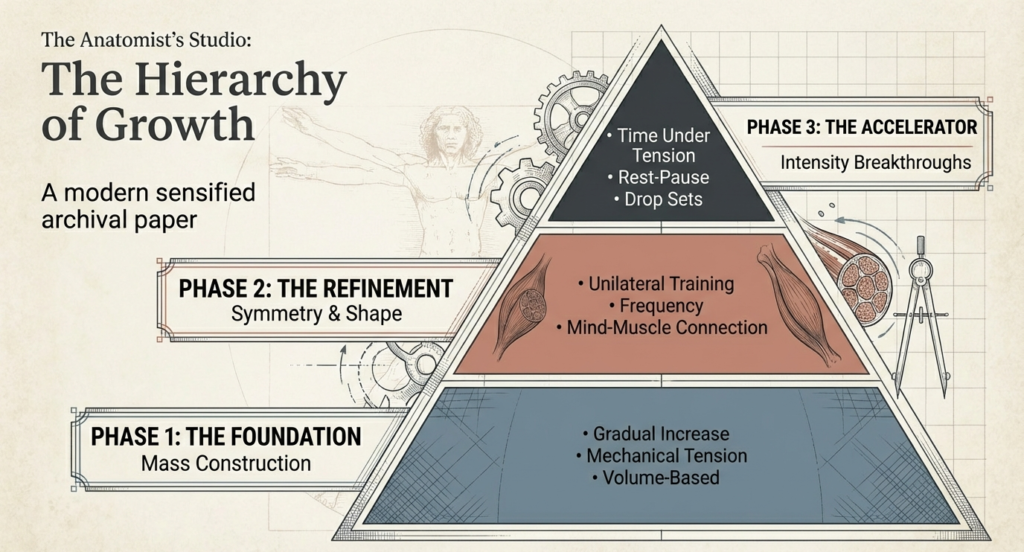
Hypertrophy training is structured into three distinct phases: The Foundation, The Refinement, and The Accelerator, with all three phases collectively covering nine proven hypertrophy methods..This picture indicates the most important reality of hypertrophy training: hypertrophy is developed with the help of fatigue control and not necessarily heavy lifting. Mechanical stress, metabolic stress and planned muscle destruction combined to promote growth, however, only when recovery is observed. Unregulated surplus burden causes stagnated growth and imbalance. Smart training enables the activation of the correct muscle fibers, manages the volume, and maintains the balance between intensity and rest.
The management of fatigue enables the muscles to accommodate, repair micro-tears and become stronger with time. When the fatigue is controlled and the mind muscle connection refined, hypertrophy would be long-term, symmetrical and sustainable as opposed to short-term and prone to injury.
Phase 1: The Foundation (Mass Construction)
Method 1: Gradual Increase Training
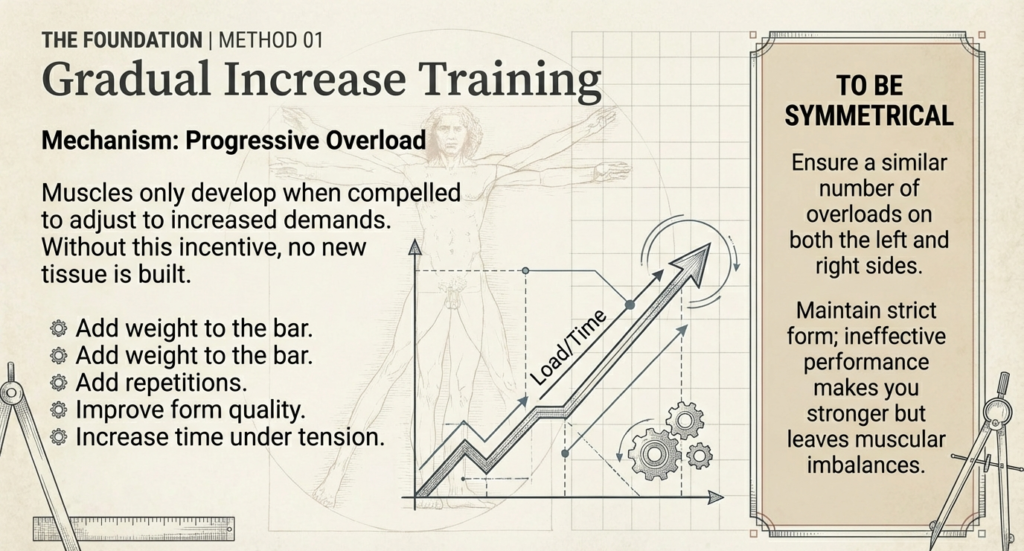
The basis of hypertrophy is progressive overload. It consists of the slow build up of muscle stress. This may be achieved through weight addition, additions of reps, betterment of form or addition of time under tension. The muscles develop since they are compelled to adjust to the increased demands. In the absence of progressive overload, there is no incentive to develop additional muscle tissue in the body. This technique works particularly well with newcomers and middle achievers developing a substantial mass foundation.
To be symmetrical, make sure that there is a similar number of overloads on each side with strict form and controlled reps. Ineffective performance can make one stronger but leave muscular imbalances.
Method 2: Mechanical Tension Focus
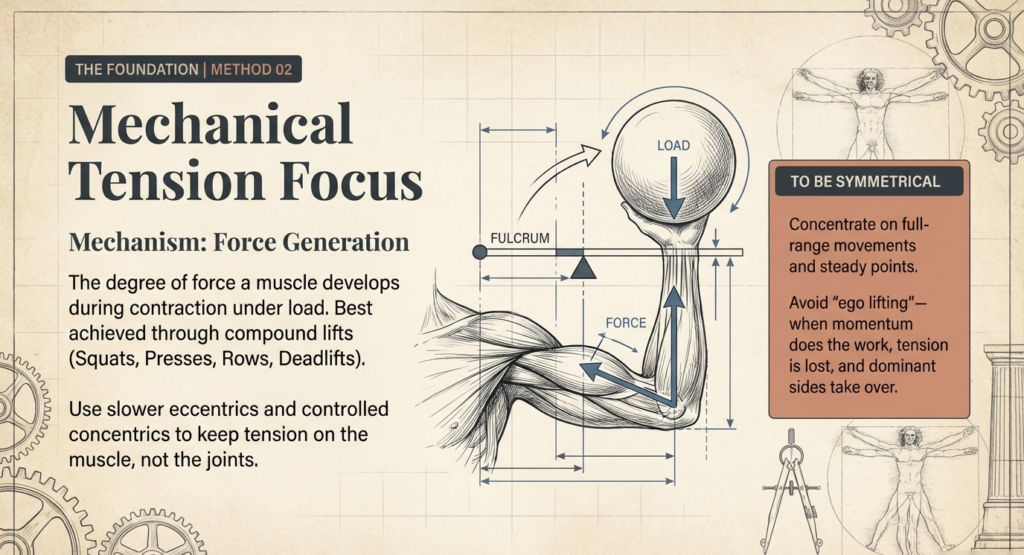
The degree of force that a muscle develops during contraction under load is called mechanical tension. Compound lifts that are done with the right method produce great tension which is a key factor in muscle building. Squats, presses, rows and types of deadlifts are the exercises that are best in tension-generating. Slower eccentrics and controlled Concentrics take longer time under tension avoiding over-emphasis on the joints.
To be symmetrical, concentrate on full-range movements and steady points. Avoid ego lifting. When the muscles and not momentum are doing the work then it is best to use mechanical tension.
Method 3: Volume-Based Training
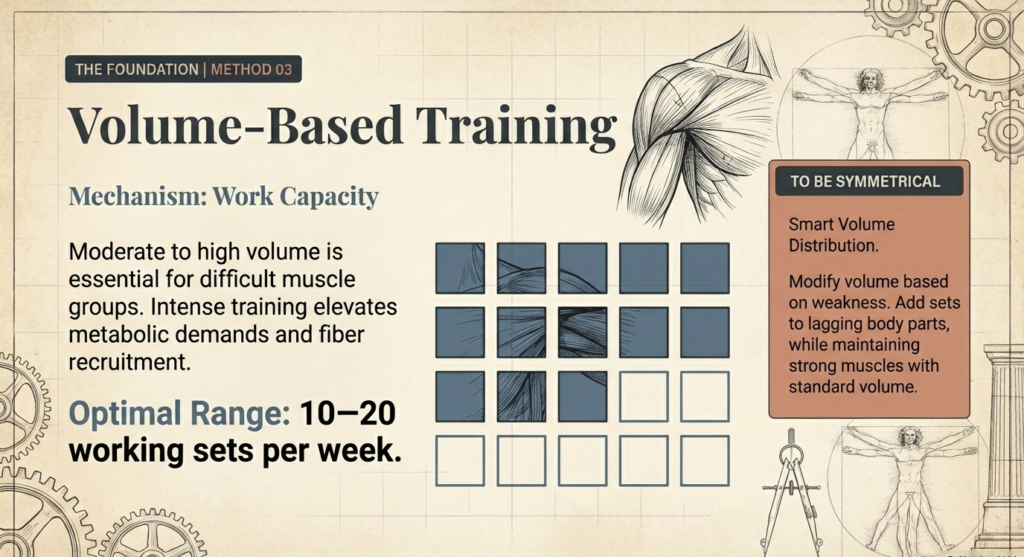
The amount of work done is known as training volume and typically this is set-reps-load. A moderate to high volume is essential in hypertrophy, particularly, to difficult muscle groups. The majority of the muscles are responsive to 10-20 good working sets in a week. Intense training elevates metabolic demands and recruitment of muscle fibers resulting in apparent size gains.
As a measure of symmetry, modify volume in each muscle group depending on the weaknesses. Weaknesses in certain body parts might require addition of more sets, whereas strong muscles might only need to be maintained. The secret of aesthetic equilibrium lies in smart volume distribution.
Phase 2: The Refinement (Symmetry & Shape)
Method 4: Unilateral Training
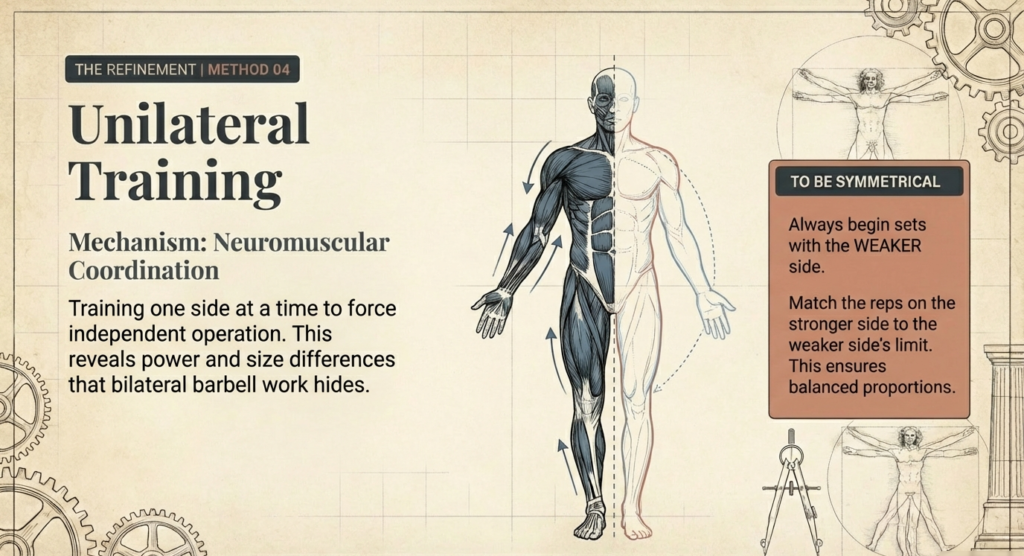
Unilateral training consists of training of one arm at a time. Examples are the single arm rows, the single arm lunges, the single arm presses and the one arm lateral raises. The approach reveals the power and size difference and compels both parties to operate on their own. It enhances the neuromuscular coordination and equals muscle activation. Unilateral training is required to attain symmetry. Begin the sets with the weaker side and end with reps of the stronger side. In the long run, it results in the development of balanced muscle mass, and an appropriate proportion of physiques.
Method 5: Frequency-Based Training
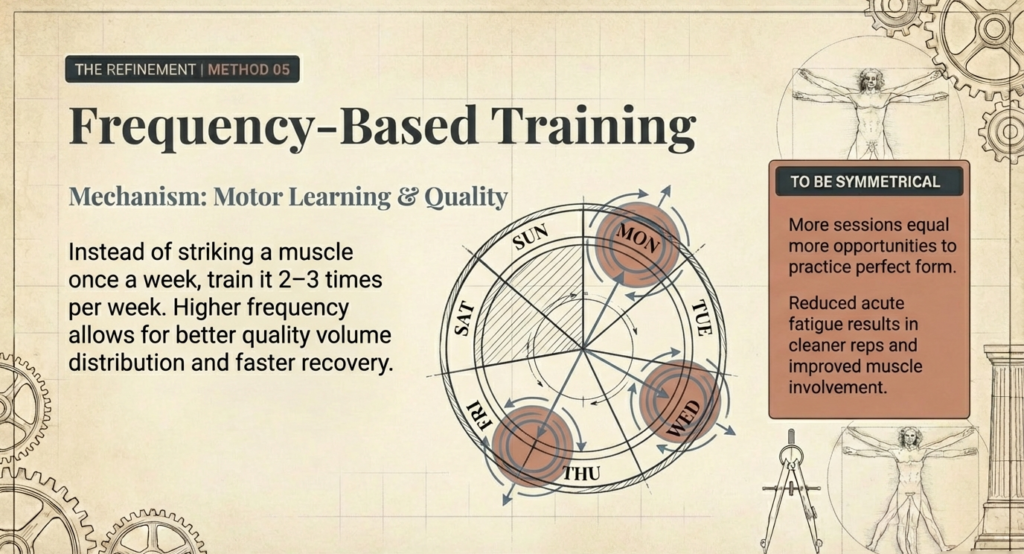
The rate with which a muscle is trained in a week is referred to as training frequency. Rather than striking a muscle once a week, a number of lifters improve with 2-3 sessions per muscle, per week. The greater frequency permits more quality volume distribution, and higher recovery between sessions. It also strengthens the movement patterns and muscle activity. To be symmetrical, a higher frequency provides more chances to overcome the imbalances and perfect the method. Reduced exercise fatigue will result in cleaner reps and improved muscle involvement.
Method 6: Mind-Muscle Connection
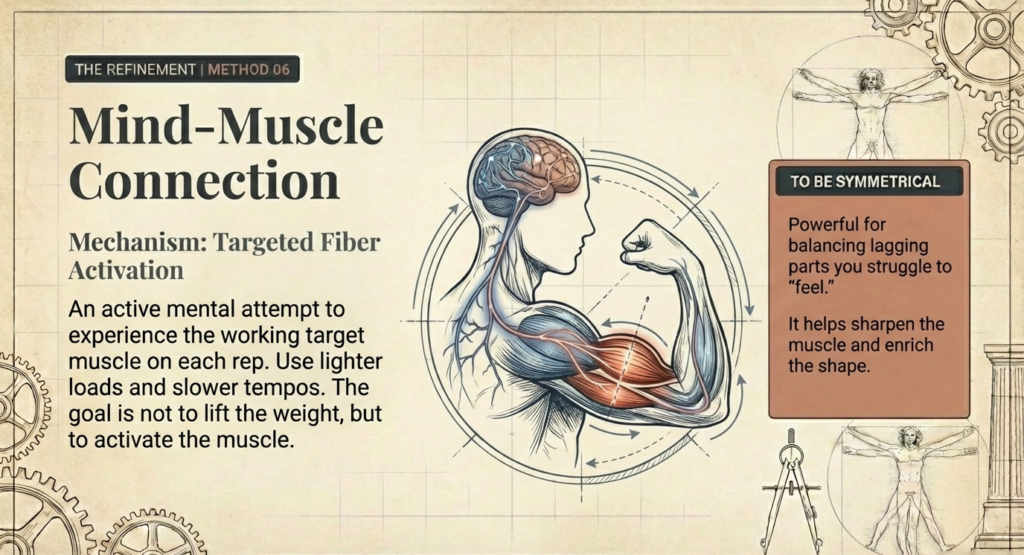
Mind-muscle connection refers to the active attempt to experience the working target muscle on each rep. Although it is usually undervalued, studies have demonstrated that it can be very effective in enhancing hypertrophy especially in isolation exercises. It is a technique based on lighter loads, slow tempo, and concentrated contractions. It is not to lift weight but activate the muscles.
This is a very powerful method to be used in symmetry. It aids in balancing imbalances, muscles are sharpened, and shape is enriched. It is popular among bodybuilders who are interested in achieving the perfect shape of their muscles and not the bulk.
Phase 3: The Accelerator (Intensity Breakthroughs)
Method 7: Time Under Tension (tut)
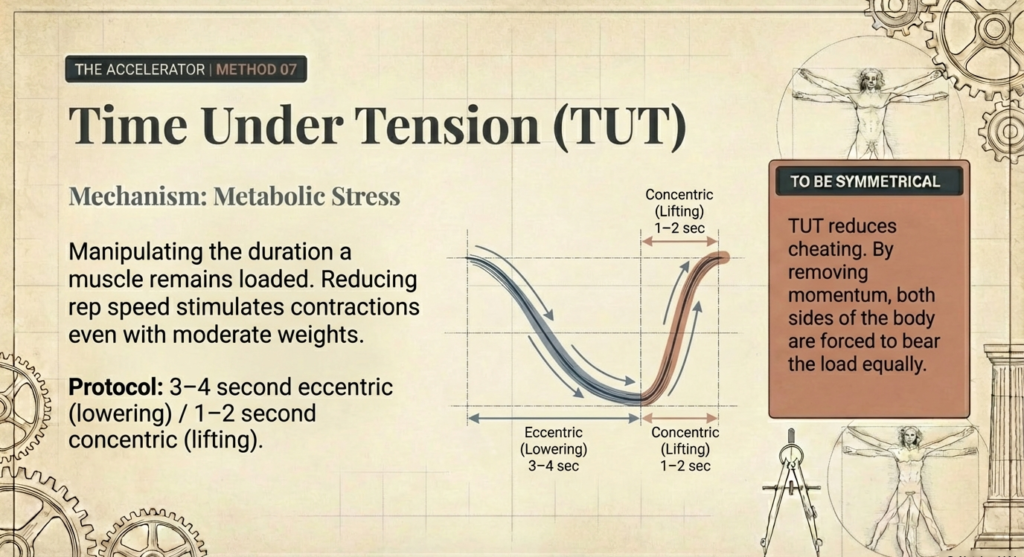
Time under tension is concerned with the duration of time taken by a muscle to remain loaded on a set. Reduction in speed of reps stimulates muscle contractions at moderate weights. One method is a 3- 4 second eccentric and a 1- 2 second concentric. This enhances the stress of metabolism and enhances the connection between the mind and muscles, and it is best used in isolation exercises. TUT training is very good in terms of symmetry since it reduces the amount of cheating and the two parties have to work equally. It particularly works well on arms, delts, calves and chest shaping
Method 8: Rest-pause training
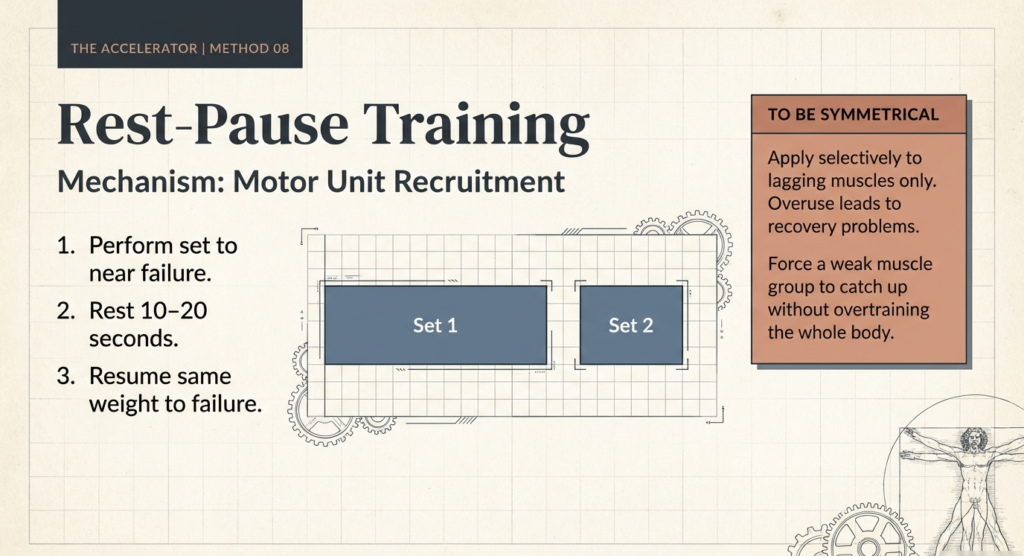
Rest- pause training: It is a series of sets to close to the maximum intensity, followed by a short time (10-20 seconds) of rest and then resume using the same weight. This enables additional reps with heavy loads within a short period of time. The technique augments motor unit enlistment and metabolic overload without causing a significant expansion in the duration of the workout. It is very efficient in terms of hypertrophy as well as very taxing.
Selective rest-pause on last sets. To be symmetrical, it is preferable to apply it to the lagging muscles only because when it is overused, it may lead to recovery problems, and imbalance is something undesirable.
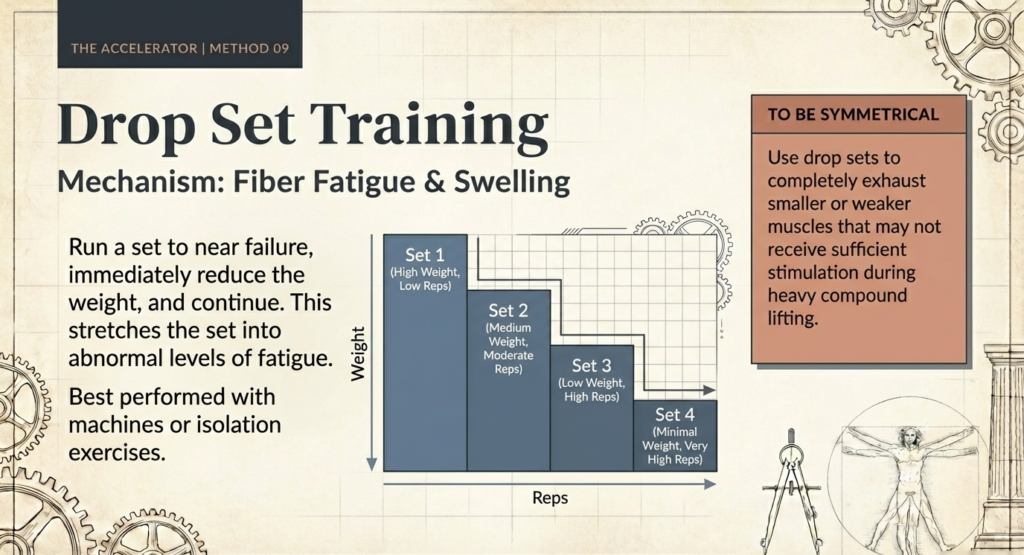
Method 9: Drop set training
The drop sets include running a set to a point of near failure and at this stage, the weight is dropped and the set is proceeded with additional reps. This stretches the set towards an abnormal level of fatigue. The drop sets induce muscle fiber fatigue and metabolic load and result in severe muscle swelling and hypertrophy indications. They can only be safer with machines or isolation exercises. To be symmetric, drop sets can completely exhaust smaller/ weaker muscles that might not receive sufficient stimulation when heavy lifting is performed.
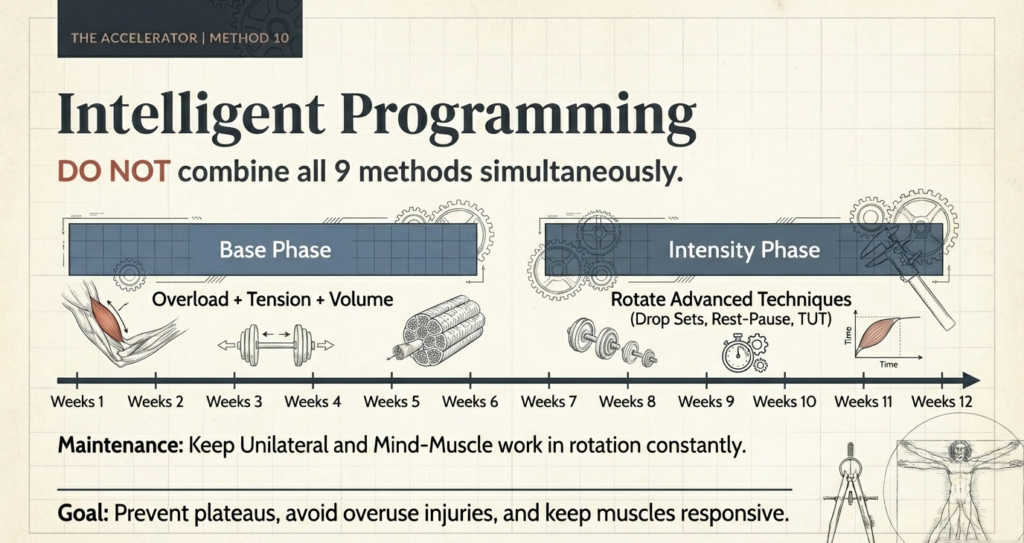
Intelligent programming
There is no need to combine all the nine methods simultaneously because it is counterproductive. The trick lies in smart programming. Train on the basis of progressive overload, mechanical tension and volume. Next switch to the advanced techniques such as drop sets, rest-pause, or time under tension of intensity phases. Always have unilateral and mind-muscle connection training to ensure there is symmetry. Periodization is critical. The rotate techniques should come after every 4-6 weeks to prevent plateaus and overuse injuries and ensure that the muscles are responsive.
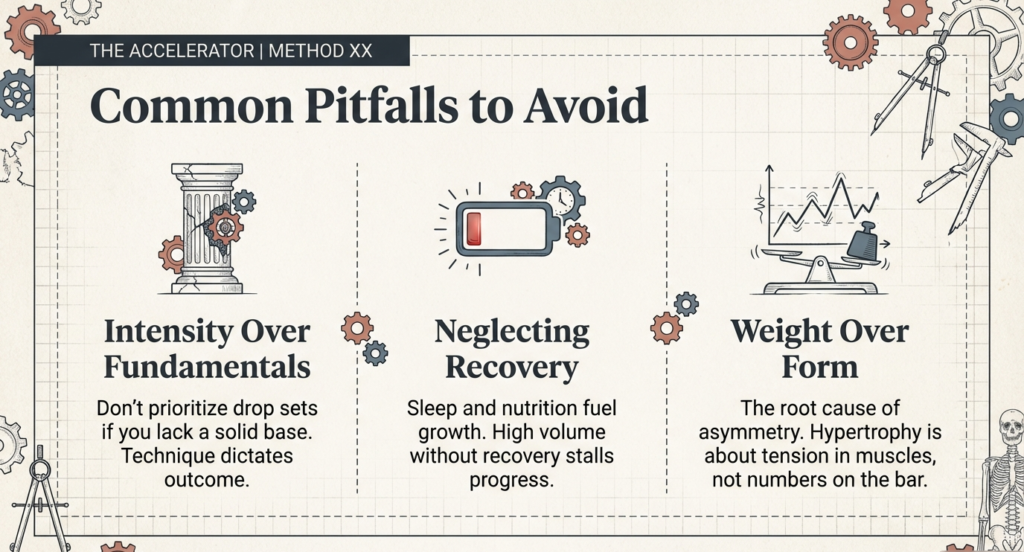
Common Pitfalls to Avoid
A big mistake is putting more emphasis on intensity techniques instead of giving importance to fundamentals. Compromised techniques enhance the outcomes only with solid base. The other error is not to take care of recovery. Poor sleep and nutrition used in the growth may cause stalling of growth through high volume or intensity techniques. And finally, weight over form results in asymmetry. Hypertrophy has nothing to do with numbers on the bar, but tension in the muscles.
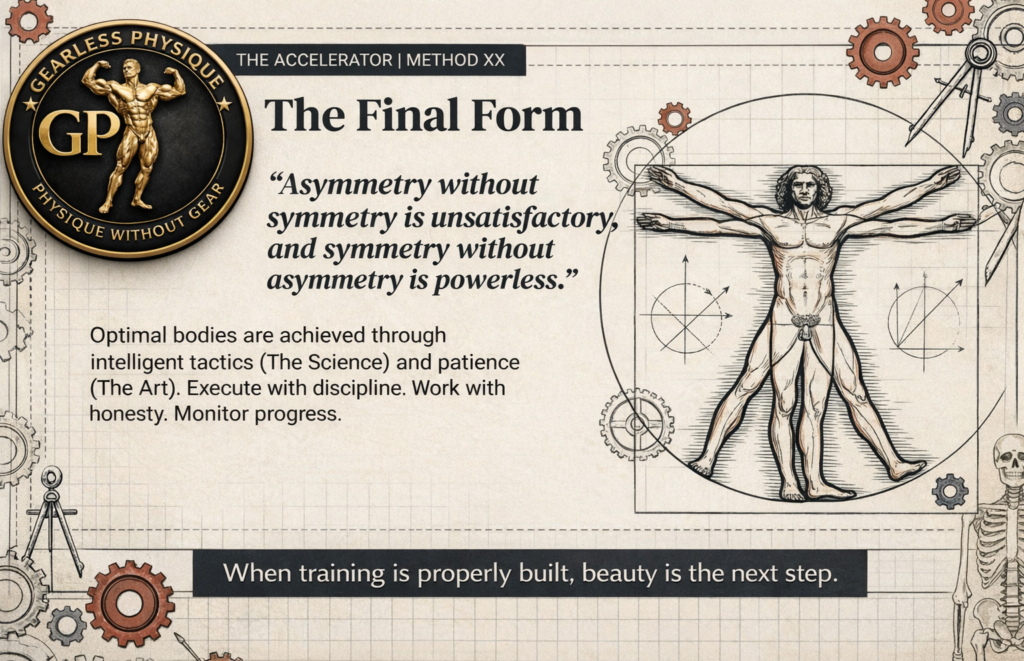
Final Thoughts
The art and science of hypertrophy training. Asymmetry without symmetry is unsatisfactory, and symmetry without asymmetry is powerless. Optimal bodies are achieved through applying intelligent tactics and patience. These are 9 hypertrophy training techniques that will equip you with the means to pack on the muscle. Use them with discipline, execute the plan and work with honesty, monitor the progress.
When training is properly built, the development of muscles can be forecasted- and beauty is the next step.

Gearless Physique
Physique Without Gear
Your transformation starts now. Who's with me?