Table of Contents
ToggleUltimate Somatotype Bodybuilding Guide (2026): Train Smarter for Your Body Type Naturally
Written by Aashish Rawat | Certified Fitness Coach | 14+ Years Experience
Last Reviewed: January 2026
In this blog Ultimate Somatotype Bodybuilding Guide (2026): Train Smarter for Your Body Type Naturally we learn about bodytype. Have you ever wondered why one person seems to build muscle quickly while another struggles despite following the same workout and diet plan? Many lifters believe the answer lies in their body type, which is why the Somatotype Bodybuilding Guide remains one of the most searched topics in fitness. Understanding your natural tendencies can help you make smarter training and nutrition decisions, but it should never be seen as a limit to your progress.
The classic somatotype system divides people into three general body types: ectomorph, mesomorph, and endomorph. While modern exercise science shows that most people are a combination of these body types rather than fitting perfectly into one category, the concept can still serve as a practical framework for personalizing your bodybuilding approach. Genetics, training quality, nutrition, recovery, and consistency all play a much bigger role in determining your long-term results.
In this comprehensive guide, you’ll learn what somatotypes really mean, how they influence muscle growth and fat storage, and how to adapt your workouts, nutrition, and recovery strategies based on your individual characteristics. Whether you’re a beginner starting your fitness journey or an experienced natural bodybuilder looking to break through a plateau, this guide will help you train smarter, avoid common myths, and build a stronger, healthier physique naturally.
As a natural bodybuilding coach with more than 14+ years of experience, I’ve found that the most effective approach combines structured strength training, smart nutrition, adequate recovery, and consistency.
Read more: 12-Week Workout and Diet Plan for Fat Loss (70 kg Female)
Want Personal Coaching?
Struggling to build muscle or lose fat naturally? Get a customized workout plan, diet plan, and direct guidance from Aashish Rawat (14+ Years Experience).
 Muscle Gain Coaching Fat Loss Coaching Natural Bodybuilding Plans Online Support
The somatotype Blueprint
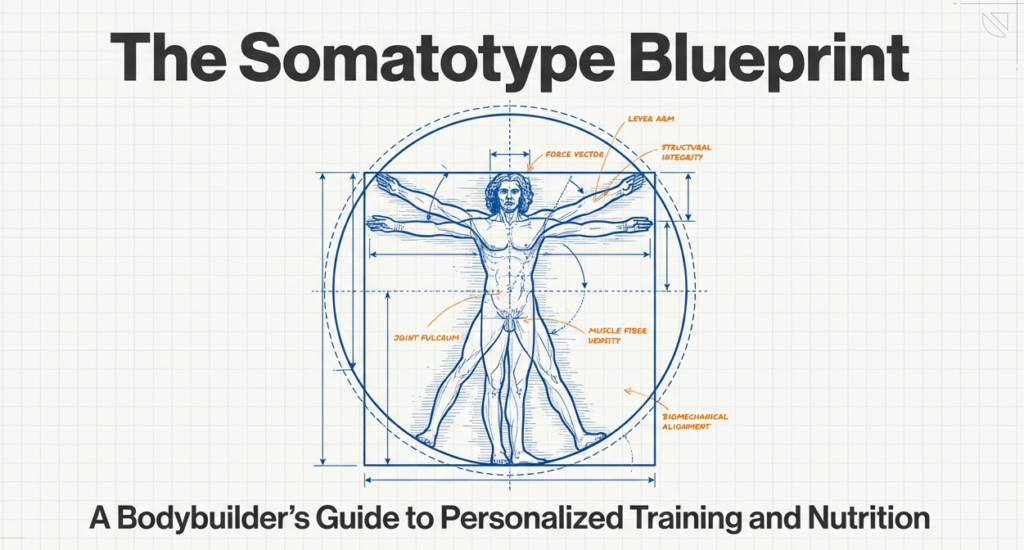
The somatotype blueprint is a powerful concept that helps bodybuilders personalize their training and nutrition based on their unique body structure. Instead of following generic plans, understanding whether you lean toward ectomorph, mesomorph, or endomorph traits allows you to optimize results more efficiently. This approach focuses on how your body responds to exercise, recovery, and diet, helping you build muscle, lose fat, and improve performance strategically.
By aligning your workouts, calorie intake, and recovery methods with your natural tendencies, you can avoid wasted effort and plateaus. The somatotype blueprint is not a limitation but a smart framework that guides you toward sustainable progress, better physique development, and long-term bodybuilding success.
Quick Summary
Before diving into the details, here are the most important takeaways from this guide:
- Somatotypes are a helpful framework, not a rulebook. Most people have a mix of ectomorph, mesomorph, and endomorph characteristics.
- Your genetics influence your starting point, but they don’t determine your future. Consistent training, proper nutrition, quality sleep, and progressive overload have a much greater impact on your results.
- Ectomorphs often benefit from higher calorie intake, compound exercises, and a focus on strength and muscle-building.
- Mesomorphs generally gain muscle and strength more easily but still require structured training and balanced nutrition to maximize progress.
- Endomorphs can build impressive muscle but usually need to pay closer attention to calorie intake, activity levels, and recovery to manage body fat effectively.
- There is no one-size-fits-all workout or diet. The best bodybuilding plan is one that matches your goals, experience level, recovery capacity, and lifestyle.
- Modern exercise science emphasizes individualization over labels. Body type should guide your training decisions—not limit your expectations.
- Long-term success comes from consistency, smart programming, and patience. Your daily habits will always matter more than your natural body type.
What Is a Somatotype?
A somatotype is a system used to describe a person’s natural body composition and physical characteristics. In bodybuilding and fitness, it helps explain why some people tend to stay lean, others build muscle more easily, and some store body fat more readily. The three classic somatotypes are ectomorph, mesomorph, and endomorph.
The concept was introduced in the 1940s by psychologist Dr. William H. Sheldon, who believed that body shape was linked to certain personality traits. While modern science has rejected the idea that body type determines personality, the physical classification of body types is still widely used as a simple framework in fitness and bodybuilding. Today, coaches use somatotypes to help tailor training, nutrition, and recovery strategies—not to predict someone’s potential.
It’s important to understand that very few people fit perfectly into a single body type. Most individuals display characteristics of two or even all three somatotypes. For example, someone may naturally have the lean frame of an ectomorph while also gaining muscle like a mesomorph. This is why successful fitness programs focus on individual progress rather than strict body type labels.
Why Are Somatotypes Important in Bodybuilding?
Understanding your body type can provide a useful starting point when designing a workout or nutrition plan. While your genetics influence factors such as bone structure, muscle insertions, and fat distribution, they do not determine how much muscle you can build or how strong you can become. Training quality, progressive overload, nutrition, recovery, and consistency remain the biggest drivers of long-term success.
Knowing your natural tendencies can help you make smarter decisions, such as adjusting your calorie intake, training volume, cardio frequency, and recovery strategies. For example, an ectomorph who struggles to gain weight may benefit from a calorie surplus and fewer unnecessary cardio sessions, while an endomorph aiming to lose body fat may prioritize higher daily activity and careful calorie management.
A Real-Life Example
Imagine two beginners joining the gym on the same day. One has a naturally slim frame and finds it difficult to gain weight, while the other gains both muscle and fat quickly. If both follow the exact same workout and diet, their progress may look very different. Instead of assuming one program works for everyone, a knowledgeable coach would adjust calorie intake, training volume, recovery, and cardio based on each person’s individual needs.
This personalized approach is the real value of understanding somatotypes. Rather than limiting your expectations, body type should simply help you make smarter decisions as you work toward your fitness goals.
Coach’s Insight: Your body type is your starting point—not your finish line. Consistent training, balanced nutrition, quality sleep, and progressive overload will always have a greater impact on your physique than the label you assign to your body.
Do you know your Somatotype?
Do you know your somatotype? Your somatotype describes your natural body structure and how you typically respond to training, food, and recovery. Whether you are an ectomorph, mesomorph, or endomorph, understanding this helps you train smarter, not just harder. It explains why some people build muscle quickly, others stay naturally lean, and some gain fat more easily. Knowing your type guides your choices in workout intensity, nutrition, and recovery strategies. It is not a fixed limit but a starting point that helps you design a plan that fits your body, so you can build a stronger, healthier physique with consistent effort.
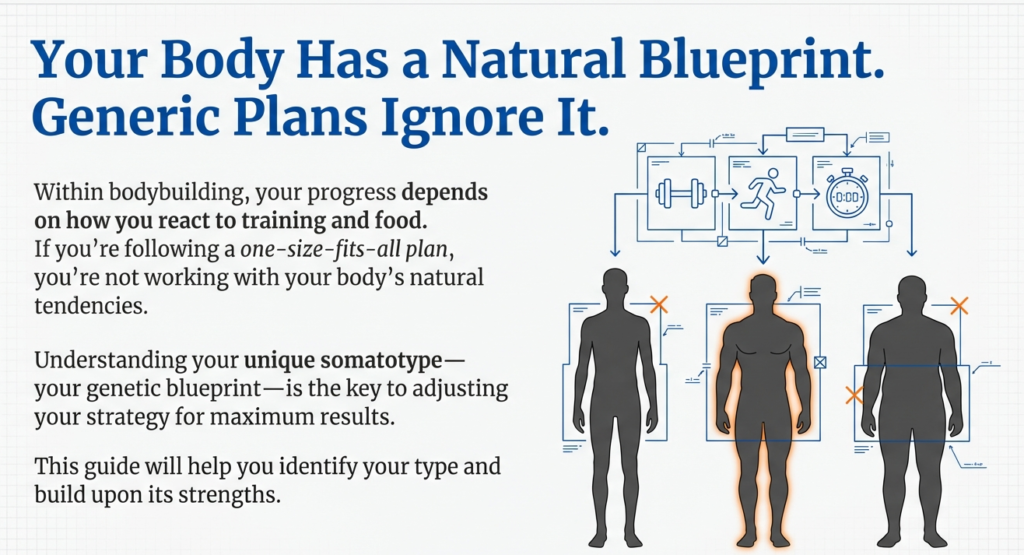
The Science Behind Somatotypes
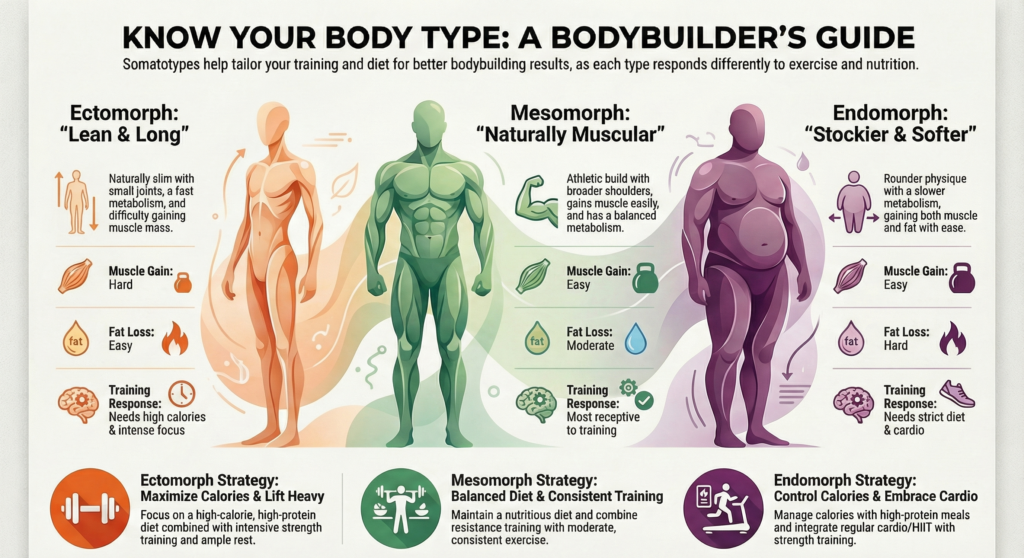
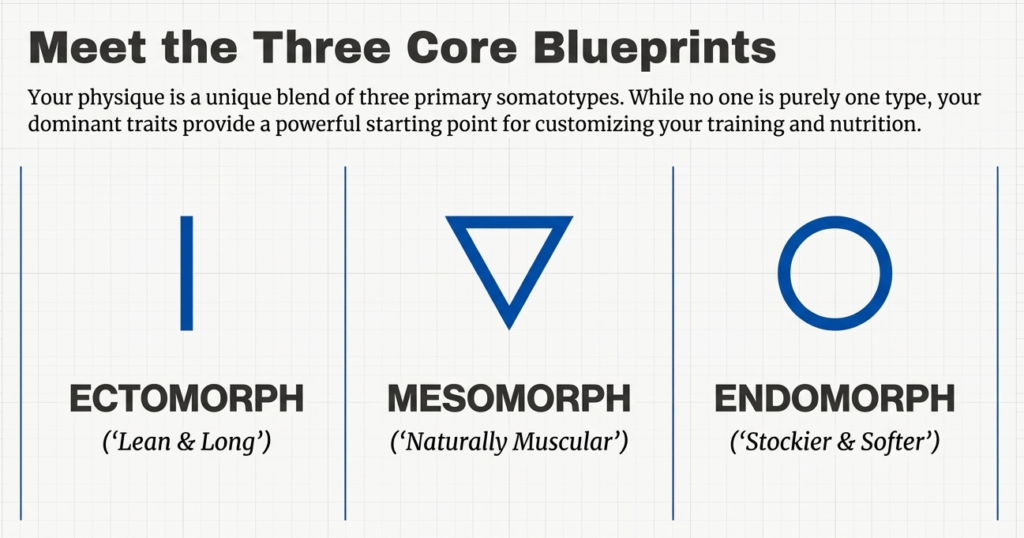
Everyone’s natural build can be broadly described using three main somatotypes: ectomorph, mesomorph, and endomorph. These categories help explain differences in metabolism, muscle gain, fat storage, and overall physique, and why people respond differently to the same training and diet. Some naturally stay lean and struggle to gain weight, others build muscle easily, while some gain fat more quickly. These labels are not limits but guides. Most people are actually a mix of types, with one dominant. By recognizing your dominant traits, you can choose workout styles and nutrition strategies that better match your body, leading to smarter training, steadier progress, and more sustainable results over time.
The 3 Main somatotypes
Everyone’s natural build can be broadly described using three main somatotypes: ectomorph, mesomorph, and endomorph. These categories help explain differences in metabolism, muscle gain, fat storage, and overall physique, and why people respond differently to the same training and diet. Some naturally stay lean and struggle to gain weight, others build muscle easily, while some gain fat more quickly. These labels are not limits but guides. Most people are actually a mix of types, with one dominant. By recognizing your dominant traits, you can choose workout styles and nutrition strategies that better match your body, leading to smarter training, steadier progress, and more sustainable results over time.
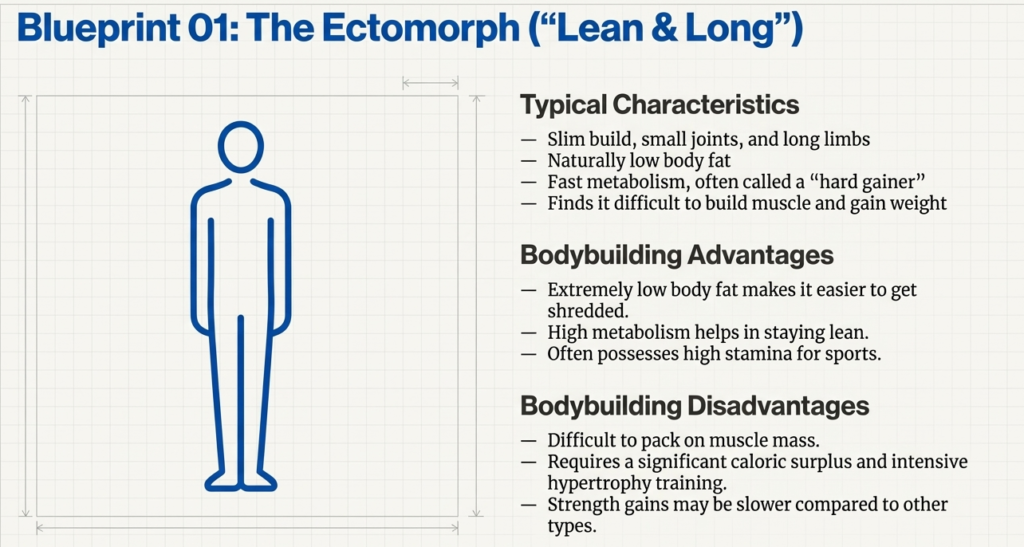
Ectomorph: Lean & Long
Advantages in Bodybuilding:
- Naturally Lean Physique – Ectomorphs often have a leaner appearance, which can make muscle definition more noticeable as they build muscle.
- Lower Tendency to Store Fat – Some naturally lean individuals may find it easier to maintain a lower body-fat level compared with people who gain fat more easily.
- Sharp Muscle Definition – Once sufficient muscle is developed, a naturally lean frame can create a defined and aesthetic appearance.
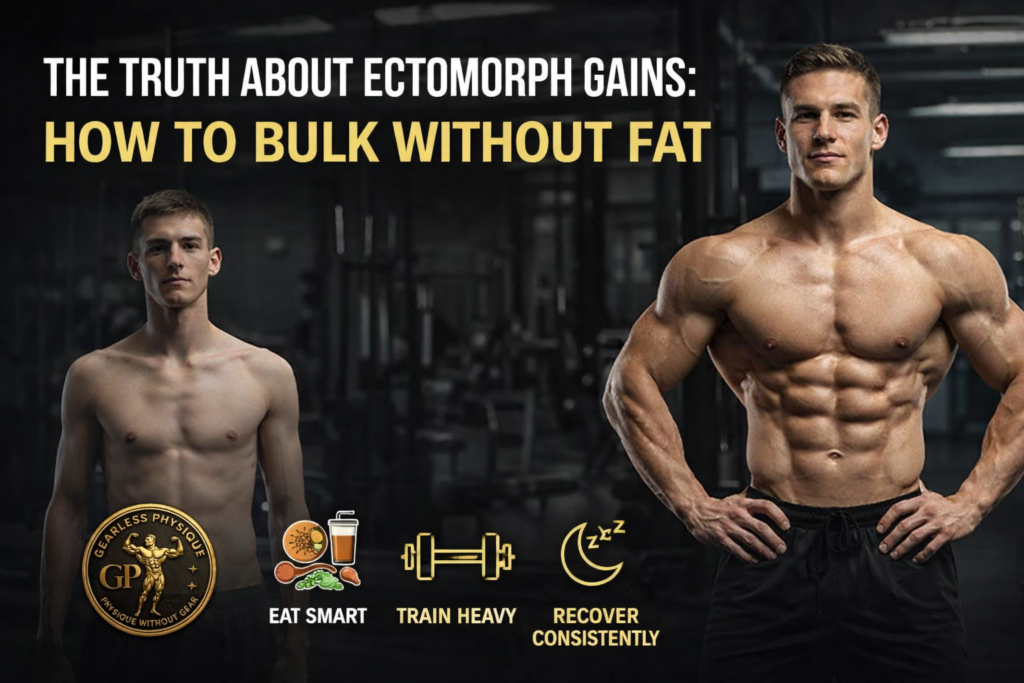
- Good Starting Point for a Lean Bulk – Because gaining excessive fat may be less of a concern for some naturally lean people, a controlled calorie surplus can be useful for building muscle.
- Athletic Appearance – A lean frame combined with developed shoulders, chest, back, and legs can create an impressive athletic physique.
Disadvantages in Bodybuilding:
- Difficulty Gaining Body Weight – Some naturally lean people struggle to consume enough calories consistently to increase their body weight.
- Muscle Gain Can Feel Slow – Building noticeable muscle requires patience, especially when maintaining a calorie surplus is difficult.
- High Food Requirements – A person with high activity levels may need to eat considerably more food to support weight gain and recovery.
- Easy to Undereat – Busy schedules, low appetite, or skipping meals can make it difficult to consistently meet calorie and protein targets.
- Overtraining Risk – Some beginners believe that more training means faster growth. Excessive volume without enough food and recovery can make progress harder rather than easier.
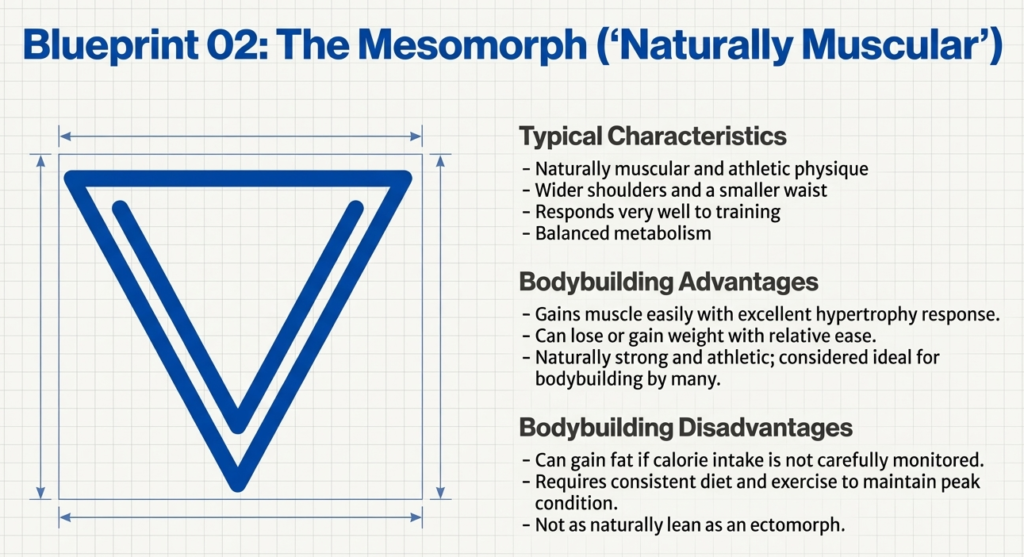
Mesomorph: Naturally Muscular
This is the type of body that is characterized by naturally muscular and athletic body, with wider shoulders and narrow waist. People of this structure are easy to train, build muscle and also their metabolism is in balance, which enables them to control both muscle building and fat content.
Advantages in Bodybuilding:
- Naturally Athletic Build – Mesomorphs are traditionally described as having broader shoulders, a stronger frame, and a naturally muscular appearance.
- Muscle Gain Potential – They may find it relatively easier to build muscle when following consistent resistance training and adequate nutrition.
- Good Response to Strength Training – A mesomorphic build can provide a strong foundation for compound movements such as squats, presses, rows, and deadlifts.
- Balanced Physique Development – Their naturally athletic proportions can make it easier to create a balanced and aesthetic bodybuilding physique.
- Versatile Training Potential – Mesomorphs can generally benefit from different training approaches, including hypertrophy, strength, and athletic conditioning.
Disadvantages in Bodybuilding:
- Can Gain Body Fat Too – Having a naturally muscular build doesn’t mean someone is protected from fat gain. Excess calories can still increase body fat.
- May Become Overconfident – Easy early progress can sometimes lead beginners to underestimate the importance of proper nutrition, technique, and recovery.
- Plateaus Can Still Happen – Natural muscle-building progress eventually slows, making progressive overload and intelligent programming increasingly important.
- Nutrition Still Matters – A mesomorphic body type does not eliminate the need to control calories and consume adequate protein for specific bodybuilding goals.
- Body-Type Labels Can Be Misleading – Not every mesomorph responds to training or nutrition in the same way. Genetics, lifestyle, training experience, and body composition matter more than the label.
Bottom line: A mesomorphic build may provide certain advantages for bodybuilding, but it doesn’t guarantee results. Consistent training, appropriate nutrition, recovery, and patience remain the foundation of a successful physique.
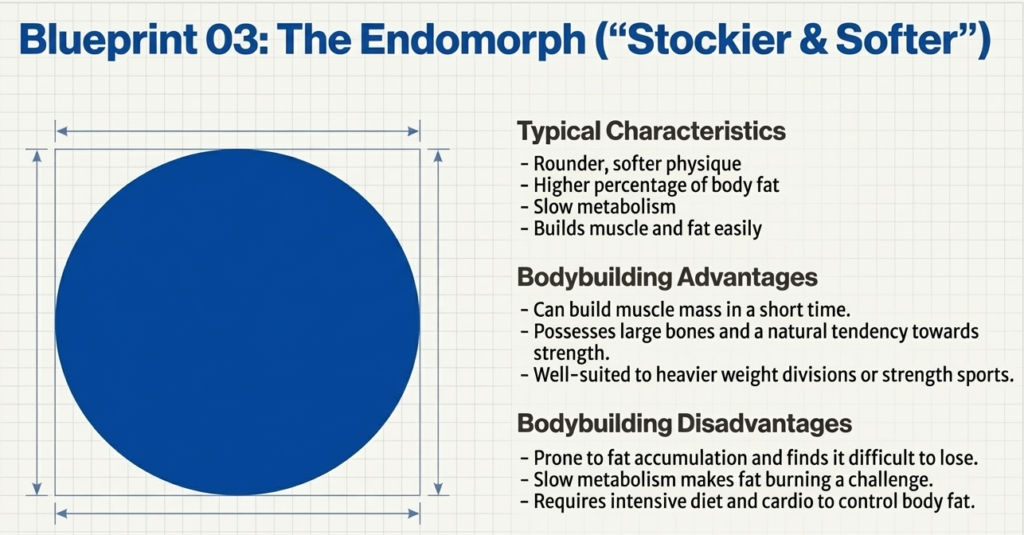
Endomorph: Stockier & Softer
Advantages in Bodybuilding:
- Strong Muscle-Building Potential – An endomorphic build is traditionally associated with a thicker frame, which can provide a solid foundation for developing muscle mass.
- Powerful Physique – A naturally broader or heavier structure can create an impressive bodybuilding appearance when combined with developed muscles.
- Good Strength Potential – A larger frame and higher body mass can provide a useful foundation for strength-focused exercises such as squats, presses, and deadlifts.
- Muscle Mass Can Look Impressive – When body fat is managed effectively, added muscle on a thicker frame can create a powerful and muscular appearance.
- Good Bulking Potential – People who naturally gain weight easily may find it easier to maintain the calorie intake needed during a muscle-building phase.
Disadvantages in Bodybuilding:
- Fat Gain Can Happen Easily – A calorie surplus that is too large may result in more body-fat gain than desired during a muscle-building phase.
- Cutting May Require More Attention – Managing calorie intake and maintaining consistent activity can be particularly important when the goal is reducing body fat.
- Calorie Control Is Important – Portion sizes and overall calorie intake may need closer attention to prevent unnecessary weight gain.
- Cardio May Become Useful – Regular cardio or increased daily activity can help support cardiovascular fitness and energy expenditure alongside resistance training.
- Muscle Definition May Take Longer to Show – Even with significant muscle underneath, higher body fat can make muscular definition less visible until body fat is reduced.
Bottom line: An endomorphic build can provide a strong foundation for bodybuilding, but body-fat management may require extra attention. Ultimately, training, nutrition, activity, recovery, and genetics matter more than the somatotype label.
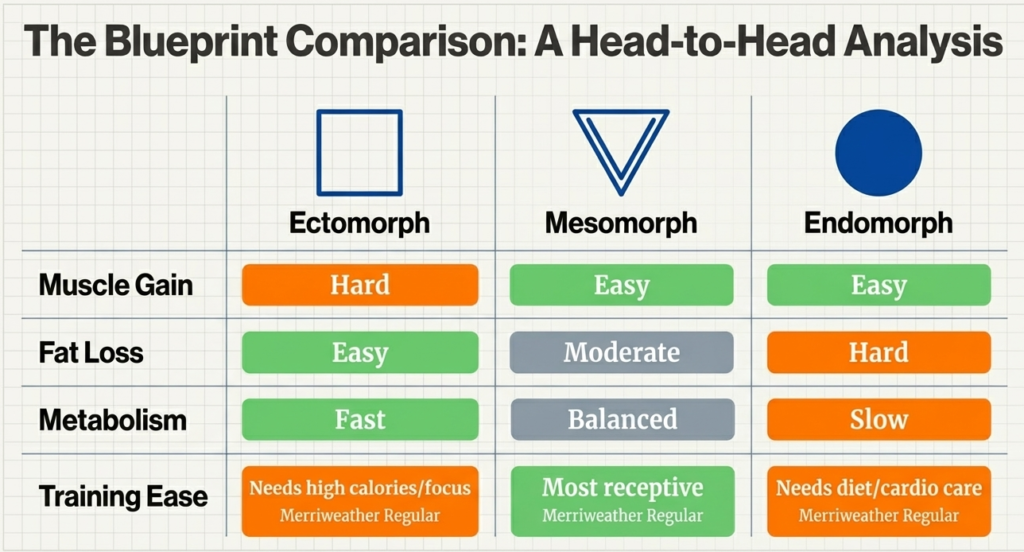
Key Pros & Cons Summary
| Somatotype | Key Advantages | Key Disadvantages |
|---|---|---|
| Ectomorph | Naturally lean appearance; lower tendency to accumulate body fat; muscle definition can show clearly; suitable for a lean-bulk approach; athletic-looking physique | May struggle to gain weight; muscle gain can feel slow; higher calorie intake may be required; easy to undereat; excessive training can interfere with recovery |
| Mesomorph | Naturally athletic build; good muscle-building potential; strong foundation for resistance training; balanced physique potential; adaptable to different training styles | Can still gain body fat; may become overconfident with early progress; plateaus still occur; nutrition remains important; body-type labels can oversimplify individual differences |
| Endomorph | Solid frame; potential for impressive muscle mass; good strength potential; powerful physique; may find gaining body weight easier | Fat gain can occur quickly; cutting may require more attention; calorie control is important; cardio/activity may be useful; muscle definition can take longer to reveal |
The Bottom Line
Your somatotype can provide a general description of your natural physique, but it should never determine what you believe is possible. Ectomorphs, mesomorphs, and endomorphs can all build muscle, lose fat, and develop impressive physiques.
The most important factors are progressive resistance training, appropriate calorie intake, sufficient protein, recovery, daily activity, and long-term consistency. Instead of trying to fit perfectly into one body-type category, use your actual progress to guide your training and nutrition decisions.
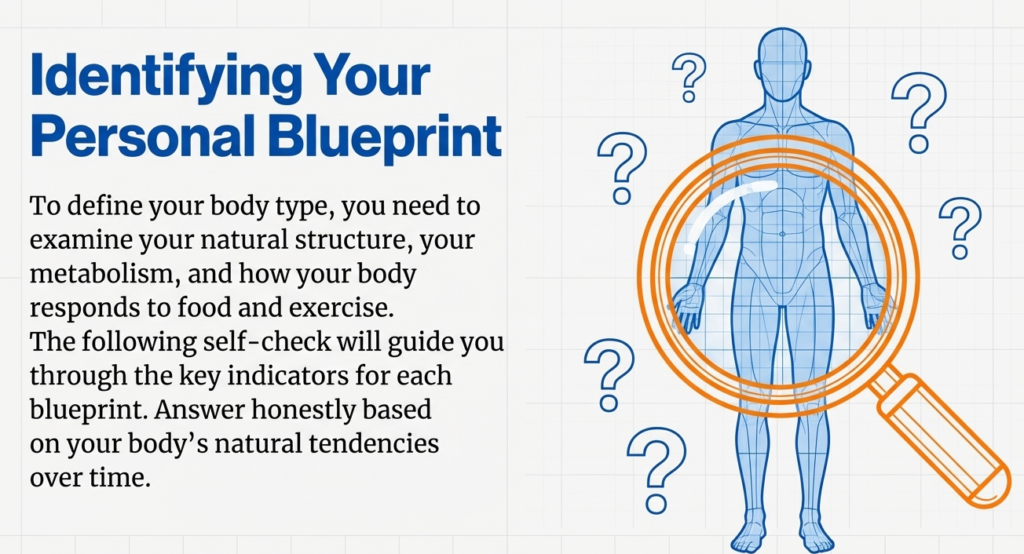
How to Know Your somatotype
You can estimate your somatotype by watching how your body naturally looks and reacts to food, training, and weight changes over time. Notice how easily you gain muscle, how fast you lose or store fat, and whether your metabolism feels naturally fast or slow. If you stay lean and struggle to gain weight, you likely lean ectomorph; if you add muscle easily and stay fairly balanced, you show mesomorph traits; if you gain fat quickly but also build muscle, you lean endomorph. Most people are a mix, but knowing your dominant pattern helps you pick smarter training and nutrition strategies.tuasaude+2
Find your somatotype by:
Examining your natural bone structure
Observing your metabolism speed
Watching your response to food (do you gain mostly fat or muscle?)
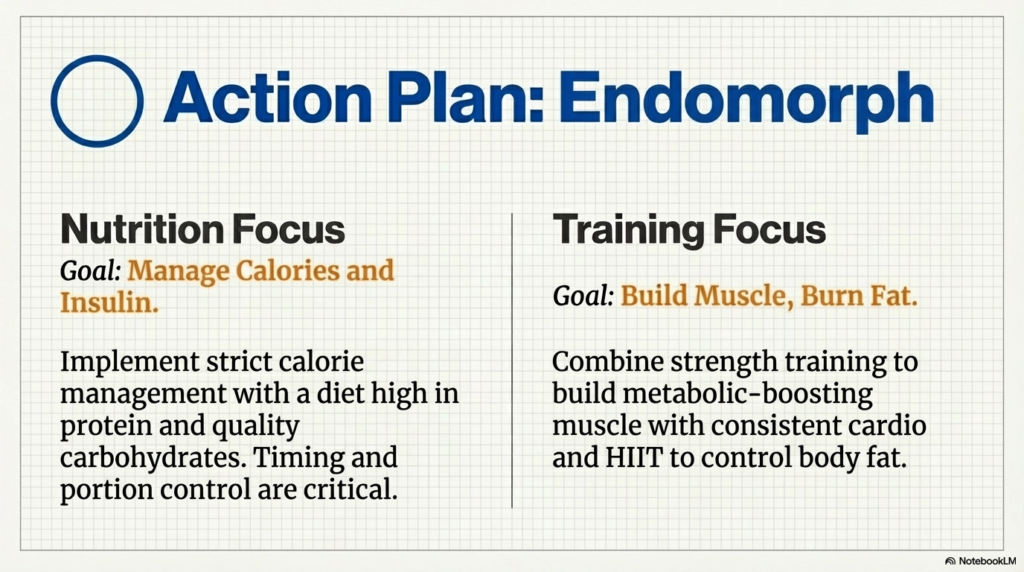
Endomorph tips: Combine lighter weights, a disciplined diet, and regular cardio to help control body fat while still supporting muscle.
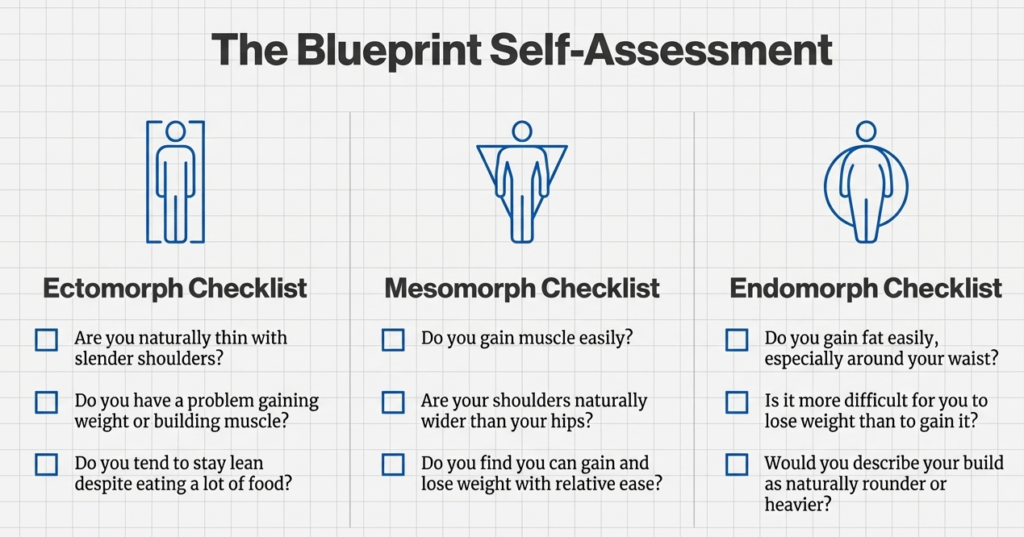
General Self-Check
Ectomorph:
- Do you happen to be thin with slender shoulders?
- Would you say you have a problem with gaining weight or building muscle?
- Do you keep slender despite eating a lot of food?
Mesomorph:
- Do you gain muscle easily?
- Do you have wider shoulders than hips?
- Do you easily gain and lose weight, respectively?
Endomorph:
- Are you prone to gaining fat, especially at the waist?
- Is it more difficult to lose than gain weight?
- Are you of a rounder, heavier build?
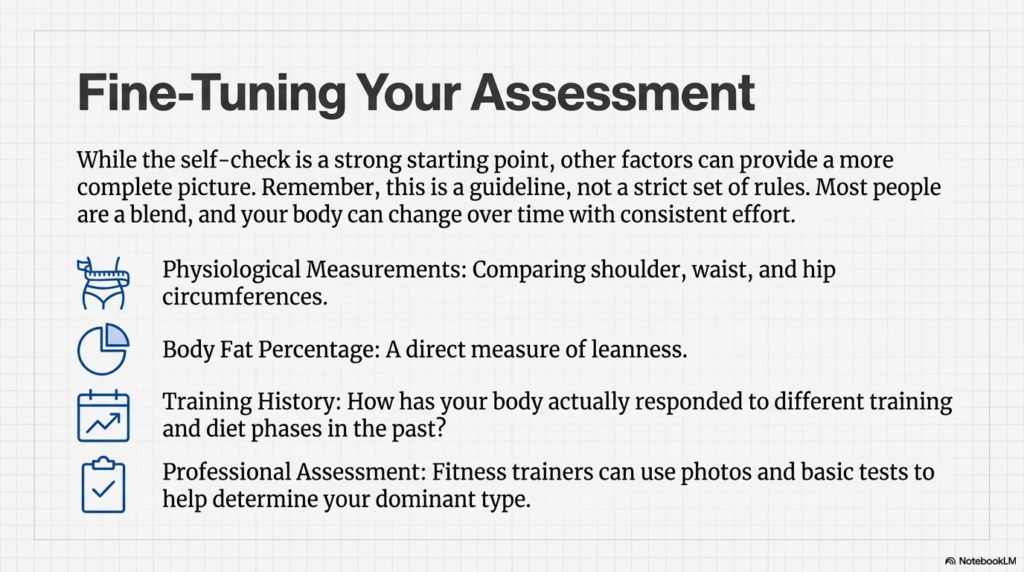
Physio metric measurements: shoulders vs waist vs hips
Body fat percentage:
Body fat callipers are used to measure the thickness of skinfolds at specific sites on the body, which helps estimate body fat percentage. They are commonly used in fitness settings to track changes in body composition over time.
Training history:
The way you gained or lost weight/muscle over time. Most fitness trainers also take photos or just some basic tests to determine your somatotype (body type). It is important to note that this is also just a guideline, not a strict set of rules.
Activating your personalized action plan
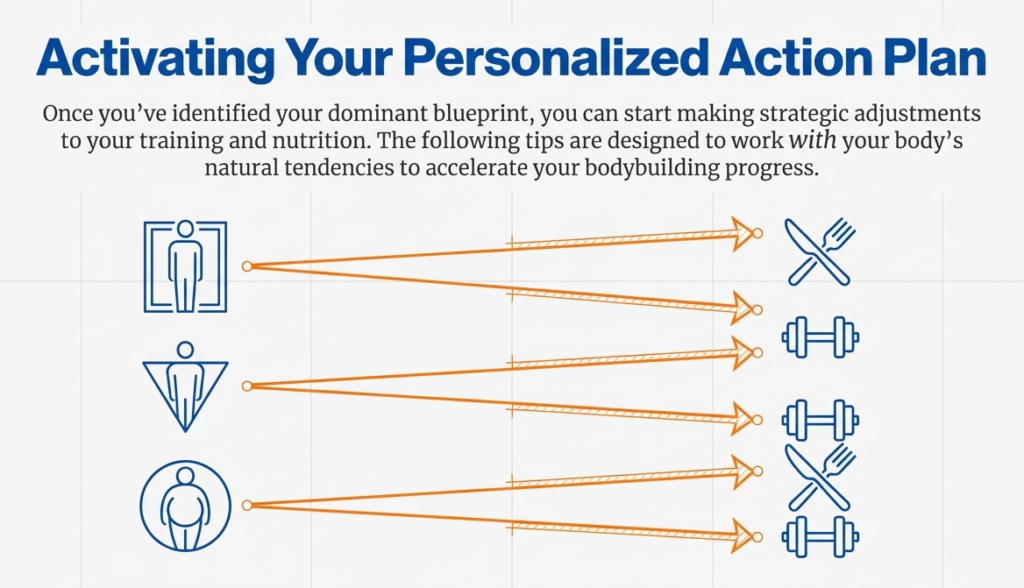
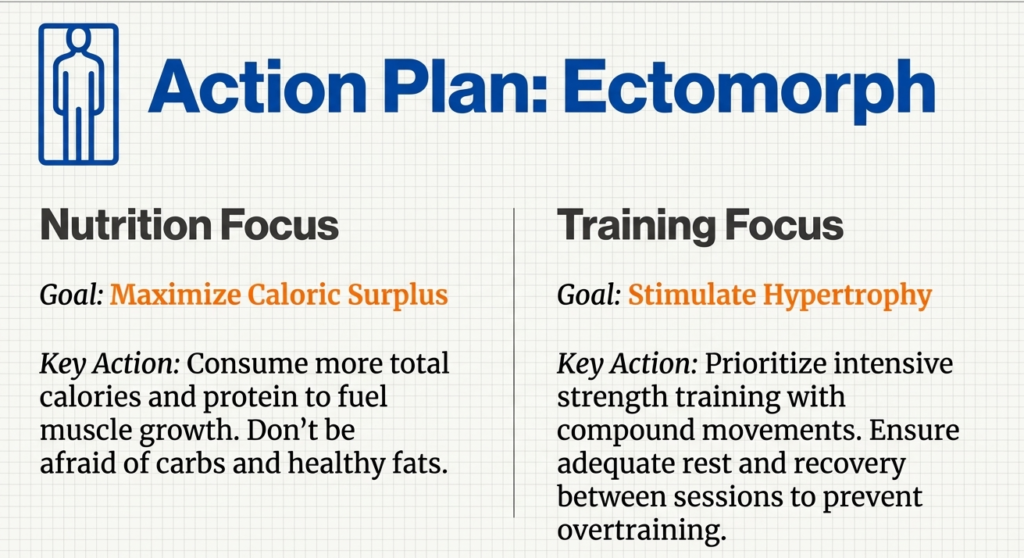
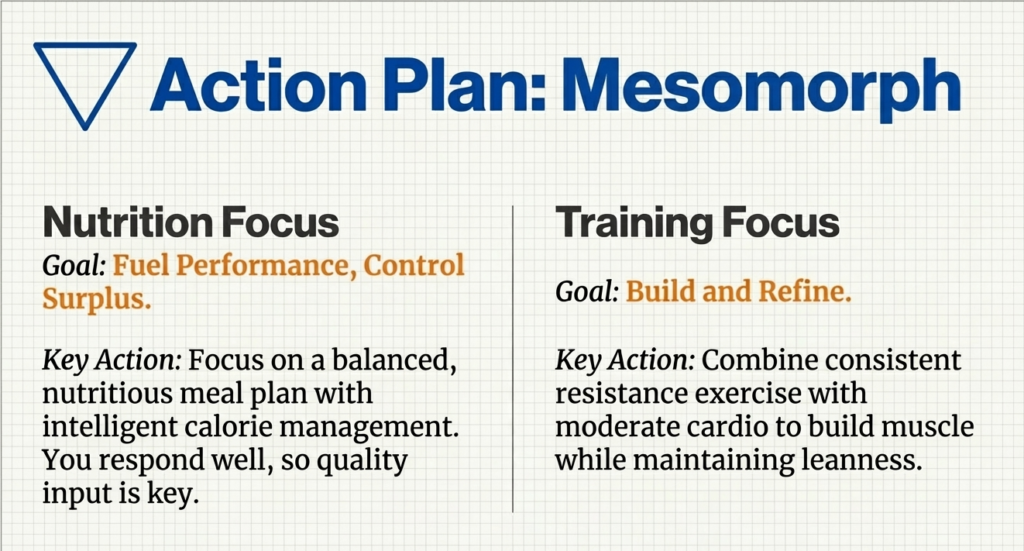
Understanding your dominant body type can help you make smarter bodybuilding decisions, but it should be treated as a general guideline rather than a strict rule. Ectomorphs may benefit from a calorie surplus, higher meal frequency, and progressive strength training to support muscle growth. Mesomorphs often respond well to balanced calories, consistent resistance training, and regular adjustments based on progress.
Endomorphs may benefit from careful calorie control, high-protein meals, strength training, and sufficient daily activity to manage body fat while building muscle. Regardless of your body type, focus on progressive overload, adequate protein, quality sleep, hydration, and consistency. Your actual progress should always guide adjustments to your training and nutrition plan.
Fast Bodybuilding Tips according to Type
Ectomorph:
If you have an ectomorph body type, the biggest challenge is usually gaining body weight and muscle. But you don’t need to eat everything in sight or train for hours. A smart approach with enough food, progressive training, and recovery can make a big difference.
Tips for Ectomorphs
Eat in a calorie surplus
If your weight isn’t increasing, you’re probably not eating enough. Start with a modest calorie surplus and monitor your body weight weekly.Prioritize protein
Aim for around 1.6–2.2 g of protein per kg of body weight each day. Eggs, chicken, fish, dairy, paneer, lentils, soy, and whey can make this easier.Don’t fear carbohydrates
Rice, oats, potatoes, bananas, bread, and other carb sources provide useful energy for hard training and help you consume enough calories.Use calorie-dense foods
Nuts, peanut butter, whole milk, cheese, olive oil, ghee, dried fruits, and smoothies can add calories without making every meal enormous.Train for progressive overload
Focus on getting stronger over time. Gradually increase your weights, repetitions, or training volume rather than simply doing more exercises.Don’t overdo cardio
Cardio is good for your heart and fitness, but excessive cardio can make it harder to maintain the calorie surplus needed for weight gain.Train consistently, not endlessly
You don’t need two-hour workouts. A well-structured 3–5 day resistance-training routine can provide plenty of stimulus for muscle growth.Give your muscles time to recover
Muscle growth happens during recovery, not just during training. Get adequate sleep and avoid training every muscle hard every day.Track your progress
Weigh yourself regularly, take progress photos, and record your lifts. If your weight hasn’t moved for several weeks, gradually increase your food intake.Be patient
Don’t expect a dramatic transformation in a few weeks. Building noticeable muscle takes months and years of consistent training and nutrition.
One important point
“Ectomorph” is a traditional body-type classification, not a precise scientific diagnosis of your metabolism or muscle-building potential. Don’t let the label convince you that you’re genetically incapable of gaining muscle. Your actual calorie intake, training, activity level, sleep, and genetics matter much more.
For an ectomorph trying to build muscle, the simple formula is: eat enough + train progressively + recover properly + stay consistent.
Mesomorph:
Tips for a Mesomorph Body Type
Mesomorphs are traditionally described as having a naturally athletic build, broader shoulders, a moderate waist, and an easier time gaining muscle. But remember, somatotypes are only general descriptions, not strict scientific categories. Your results still depend on training, nutrition, genetics, sleep, and consistency.
Prioritize progressive overload – Gradually increase weight, reps, or training quality rather than simply training harder.
Keep protein high – Aim around 1.6–2.2 g of protein per kg of body weight when building muscle.
Control calories – Don’t assume you can eat anything because you gain muscle easily. Use a small calorie surplus for muscle gain and a moderate deficit for fat loss.
Train with structure – A Push/Pull/Legs, Upper/Lower, or well-designed full-body routine can work extremely well.
Don’t neglect cardio – Include 2–3 moderate cardio sessions weekly for cardiovascular fitness and overall health.
Watch body-fat gain – If you’re bulking, keep the surplus controlled rather than turning every meal into a cheat meal.
Eat quality carbohydrates – Rice, oats, potatoes, fruits, and whole grains can support training performance and recovery.
Include healthy fats – Eggs, nuts, seeds, olive oil, dairy, and fatty fish provide important nutrients.
Prioritize recovery – Muscle grows during recovery, so adequate sleep and rest days are essential.
Track your progress – Monitor body weight, measurements, strength, photos, and gym performance rather than relying only on the mirror.
Bottom line: A mesomorph may have certain natural advantages, but consistency still beats genetics. A smart diet, progressive training, and proper recovery are what ultimately build the physique.
Endomorph:
If you have an endomorph-like body type, you may naturally carry more body fat and find weight gain easier than some people. But remember, “endomorph” is a simplified body-type category, not a strict scientific classification. Your actual results depend on genetics, calorie intake, activity, training, sleep, and consistency.
Tips for an Endomorph-Like Body Type
Prioritize protein – Include eggs, chicken, fish, dairy, soy, lentils, and other protein-rich foods regularly.
Control total calories – If your goal is fat loss, maintain a moderate calorie deficit rather than following an extreme diet.
Keep strength training central – Lift weights consistently to preserve and build muscle while reducing body fat.
Choose filling foods – Vegetables, fruits, potatoes, oats, whole grains, and lean proteins can help control hunger.
Don’t eliminate carbohydrates – Adjust portions according to your activity and calorie needs rather than cutting carbs completely.
Add regular cardio – Walking, cycling, or other enjoyable activities can increase calorie expenditure without replacing strength training.
Watch liquid calories – Sugary drinks, high-calorie coffees, and frequent shakes can add calories without making you very full.
Stay consistent – Don’t switch between keto, fasting, detoxes, and crash diets every week. Give a sensible approach enough time to work.
Track your progress – Monitor body weight, waist measurements, strength, and progress photos instead of relying only on the scale.
Prioritize recovery – Adequate sleep and rest support training performance, appetite control, and long-term progress.
The biggest takeaway: Don’t let the word “endomorph” become an excuse or limitation. With appropriate nutrition, progressive training, daily activity, and consistency, you can significantly change your body composition.
Frequently Asked Questions About Somatotypes
1. What are the three main somatotypes?
The traditional somatotype system describes three body types: ectomorph, mesomorph, and endomorph. Ectomorphs are generally described as naturally lean, mesomorphs as more muscular and athletic, and endomorphs as having a greater tendency to store body fat.
2. What is an ectomorph body type?
An ectomorph is traditionally described as having a lean frame, narrower shoulders, and difficulty gaining body weight. People with this build may need to pay extra attention to calorie intake and resistance training when their goal is to gain muscle.
3. How should an ectomorph train for muscle growth?
Ectomorphs should focus on progressive resistance training, compound exercises, adequate recovery, and sufficient calories and protein. Spending less time on unnecessary cardio can also make it easier to maintain a calorie surplus.
4. What is a mesomorph body type?
A mesomorph is traditionally described as having a naturally athletic build, broader shoulders, and relatively easier muscle development. However, having this body type does not guarantee muscle growth without proper training and nutrition.
5. How should a mesomorph eat and train?
A mesomorph can generally follow the same fundamental principles as anyone else: match calorie intake to the goal, consume enough protein, train progressively, and recover properly. Nutrition should be adjusted according to actual progress rather than body-type labels.
6. What is an endomorph body type?
An endomorph is traditionally described as having a softer or wider body structure and a greater tendency to gain body fat. For someone with this build who wants to lose fat, managing calorie intake, protein, resistance training, and daily activity can be particularly useful.
7. How should an endomorph train for fat loss?
A combination of strength training, regular physical activity, and appropriate cardio can support fat loss. Resistance training is especially important because it helps preserve muscle while reducing body weight.
8. Can an ectomorph become muscular?
Yes. An ectomorph can build significant muscle with consistent resistance training, adequate calories, sufficient protein, and recovery. Being naturally lean may affect how quickly weight is gained, but it does not prevent muscle development.
9. Can someone change from one somatotype to another?
Your basic skeletal structure and genetics do not simply change from one somatotype to another. However, your body composition can change dramatically through training, nutrition, and lifestyle, which may make your physique look very different over time.
10. Are ectomorph, mesomorph, and endomorph scientifically accurate body types?
They are best viewed as traditional physique classifications rather than precise scientific categories. People have a wide range of body shapes, genetics, metabolism, and body compositions, so your individual response to training and nutrition matters more than your somatotype label.
Final Note
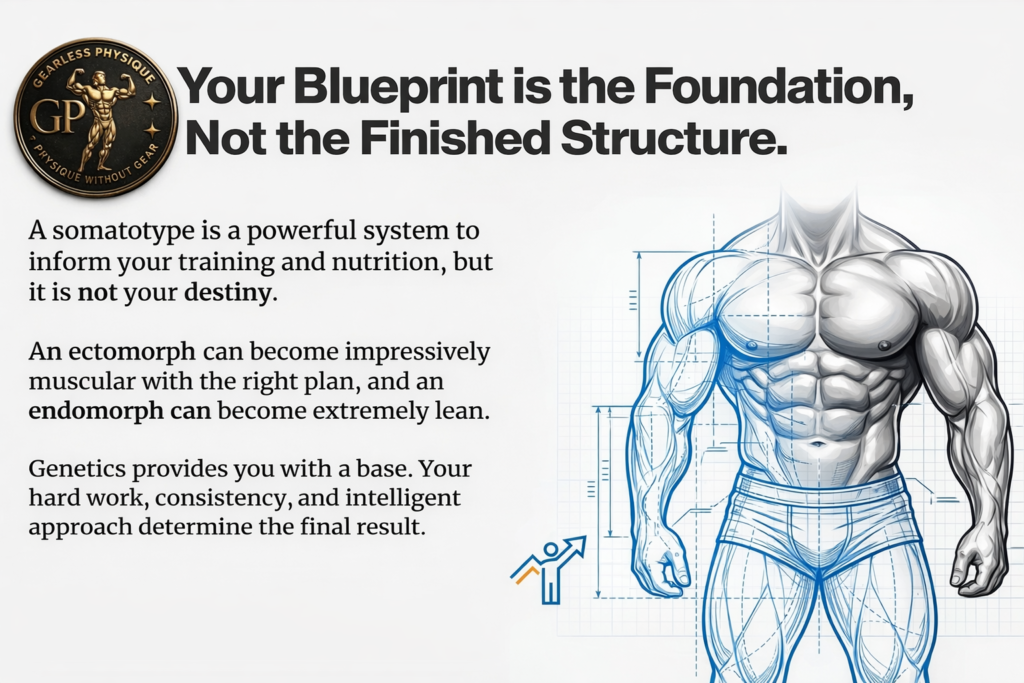
Somatotypes are a useful way to understand how your body naturally responds to training, nutrition, and recovery, but they are not your destiny. Being labeled ectomorph, mesomorph, or endomorph is simply a starting framework, not a fixed limit. An ectomorph “hard gainer” can still build a strong, muscular physique with progressive resistance training, enough calories, and quality nutrition, while an endomorph can become lean and defined through disciplined eating and structured workouts.
Genetics influence bone structure, metabolism, and tendencies, but effort, consistency, smart programming, and lifestyle choices shape your final result. When training and diet match your individual needs, any somatotype can achieve major, long-term transformation.
At Gearless Physique, we believe in sustainable natural bodybuilding methods that deliver real-world results without shortcuts.
Stay consistent, trust the process, and your transformation will follow.
About the Author
Certified fitness coach with 14+ years of experience in natural bodybuilding and strength training. Founder of GearlessPhysique.com. Aashish has coached hundreds of natural lifters — helping real people build real muscle without drugs, gimmicks, or guesswork.

Gearless Physique
Physique Without Gear
Your transformation starts now. Who's with me?