A Complete Powerlifting Guide 2026 (Training, Strength & Progression)
A complete powerlifting guide will cease being about blindly lifting heavy weights. It is based on smart training, sustainable energy, adequate rest, and health of the joints. Powerlifting needs to be structured whether you are an amateur going under the bar or an experienced lifter who is trying to reach another personal record.
All of this is contained in this comprehensive guide to know everything about powerlifting in 2026, what you should know about training, how strength progression works and what workout programs you should follow as a beginner, intermediate, and advanced. This guide will make you smarter in your training and lift heavier, provided your aim is to get the greatest strength in the squat, bench press, and deadlift.
What Is Powerlifting?
A strength sport is powerlifting that concentrates on three lifts namely squat, bench press, and deadlift. The aim is to push the greatest weight per lift once in every lift and be able to compete and use proper technique.
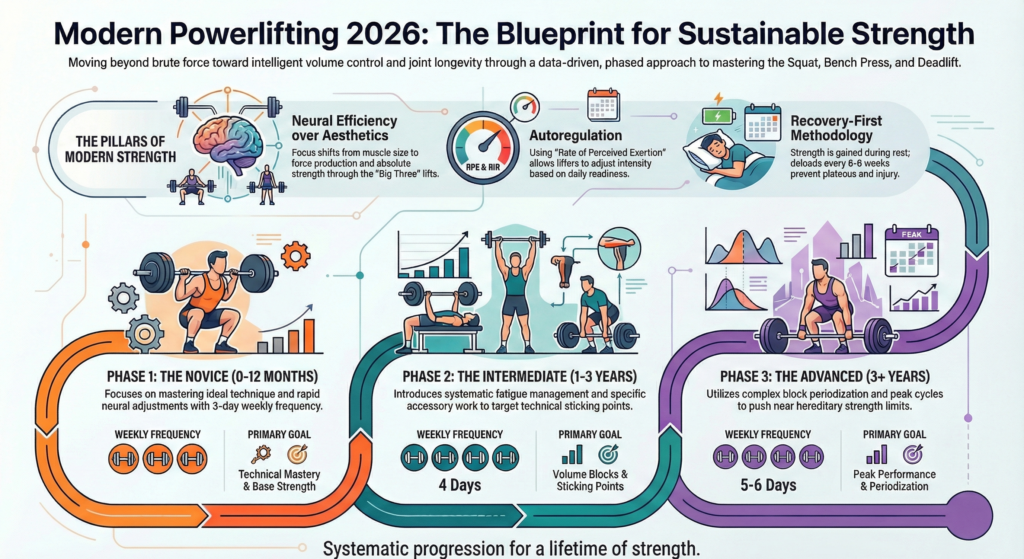
Powerlifting does not focus on the size of the muscle and its aesthetics like in bodybuilding but rather on neuromuscular efficiency, the ability to produce force and absolute strength. Training is associated with a low to medium number of reps, a heavy load, and a long rest. By 2026, powerlifting has developed intelligent volume control, injury prevention systems, as well as personalized progression models.
Powerlifting/ Bodybuilding.
Powerlifting and bodybuilding tend to be similar yet the objective of each one is quite different. Powerlifting is concerned with the amount of weight, whereas bodybuilding is concerned with the appearance of your muscles. The lifts that powerlifters engage in are mostly a combination of compounds, and they do not pay much attention to isolation training.
To achieve muscle hypertrophy, bodybuilders work at extra-volume and increased reps. Lower reps and heavy loads are used by powerlifters to enhance neural drive and efficiency of technique. Most current-day lifters use a combination of both styles where they use bodybuilding accessories to aid in the performance of powerlifting and minimize chances of injuries.
The paradigm shift engineering strength
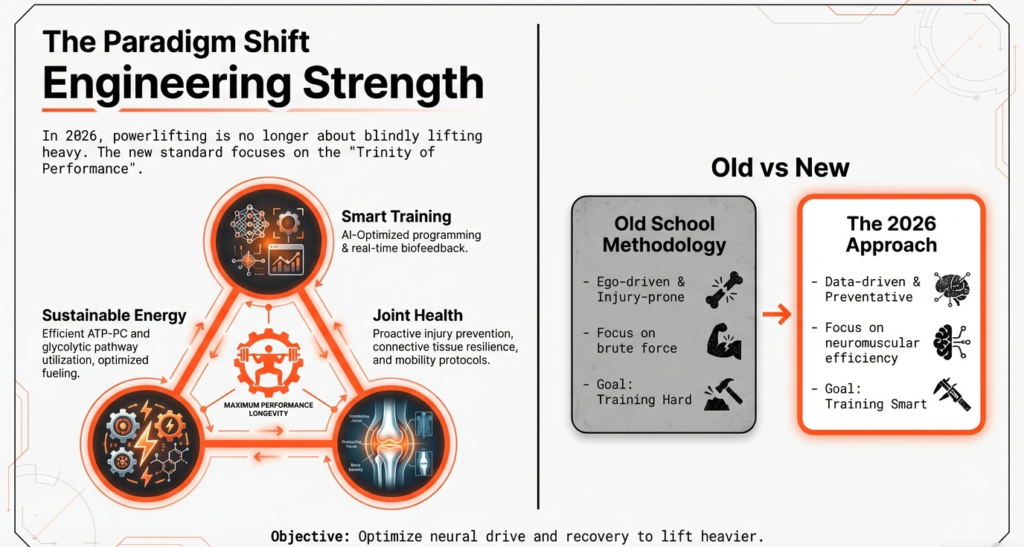
This infographic describes the current paradigm shift in the field of powerlifting, with power training in 2026 no longer being brute-force training, but rather a smarter, more engineered one. It focuses on the three parts of performance, which include smart training, sustainable energy systems, and joint health. The picture compares the archaic, egoistic approach with the contemporary, data-oriented one, which has neuromuscular efficiency, injury prevention, and long-term progress in its priority list.
The visual elements demonstrate the integration of optimized programming, recovery-driven strategies and mobility work to maximize the performance and durability. With this, the whole graphic supports the idea that the current-day powerlifting is training and management of fatigue, and sustainable long-term strength.
the Basics of Complete Powerlifting guide
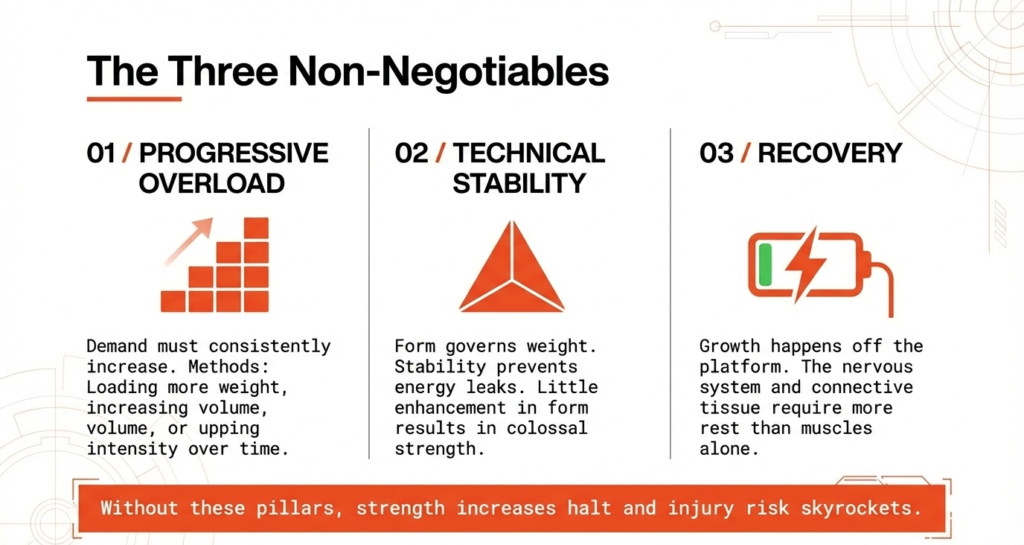
A complete powerlifting guide is based on several principles that cannot be negotiable. The basis is progressive overload, which implies that you have to keep loading up, increasing volume, or intensity. Stability in technique is also a crucial element with little enhancement in form resulting in a colossal strength.
The important role is played by recovery. Heavy lifting puts a lot of stress on nervous system, joints and connective tissue. By 2026, smart lifters are just as concerned about sleep, deloads, fatigue management as much as training intensity. Unless recovery is achieved, the strength increase will be halted and the risk of injury will increase.
The Future of Strength Progression in 2026.
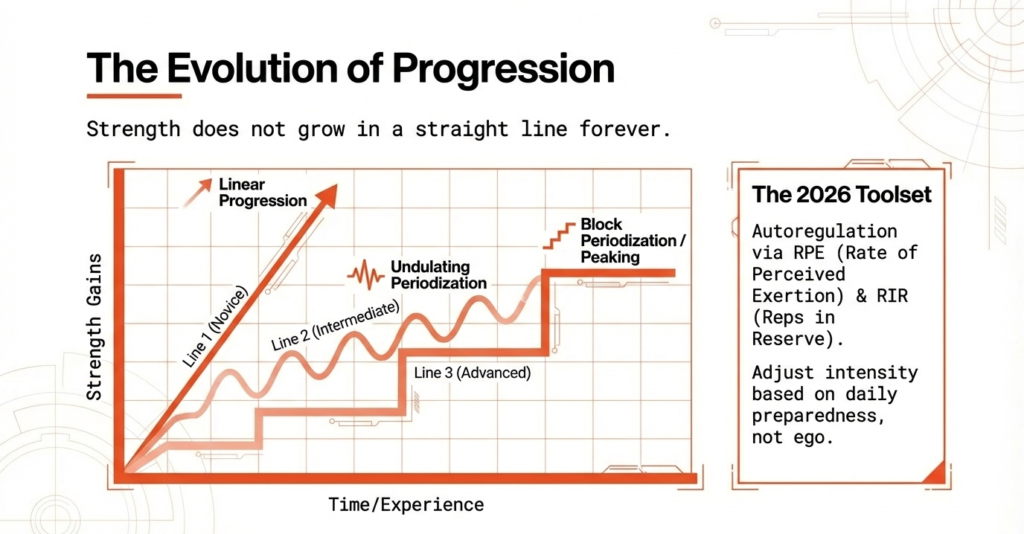
The development of strength is no longer linear indefinitely. Novices can gain weight every week, whereas at the intermediate and advanced levels, the lifters have to follow systematic progression models. Wave loading, autoregulation and percentage based training are also used in modern powerlifting as a means of fatigue management.
The most common 2026 is Rate of Perceived Exertion (RPE) and Reps in Reserve (RIR). These gadgets allow lifters to change intensity depending on the daily preparedness. Rather than cramming the weights on their bad days, lifters now train at the productive intensity ranges towards meaningful long-term progress.
Novice Powerlifting (0-12 months) Training
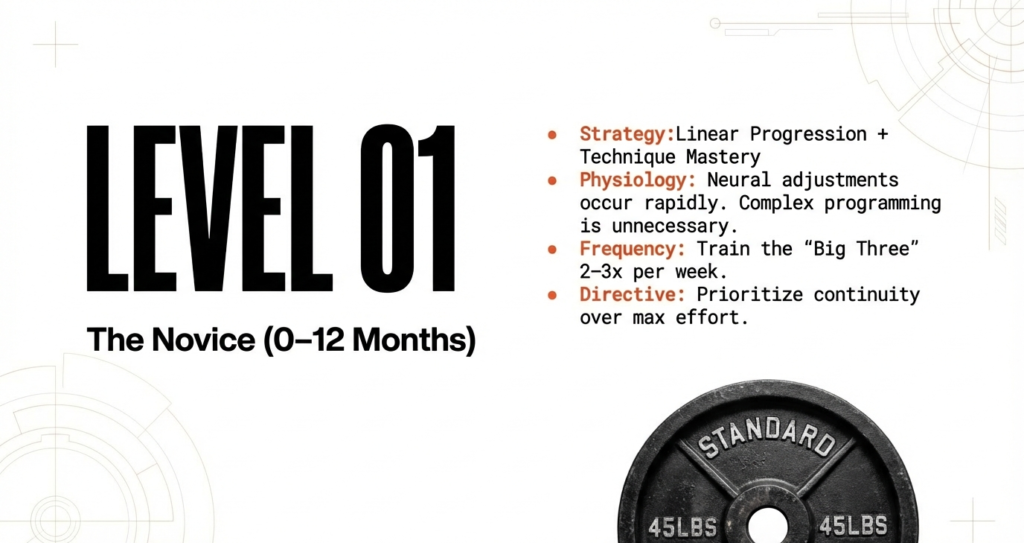
Novice lifters ought to deal with mastering ideal technique and establishing a base of strength. At this level, the neural adjustments occur rapidly and the complex programming can be made frequently. The focus of training must be on the big three lifts which must be done two-three times a week. Technique, muscle balance and injury prevention should be facilitated by accessory movements. Newcomers are not supposed to strain too much and instead they should prioritize continuity as opposed to maximum effort.
Novice Powerlifting (3 Days/Week) Workout Plan.
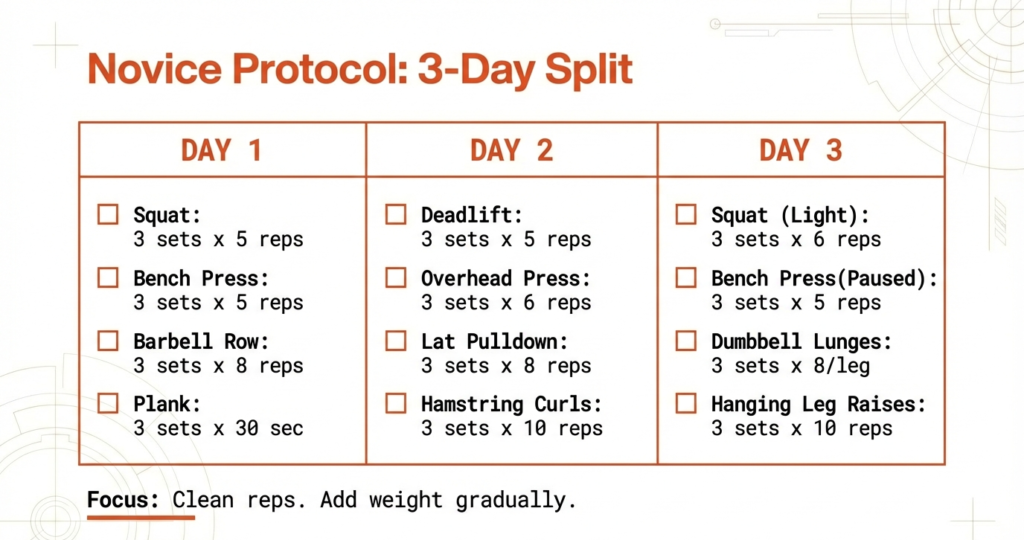
Day 1:
- Squat: 3×5
- Bench Press: 3×5
- Barbell Row: 3×8
- Plank: 3×30seconds
Day 2:
- Deadlift: 3×5
- Overhead Press: 3×6
- Lat Pulldown or Pull-ups: 3×8
- Hamstring Curls: 3×10
Day 3:
- Squat (Light): 3×6
- Bench Press (Paused): 3×5
- Dumbbell Lunges: 3×8 per leg
- Hanging Leg Raises: 3×10
The beginners are supposed to gain weight gradually, paying more attention to the clean reps and the stable technique.
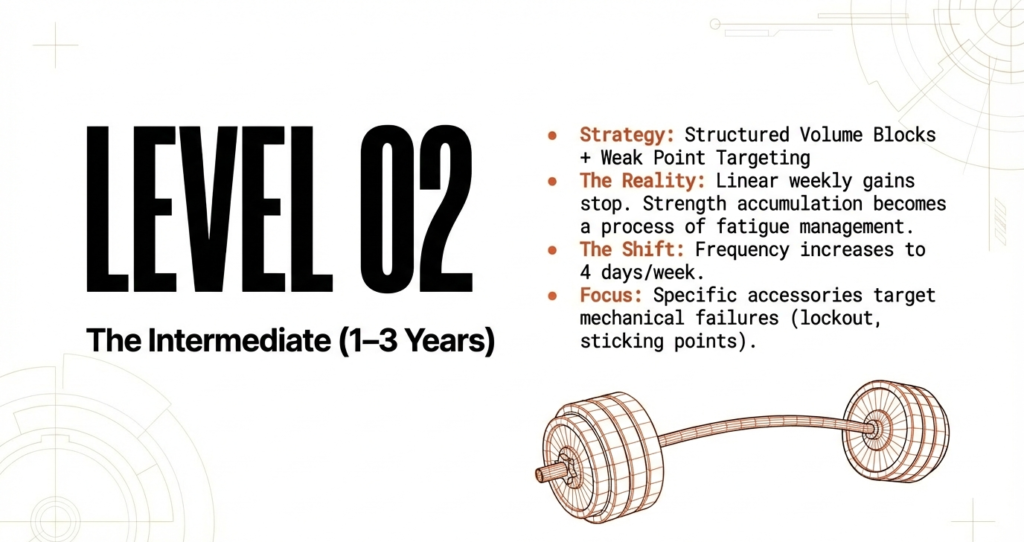
Median Powerlifting Training (1-3 Years)
The intermediate lifters are unable to gain weight on a weekly basis. Gain in strength is an undegrading process and fatigue management is necessary. Structured volume blocks and intensity phases are advantageous to the lifters at this stage. The frequency of training is raised, and the weight-lifting can be trained twice to thrice a week with different intensity. The accessories are made more specific and focus on the weak areas of the lifts such as lockout strength, sticking points and positional weaknesses.
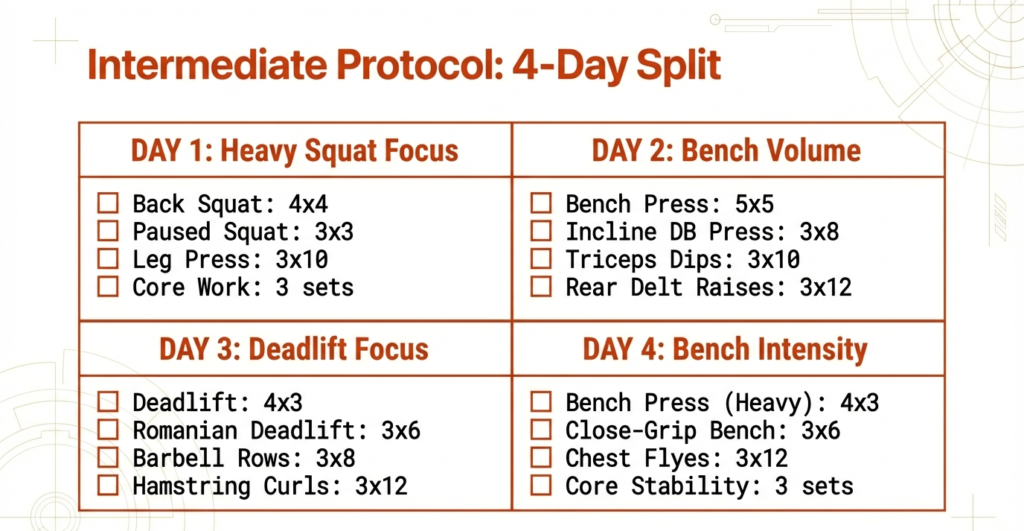
Intermediate Routine Workout Powerlifting (4 Days/Week)
Day 1 – Heavy Squat Focus
- Back Squat: 4×4
- Paused Squat: 3×3
- Leg Press: 3×10
- Core Work: 3 sets
Day 2 – Bench Volume
- Bench Press: 5×5
- Incline Dumbbell Press: 3×8
- Triceps Dips: 3×10
- Rear Delt Raises: 3×12
Day 3 – Deadlift Focus
- Deadlift: 4×3
- Romanian Deadlift: 3×6
- Barbell Rows: 3×8
- Hamstring Curls: 3×12
Day 4 – Bench Intensity
- Bench Press (Heavy): 4×3
- Close-Grip Bench: 3×6
- Chest Flyes: 3×12
Core Stability: 3 sets
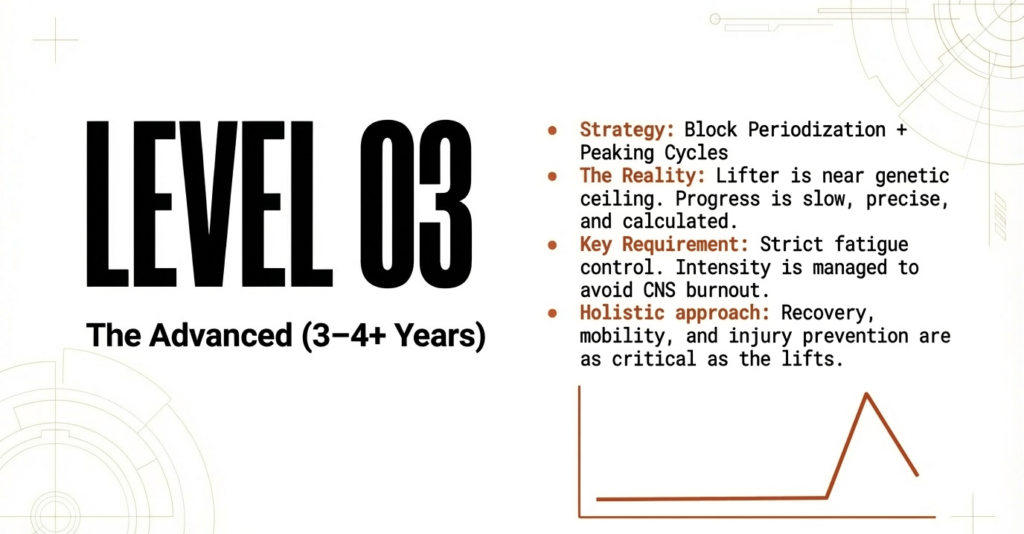
Adaptive Powerlifting Training (3-4 Years)
Seasoned powerlifters work close to their hereditary ability. Development is slow and is very precise. The training is based on the competition performance, technical refinement, and fatigue control. Expert lifters implement block periodization, peak cycles, and deload weeks in a strategic manner. The volume is calculated carefully and the intensity is handled so as not to burn the nervous system. The recovery protocols, the mobility work and prevention of injury become as significant as a lift itself.
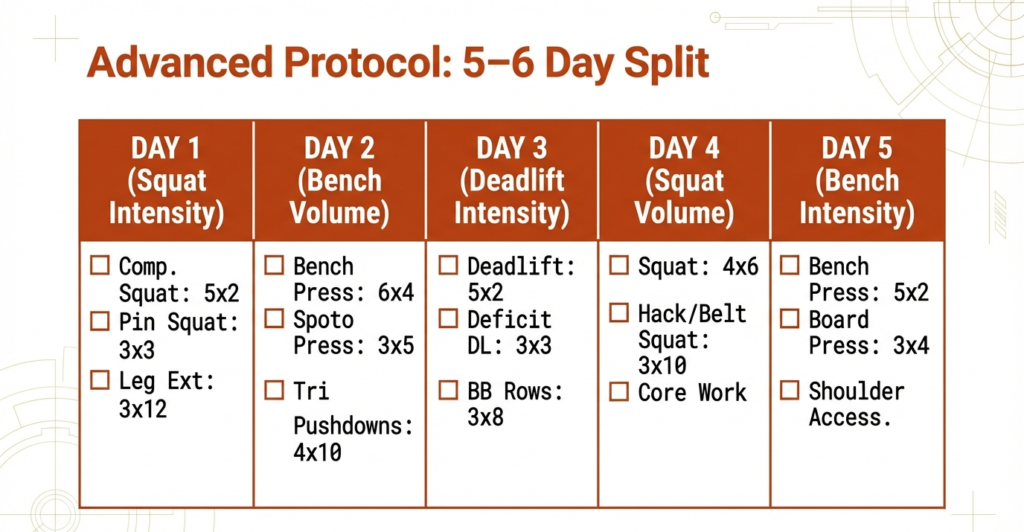
Advanced Powerlifting Workout Plan (5–6 Days/Week)
Day 1 – Squat Intensity
- Competition Squat: 5×2
- Pin Squat: 3×3
- Leg Extensions: 3×12
Day 2 – Bench Volume
- Bench Press: 6×4
- Spoto Press: 3×5
- Triceps Pushdowns: 4×10
Day 3 – Deadlift Intensity
- Deadlift: 5×2
- Deficit Deadlift: 3×3
- Barbell Rows: 3×8
Day 4 – Squat Volume
- Squat: 4×6
- Hack Squat or Belt Squat: 3×10
- Core Work
Day 5 – Bench Intensity
- Bench Press: 5×2
- Board Press: 3×4
- Shoulder Accessories
Powerlifting Accessory Training.
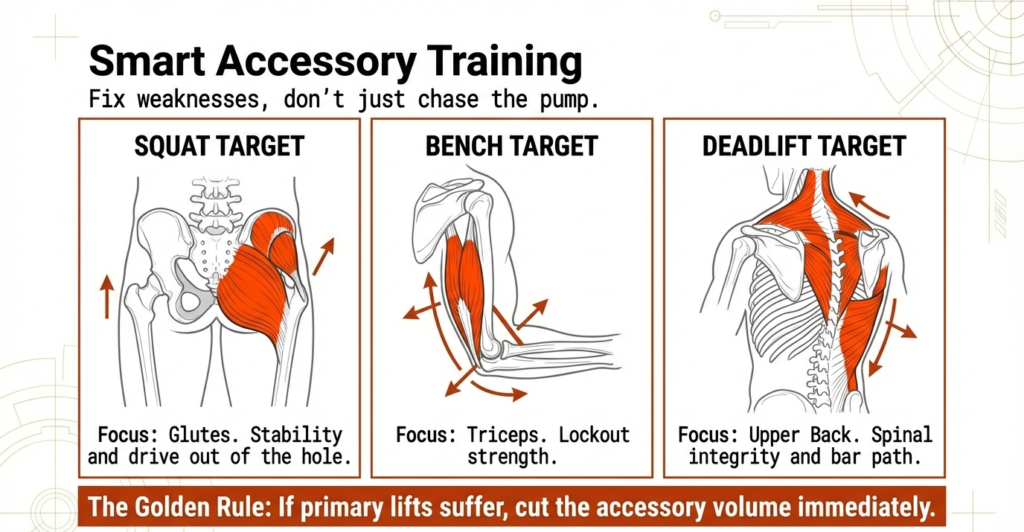
Accessory exercises are used to enhance the primary lifts and they help to tighten those muscles that are weak and enhance the stability of the joints. Accessory training is smarter and targets in the year 2026.
Popularly used accessory muscles are glutes (squats), triceps (bench press), and upper back (deadlifts). Recovery should not be compromised by accessories. When your primary lifts fail, lower the amount of accessory weight, and do not raise the total volume of accessory work.
Recovery and Deloading
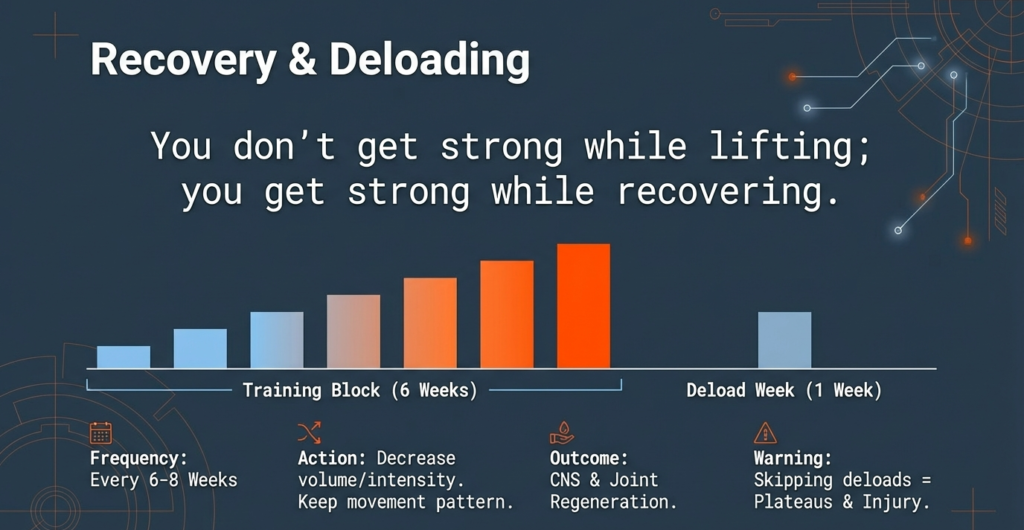
The process of progressing in terms of strength occurs during the resting period rather than during the training period. Sleep, nutrition, and stress management should be prioritized by the powerlifters. The majority of lifters take a deload after every 6-8 weeks. A deload decreases the volume and intensity without altering patterns of movement. This will enable the joints, connective tissue and the nervous system to regenerate. Deloads are usually ignored and this may result in plateau or injury.
The Powerlifting Strength Nutrition.
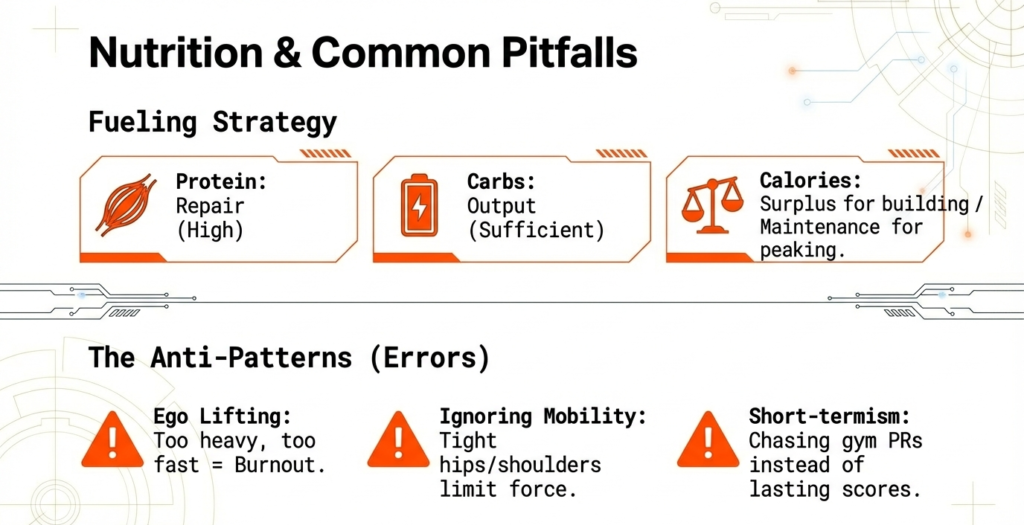
Proper nutrition is a key to powerlifting. Strength output requires sufficient carbohydrates, high contents of protein, and adequate calories. As a general guide, most powerlifters intend to attain a minor calorie surplus on training blocks and maintenance calories on peaking phases in the year 2026. Other important factors to consider are hydration, electrolytes, and micronutrients, which are important in performance and recovery.
there are some common errors in powerlifting.
Ego lifting, poor technique, or lack of recovery causes many stalling lifters. The pursuit of maximum weights at an excessively high rate causes burnout and injury. The other error is not paying attention to mobility and warm-ups. Clenched hips, shoulders, and ankles can be a very limiting ingredient to performance. Nerdy lifters are training long-lasting, rather than temporary scores.
Concluding Remarks: Powerlifting 2026.
The long-term, smart progression, and performance optimization are the aspects of powerlifting in 2026. You are a beginner trying to learn the basics or you are an advanced lifter trying to achieve elite totals, the fundamentals are the same. Learn how to lift heavy, be patient with recovery and learn to go slow. Power is developed not in a week but in years. Training smart, being regular, and the figures will come.
Read More: https://www.muscleandstrength.com/workouts/powerlifting-workout.html

Gearless Physique
Physique Without Gear
Your transformation starts now. Who's with me?