Table of Contents
Toggle10×10 German Volume Training Guide for Strength & Mass (2026)
Written by Aashish Rawat | Certified Fitness Coach | 14+ Years Experience
Last Reviewed: April 2026
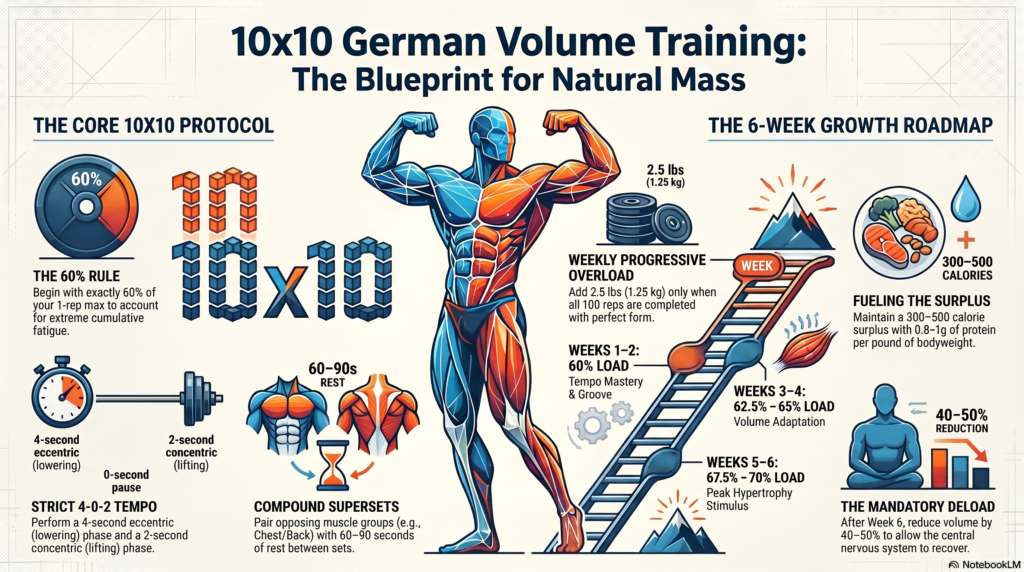
This infographic provides a complete overview of the 10×10 German Volume Training (GVT) Guide For Strength & Mass system, one of the most demanding yet effective muscle-building methods for natural lifters. At its core, the program revolves around performing 10 sets of 10 reps using approximately 60% of your one-rep max, creating a powerful stimulus for muscle growth through high training volume. The graphic highlights key principles such as the strict 4-0-2 tempo, short rest periods of 60–90 seconds, and the use of compound supersets to maximize muscle fiber recruitment.
It also outlines a structured 6-week progression roadmap, where weight is gradually increased as performance improves. Equally important, the infographic emphasizes proper nutrition, including a 300–500 calorie surplus, adequate protein intake, and hydration to support recovery and growth. After six weeks of intense training, a mandatory deload phase helps reduce fatigue and restore the nervous system. Together, these elements create a proven blueprint for building size, strength, and overall muscular development naturally.
You can also read German Volume Training: Ultimate Guide.
Quick Summary— What You'll Learn
✅ What German Volume Training (GVT) is and why it works so well for muscle mass |
✅ The complete 10×10 workout plan — day-by-day breakdown |
✅ How to progress week over week for maximum strength and size |
✅ The 5 most common GVT mistakes beginners make (and how to avoid them) |
✅ A practical diet and nutrition guide to fuel your GVT results |
✅ Who this program is best suited for — beginner, intermediate, or advanced |
✅ Answers to the most-asked GVT questions online |
Gearless Physique: The 10x10 Protocol
What if you could double your muscle gains in just 6 weeks — without fancy equipment, steroids, or spending hours at the gym every day?
German Volume Training, also called the 10×10 method, has been quietly used by elite strength coaches and natural bodybuilders for decades. This brutally effective program forces your muscles to handle a massive amount of volume in a short period of time. The result? Hypertrophy you can actually see in the mirror.
Whether you’re stuck in a plateau or just looking for a science-backed training shock, the 10×10 German Volume Training protocol might be the most powerful tool you haven’t tried yet. In this complete 2026 guide, I’ll walk you through exactly how it works, give you a ready-to-use weekly plan, and share the expert tips that make the difference between okay results and extraordinary gains.
A typical chest workout might look like:
- Bench Press: 10 sets × 10 reps
- Incline Dumbbell Press: 3 sets × 10 reps
- Cable Flyes: 3 sets × 12 reps
The massive training volume creates significant mechanical tension and metabolic stress, two major drivers of muscle hypertrophy.
Let’s get into it.
Want Personal Coaching?
Struggling to build muscle or lose fat naturally? Get a customized workout plan, diet plan, and direct guidance from Aashish Rawat (14+ Years Experience).
 Muscle Gain Coaching Fat Loss Coaching Natural Bodybuilding Plans Online Support
Why German Volume Training Works: The Science
German Volume Training isn’t just a catchy name. It’s a proven, research-supported approach to hypertrophy that has stood the test of time. Here’s what makes it so effective:
1. Extreme Volume = Maximum Muscle Fiber Recruitment
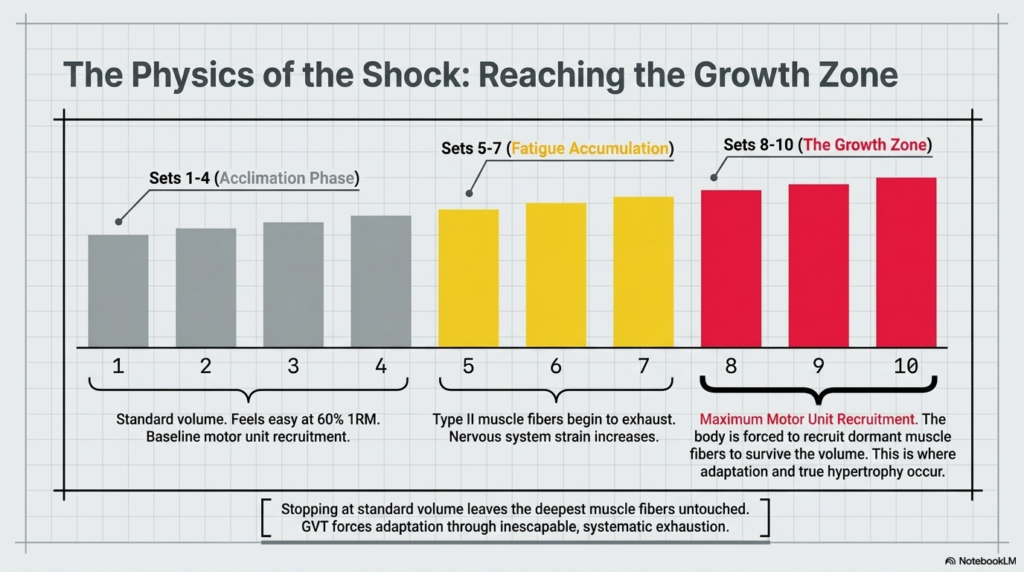
- Performing 10 sets of the same exercise forces your body to recruit nearly every available motor unit and muscle fiber. Research published in the Journal of Strength and Conditioning Research confirms that higher training volume significantly increases muscle protein synthesis — the process that actually builds new muscle tissue.
2. Progressive Overload Built Into Every Workout
- GVT is designed around systematic progressive overload. You start with a weight you can handle for 10 sets of 10 reps — typically 60% of your 1-rep max. Each week, you increase the load slightly, continuously challenging your muscles to adapt and grow stronger
3. Time Under Tension Drives Hypertrophy
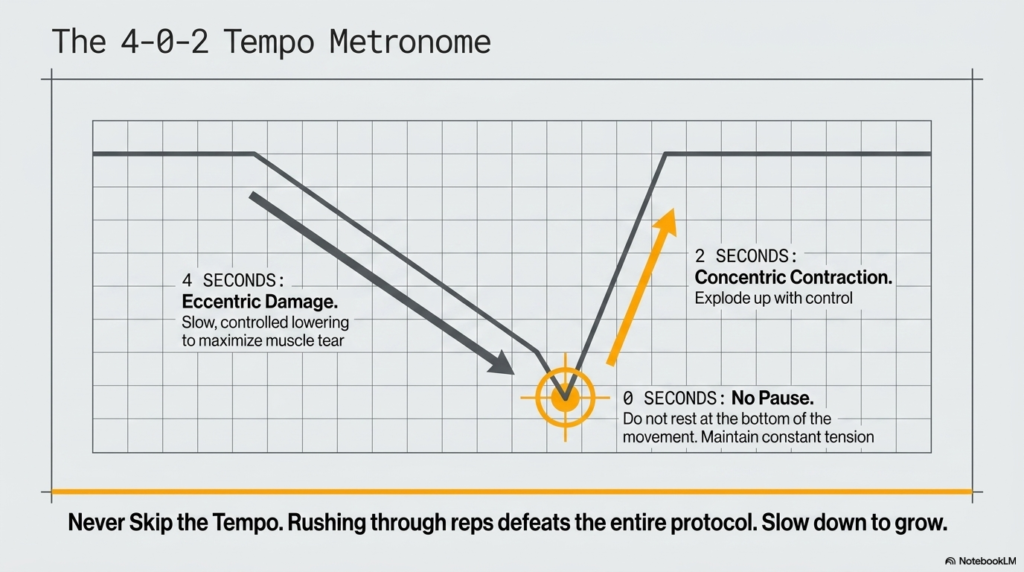
- The slow, controlled tempo used in GVT (4-0-2, meaning 4 seconds down, 0 pause, 2 seconds up) dramatically increases time under tension. This extended muscle stress is one of the primary drivers of hypertrophy, according to exercise science research
4. Compound Movements for Maximum Hormonal Response
- GVT prioritizes compound exercises like squats, bench press, and rows. These multi-joint movements trigger a significant hormonal response — increasing natural testosterone and growth hormone release — which amplifies muscle-building results without any shortcuts.
5. Efficient Workouts With Focused Recovery
- By pairing opposing muscle groups (chest/back, quads/hamstrings) and keeping accessory work minimal, GVT lets you train hard and still allow adequate recovery. This balance between stimulus and rest is exactly what natural bodybuilders need to make consistent progress.
The Complete 10x10 German Volume Training Plan
This is a 4-day training split. Each session focuses on one primary superset of compound movements (10 sets x 10 reps each) followed by 2-3 accessory exercises (3 sets x 10-12 reps each). You can also read this German Volume Training: Build More Size in 6 Weeks.
Key Parameters:
- Starting weight: 60% of your 1-rep max
- Tempo: 4-0-2 (4 sec eccentric, 0 pause, 2 sec concentric)
- Rest between sets: 60-90 seconds for supersets; 90-120 seconds for solo sets
- Weekly progression: Add 2.5 lbs (1.25 kg) when you complete all 10×10 reps with proper form
The Weekly Architecture
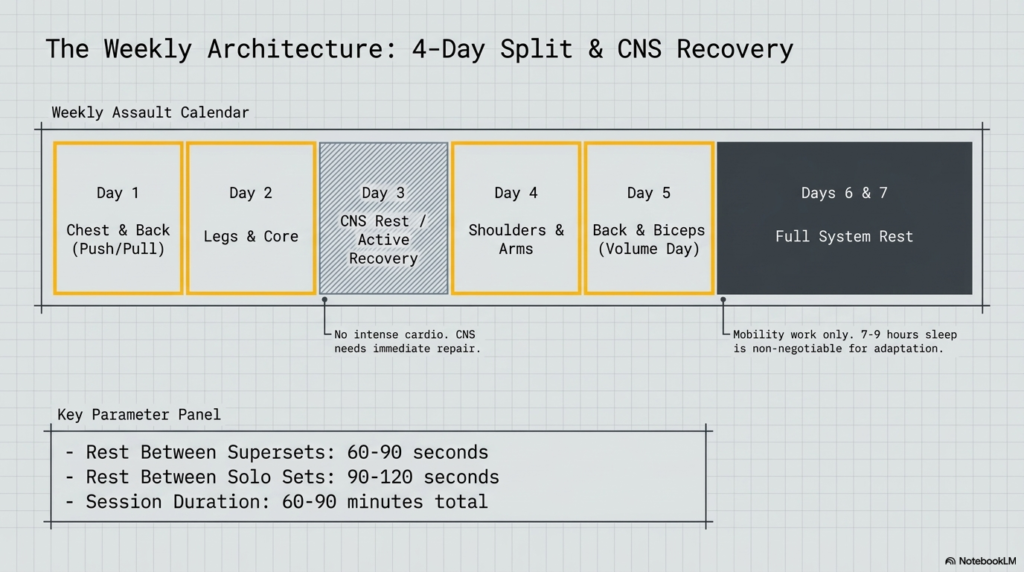
This weekly German Volume Training split is designed to maximize muscle growth while giving your body enough time to recover from the demanding 10×10 workouts. The program begins with Chest & Back on Day 1, followed by Legs & Core on Day 2. Day 3 is reserved for active recovery, allowing your central nervous system (CNS) to recover before returning to heavy training. Days 4 and 5 focus on Shoulders & Arms and Back & Biceps, helping maintain balanced muscle development.
The week finishes with two full rest days to support muscle repair and strength gains. Keep rest periods between 60–90 seconds for supersets and 90–120 seconds for individual sets, while limiting workouts to 60–90 minutes for optimal performance and recovery.
The Complete 10x10 German Volume Training Plan
This is a 4-day training split. Each session focuses on one primary superset of compound movements (10 sets x 10 reps each) followed by 2-3 accessory exercises (3 sets x 10-12 reps each). You can also read this How to Increase Muscle Size With German Volume Training.
Key Parameters:
- Starting weight: 60% of your 1-rep max
- Tempo: 4-0-2 (4 sec eccentric, 0 pause, 2 sec concentric)
- Rest between sets: 60-90 seconds for supersets; 90-120 seconds for solo sets
- Weekly progression: Add 2.5 lbs (1.25 kg) when you complete all 10×10 reps with proper form
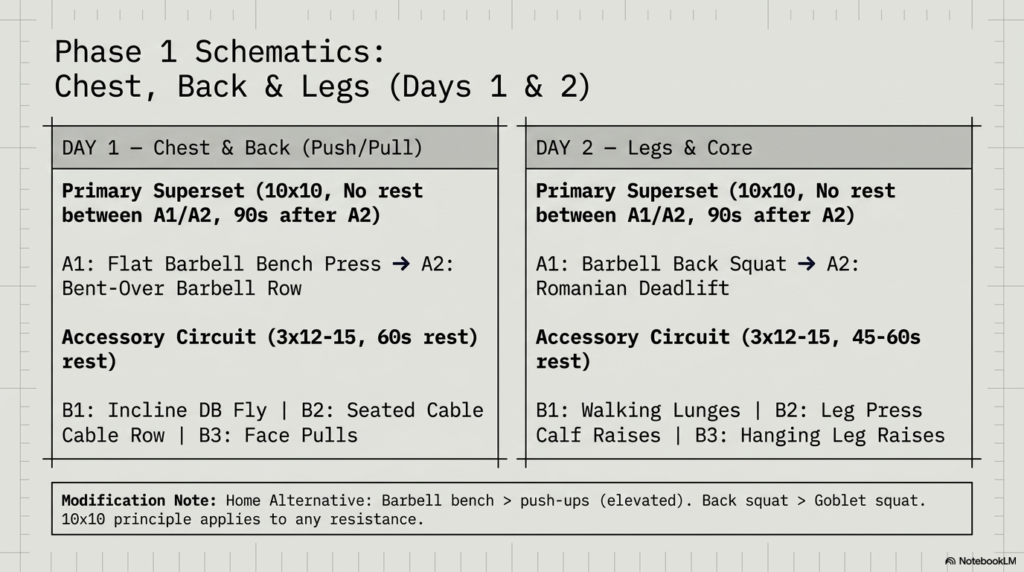
Day 1- Chest & Back(Push/Pull)
| Exercise | Sets | Reps | Rest | Notes |
|---|---|---|---|---|
| A1: Flat Barbell Bench Press | 10 | 10 | No Rest | Superset with A2 |
| A2: Bent-Over Barbell Row | 10 | 10 | 90 Sec | After A2, rest before A1 again |
| B1: Incline Dumbbell Fly | 3 | 12 | 60 Sec | Controlled stretch |
| B2: Seated Cable Row (Close Grip) | 3 | 12 | 60 Sec | Squeeze at peak |
| B3: Face Pulls | 3 | 15 | 60 Sec | Squeeze at peak |
Note Alternative: Replace barbell bench with push-ups (elevate feet for upper chest). Replace barbell row with resistance band rows or inverted bodyweight rows
DAY 2 — Legs & Core
| Exercise | Sets | Reps | Rest | Notes |
|---|---|---|---|---|
| A1: Barbell Back Squat | 10 | 10 | No rest | Superset with A2 |
| A2: Romanian Deadlift | 10 | 10 | 90 sec | Feel the hamstring stretch |
| B1: Walking Lunges | 3 | 12/leg | 60 sec | Add dumbbells for load |
| B2: Leg Press Calf Raises | 3 | 15 | 45 sec | Full range of motion |
| B3: Hanging Leg Raises | 3 | 12 | 60 sec | Core finisher |
Note Alternative: Replace back squat with goblet squat using a heavy dumbbell or backpack. Replace leg press calf raises with standing calf raises (bodyweight or loaded).
DAY 3 — REST / Active Recovery
Take a full rest day or do 20-30 minutes of light walking, stretching, or yoga. Do NOT do intense cardio — your CNS needs recovery after two hard GVT sessions.
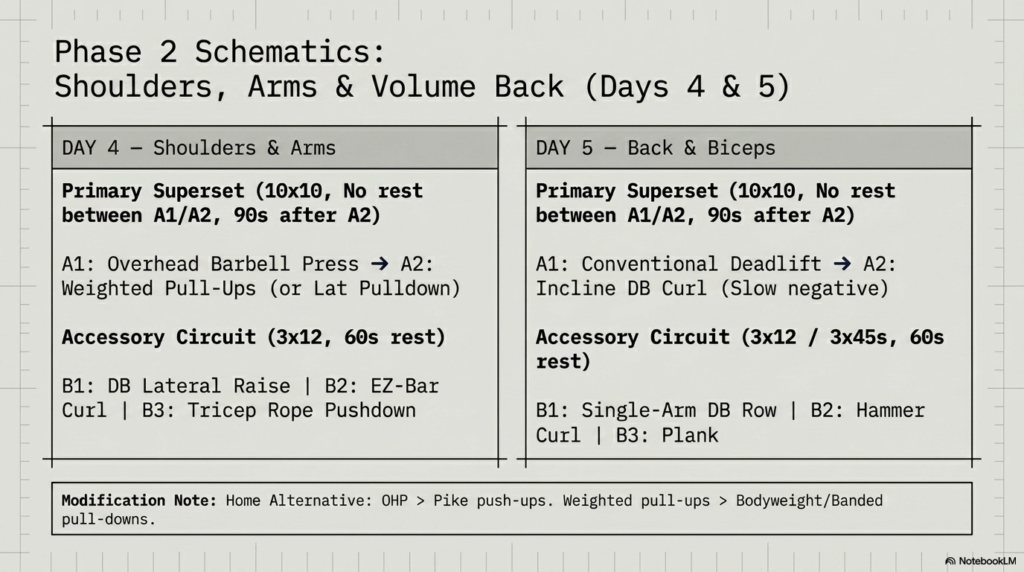
DAY 4 — Shoulders & Arms
| Exercise | Sets | Reps | Rest | Notes |
|---|---|---|---|---|
| A1: Overhead Barbell Press | 10 | 10 | No rest | Superset with A2 |
| A2: Weighted Pull-Ups or Lat Pulldown | 10 | 10 | 90 sec | Full range of motion |
| B1: Dumbbell Lateral Raise | 3 | 12 | 60 sec | Slow and controlled |
| B2: EZ-Bar Curl | 3 | 12 | 60 sec | Supinate at top |
| B3: Tricep Rope Pushdown | 3 | 12 | 60 sec | Supinate at top |
Note Alternative: Replace OHP with dumbbell press or pike push-ups. Replace weighted pull-ups with bodyweight pull-ups or resistance band pull-downs.
DAY 5 — Back & Biceps (Volume Day)
| Exercise | Sets | Reps | Rest | Notes |
|---|---|---|---|---|
| A1: Conventional Deadlift | 10 | 10 | No rest | Superset with A2 |
| A2: Incline Dumbbell Curl | 10 | 10 | 90 sec | Slow negative |
| B1: Single-Arm Dumbbell Row | 3 | 12 | 60 sec | Full elbow retraction |
| B2: Hammer Curl | 3 | 12 | 60 sec | Brachialis focus |
| B3: Plank | 3 | 45 sec | 45 sec | Core stability |
DAYS 6 & 7 — Full Rest
Two full rest days allow your nervous system and muscles to fully recover. You can include light walking, mobility work, or foam rolling. Sleep 7-9 hours per night — this is non-negotiable for GVT results.
The 6-Week Progression Curve
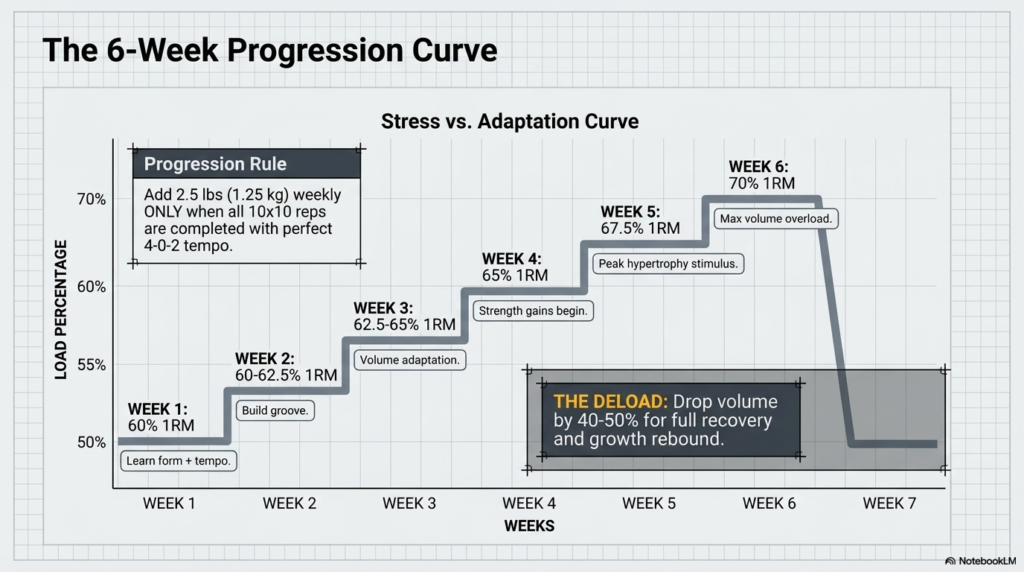
Progressive overload is essential for making German Volume Training effective, and this six-week roadmap provides a simple strategy for consistent improvement. Begin the program using 60% of your one-rep maximum, focusing on perfect technique and the prescribed 4-0-2 tempo. As you successfully complete all 10 sets of 10 reps, gradually increase the weight by 2.5–5 pounds (1.25–2.5 kg) each week. This steady progression allows your muscles, joints, and nervous system to adapt without sacrificing form. By weeks five and six, you’ll be handling heavier loads while maintaining the same training volume.
After completing the cycle, reduce training volume by 40–50% during a deload week to promote full recovery and prepare for your next training phase.
| Week | Load | Focus | When to Increase Weight |
|---|---|---|---|
| Week 1 | 60% 1RM | Learn form + tempo | Only if all 10x10 completed perfectly |
| Week 2 | 60-62.5% 1RM | Build groove, tempo mastery | Complete all reps cleanly |
| Week 3 | 62.5-65% 1RM | Volume adaptation | Add 2.5 lbs if reps achieved |
| Week 4 | 65% 1RM | Strength gains begin | Maintain load, prioritize form |
| Week 5 | 67.5% 1RM | Peak hypertrophy stimulus | Push if recovery is strong |
| Week 6 | 70% 1RM | Max volume overload | Deload the week after GVT block |
7 Expert Coaching Tips for GVT Success
|
|
|
|
|
|
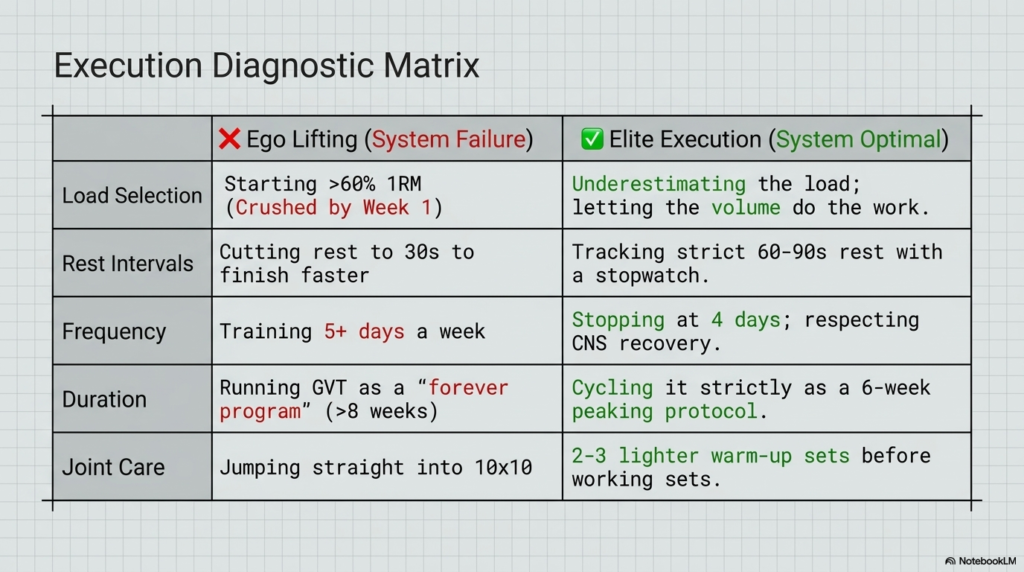
5 Common GVT Mistakes to Avoid
🚨 Watch Out For These Errors |
❌ Going too heavy too soon — GVT volume will crush you if you start above 60% 1RM in Week 1 |
❌ Skipping rest periods — Rest is part of the program. Cutting rest to 30 seconds tanks your performance |
❌ Training GVT 5+ days per week — More is not better here. Four days is the sweet spot for natural athletes |
❌ Neglecting nutrition — GVT without adequate protein and calories is like driving a race car with no fuel |
❌ Running GVT longer than 8 weeks — It’s a peaking protocol, not a forever program. Cycle it correctly |
Pre-Flight Checklist
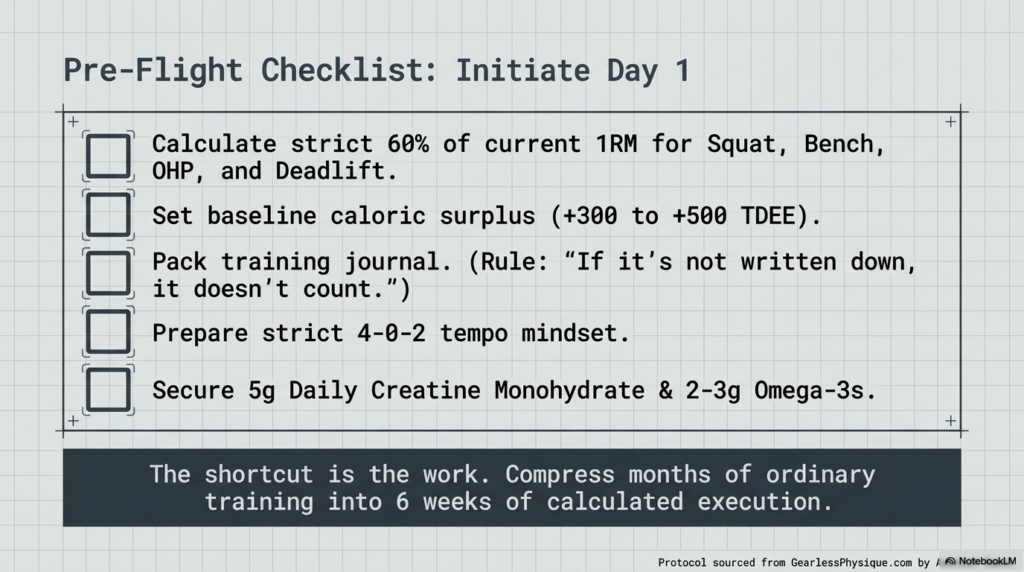
Before starting a German Volume Training cycle, taking time to prepare can make a significant difference in your results. This checklist highlights the essentials needed for a successful six-week program.
- Begin by calculating 60% of your current one-rep max for your main lifts, as using the correct weight is key to completing all 10 sets of 10 reps.
- Plan a 300–500 calorie surplus to fuel recovery and muscle growth.
- Keep a workout journal to track every session and progression.
- Commit to the strict 4-0-2 lifting tempo, which maximizes muscle tension and improves technique.
- Finally, support your training with 5 grams of creatine monohydrate and 2–3 grams of omega-3s daily to enhance performance, recovery, and overall training consistency.
Expected Results from GVT
When combined with proper nutrition and recovery, many lifters experience:
- Increased muscle size
- Better muscular endurance
- Improved strength
- Enhanced workout performance
- Greater training discipline
Most trainees notice visible changes within 4–6 weeks, especially in the chest, back, shoulders, and legs.
Diet & Nutrition Guide for GVT
German Volume Training demands a lot from your body. Without the right nutrition, you’ll feel flat, perform poorly, and recover slowly. Here’s how to eat to support your GVT results.
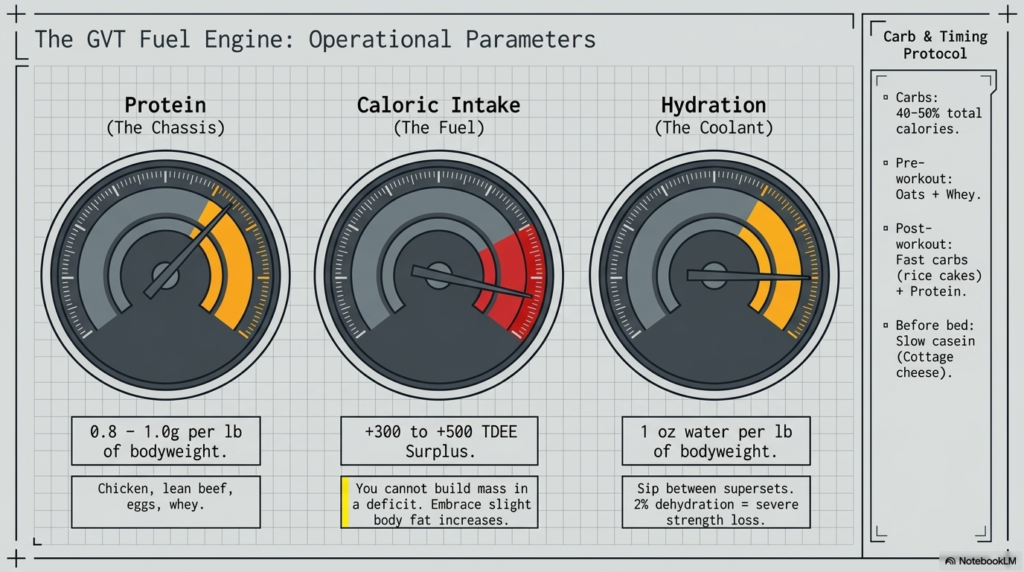
Protein — Your #1 Priority
Aim for 0.8-1g of protein per pound of bodyweight daily. For a 180 lb person, that’s 144-180g of protein per day. Best natural sources include chicken breast, 90% lean ground beef, eggs, Greek yogurt, cottage cheese, and canned tuna.
Calories — Eat to Grow
GVT is a mass-building protocol. You need a caloric surplus of 300-500 calories above your TDEE (Total Daily Energy Expenditure). Use a free TDEE calculator online and add the surplus on top. Don’t be afraid of a slight increase in body fat — that’s normal during a mass phase.
Carbohydrates — Fuel Your Workouts
Carbs are your primary workout fuel. Eat complex carbs like oats, brown rice, sweet potatoes, and whole grain bread. Aim for 40-50% of your total calories from carbs. On training days, eat a larger carb serving 1-2 hours before your workout.
Hydration
Drink at least 1 oz of water per pound of bodyweight daily. During GVT sessions, sip water between every superset. Dehydration even at 2% body weight loss significantly reduces strength output.
Natural Supplement Stack
- Creatine Monohydrate — 5g daily, no cycling needed. The most researched supplement for strength and mass gains
- Whey Protein — Only use if you struggle to hit protein targets from food. Not magic, just convenient
- Caffeine (Black Coffee or Pre-workout) — 200-400mg pre-workout to enhance focus and performance
- Omega-3 Fish Oil — 2-3g daily for joint health and inflammation control during heavy training
Meal Timing — Practical USA-Style Approach
- Pre-workout (1-2 hours before): Oats + whey protein shake or chicken + rice
- Post-workout (within 30-60 minutes): Protein + fast carbs (rice cakes + protein shake works great)
- Before bed: Cottage cheese or Greek yogurt — slow-digesting casein protein while you sleep
Sample Indian Mass-Gaining Meal Plan
You can also read this Ultimate Bulking Indian Non-Vegetarian Diet Plan.
Meal 1
- Oats
- Banana
- Whey Protein
- Peanut Butter
Meal 2
- Eggs
- Whole Wheat Toast
- Fruit
Meal 3
- Chicken Breast
- Rice
- Vegetables
Meal 4
- Whey Protein Shake
- Banana
Meal 5
- Fish or Paneer
- Potatoes
- Salad
Meal 6
- Greek Yogurt
- Almonds
Recovery Guidelines
Recovery is where growth occurs.
Sleep
Get:
- 7–9 hours every night
Hydration
Consume:
- 3–5 liters of water daily
Deload
- After 4–6 weeks of GVT, reduce volume for one week before restarting.
Stress Management
- High stress levels reduce recovery and muscle growth.
Include:
- Walking
- Stretching
- Meditation
- Deep breathing
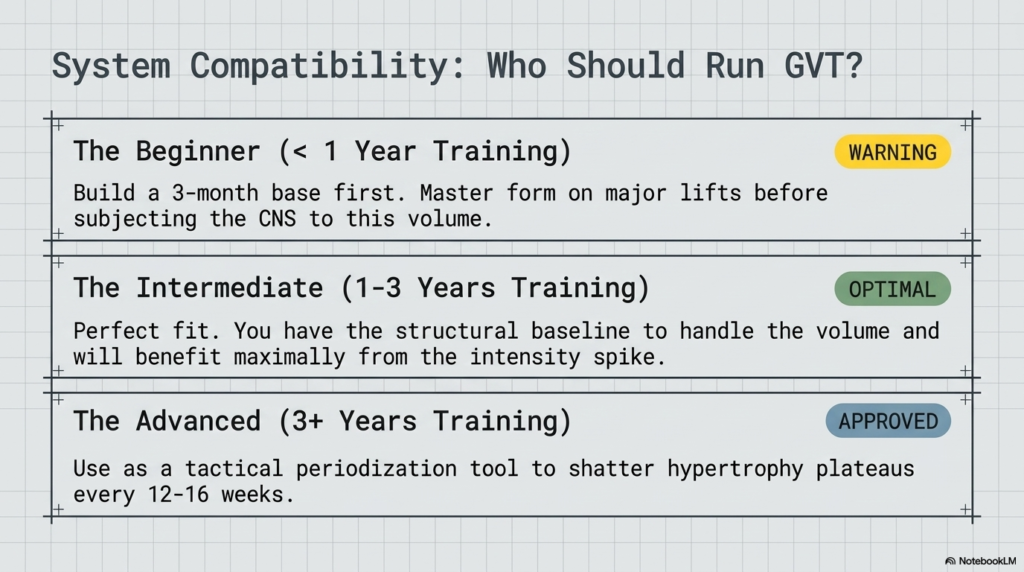
Who Should Follow the GVT Program?
Level | Suitability | Recommendation |
Beginner (< 1 year training) |
| Build a 3-month base first. Learn form on major lifts before starting GVT. |
Intermediate (1-3 years) |
| Perfect fit. You have the base to handle volume and benefit from the intensity spike. |
Advanced (3+ years) |
| Use GVT as a periodization tool to break plateaus every 12-16 weeks. |

Frequently Asked Questions
Q1: Is German Volume Training good for beginners?
- GVT can work for beginners, but it’s best suited for intermediates. If you’ve been training consistently for at least 3-6 months and have solid form on big compound lifts, you can start GVT. Complete beginners should spend at least 8-12 weeks on a basic full-body program first.
Q2: How much weight should I use for 10×10?
- Start with 60% of your 1-rep maximum. For example, if your max bench press is 200 lbs, start GVT at 120 lbs. This will feel easy in Set 1. By Set 7-8, it won’t. Trust the protocol.
Q3: Can I do German Volume Training at home?
- Yes — with adjustments. Replace barbell lifts with dumbbell equivalents or calisthenics. Push-ups for bench press, bodyweight rows for barbell rows, goblet squats for back squats. The 10×10 volume principle applies to any exercise.
Q4: How long is a typical GVT workout?
- Expect 60-90 minutes per session. The compound superset alone (10 sets each = 20 sets total) takes 30-40 minutes with proper rest. Accessory work adds another 20-30 minutes.
Q5: How often should I do German Volume Training per week?
- Four days per week is the proven sweet spot for most natural athletes. More than that increases injury risk and impairs recovery without adding meaningful results.
Q6: Will German Volume Training burn fat or only build muscle?
- GVT primarily builds muscle, but the high volume does increase caloric expenditure. If you eat in a slight surplus, you’ll gain muscle with minimal fat. If you eat at maintenance or a small deficit, you may experience body recomposition — gaining muscle while losing fat simultaneously.
Q7: What’s the difference between GVT and regular bodybuilding training?
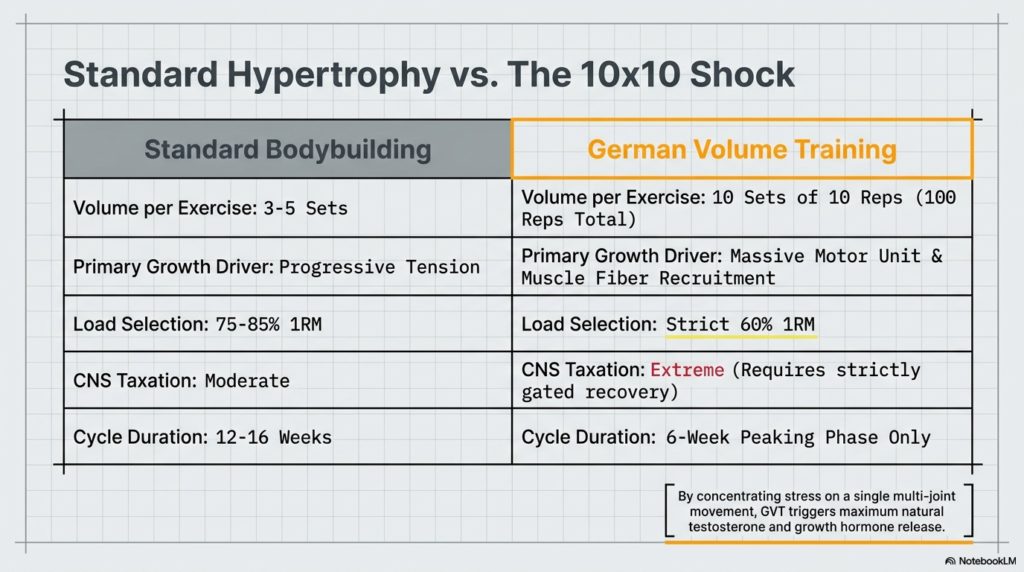
- Standard bodybuilding typically uses 3-5 sets per exercise. GVT uses 10 sets of the same exercise — dramatically higher per-exercise volume. This concentrated stress on one muscle group is what makes GVT uniquely effective for breaking through plateaus.
Q8: Can natural bodybuilders follow GVT effectively?
- Absolutely — and it’s arguably even better for natural lifters. GVT optimizes the training variables that matter most for natural bodybuilding: volume, progressive overload, and time under tension. No drugs needed to get excellent results from this program.
Note- German Volume Training (GVT) is a strength and hypertrophy program that uses 10 sets of 10 reps on compound exercises. You train 4 days per week, pair opposing muscle groups in supersets, rest 60-90 seconds between sets, and increase weight by 2.5 lbs each week when you complete all 100 reps with proper form.
Conclusion: Time to Train Like You Mean It
German Volume Training is one of the most powerful, science-backed programs in the history of natural bodybuilding. The 10×10 method isn’t flashy. It doesn’t require expensive equipment or a complicated spreadsheet. It just requires you to show up, do the work, and trust the process.
The gains from a 6-week GVT block can be genuinely life-changing — IF you apply it correctly. Start light, respect the tempo, eat enough protein, sleep enough, and track your progress. That’s the entire formula.
Stop searching for shortcuts. The shortcut is German Volume Training — it compresses months of ordinary training into weeks of intentional, structured, hard work.
Ready to transform your physique? Bookmark this guide, follow the plan, and come back to GearlessPhysique.com for more evidence-based, no-nonsense training content built for real natural athletes.
explore more helpful fitness guides below
The Insane 6-Week Muscle Shock System for Serious Size Gains
- 7 Signs You Need a Deload Week in Bodybuilding (Before Overtraining Ruins Your Progress)
- 12-Week Strength vs Hypertrophy Plan for a 60 kg Person
7 Best Rep Ranges to Build Muscle Faster (Science-Based Guide)
12-Week Summer Bulking Program for Massive Muscle Gain (Science-Based Plan)
About the Author
A certified fitness coach and the founder of GearlessPhysique.com. With 14+ years of experience in natural bodybuilding and evidence-based strength training, he has helped thousands of athletes build muscle, lose fat, and unlock their natural potential — no drugs, no gimmicks, just science and hard work.


Gearless Physique
Physique Without Gear
Your transformation starts now. Who's with me?