Table of Contents
Toggle3 Powerful Powerlifting Program Types Explained: 5x5, DUP, and Linear
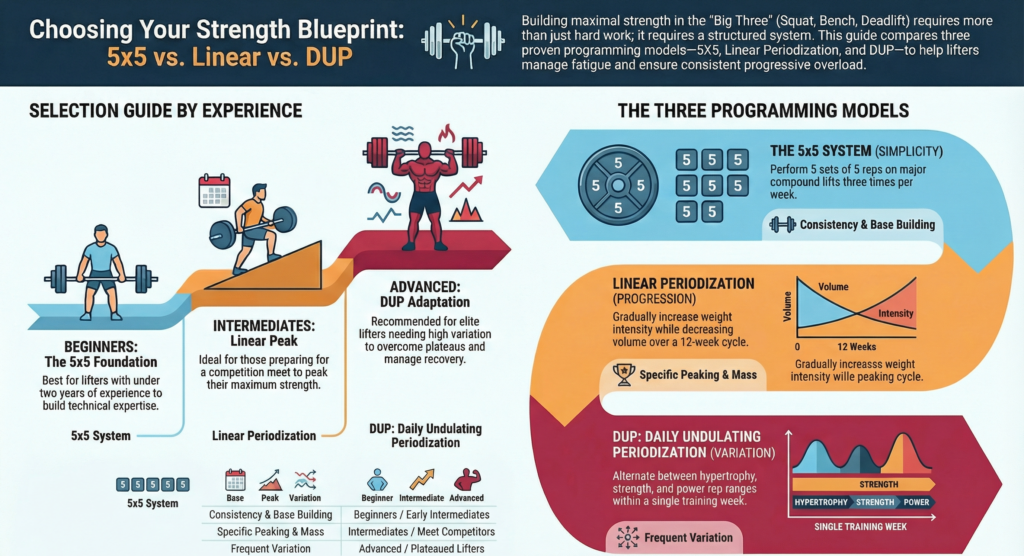
This infographic explains 3 Powerful Powerlifting Program Types Explained: 5×5, DUP, and Linear—to help lifters choose the right approach based on their experience level. Beginners benefit from the simple 5×5 system, focusing on consistency and building a strong foundation through compound lifts. Intermediate lifters progress with linear periodization, gradually increasing intensity while managing volume over time. Advanced athletes use DUP, which varies intensity and volume frequently within a week to overcome plateaus and enhance recovery. The visual highlights how each method supports progressive overload, fatigue management, and long-term strength gains, making it easier to select a structured, goal-oriented training blueprint.
3 Powerlifting Program Types Explained: 5x5, DUP & Linear
In case you are trying to gain more Squats, Benches, and Deadlifts, your training program is more important than motivation. Most lifters work hard and take the wrong structure. That is why the knowledge about the three most effective types of powerlifting programs 5×5, Linear Periodization, and DUP may help greatly to enhance your strength outcomes. In this article, we will dissect the functionality of each system, its suitability, and how it can be used without training it unnaturally.
Motivation is not enough
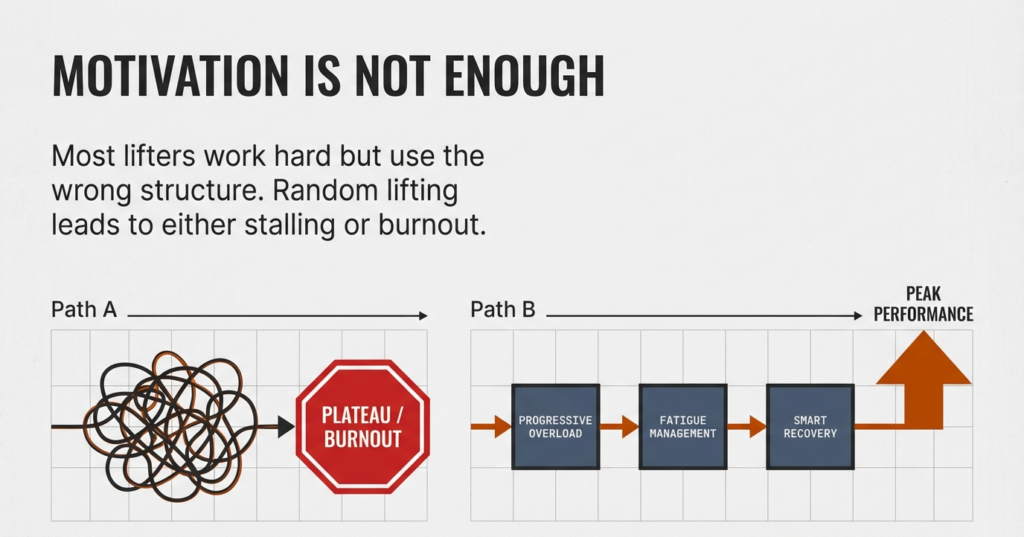
No one can achieve progress by being motivated to go to the gym. Most lifters are intense trainers who lack a design and instead they hop from workouts, intensities, and rep sets. This unsystematic method can easily result in burnout or plateaus since there is no definite system to operate in regards to overload and rest. Progressive overload, fatigue management, and strategic deloads are all required in order to develop real strength.
When training is structured in a smart way, every session leads on the previous one and performance will be enhanced as time will go by. Trends should be based on consistency, intelligent programming and rest. It is structure, rather than motivation, which transforms toil into quantifiable increases of strength.
1: The 5x5 Powerlifting Program
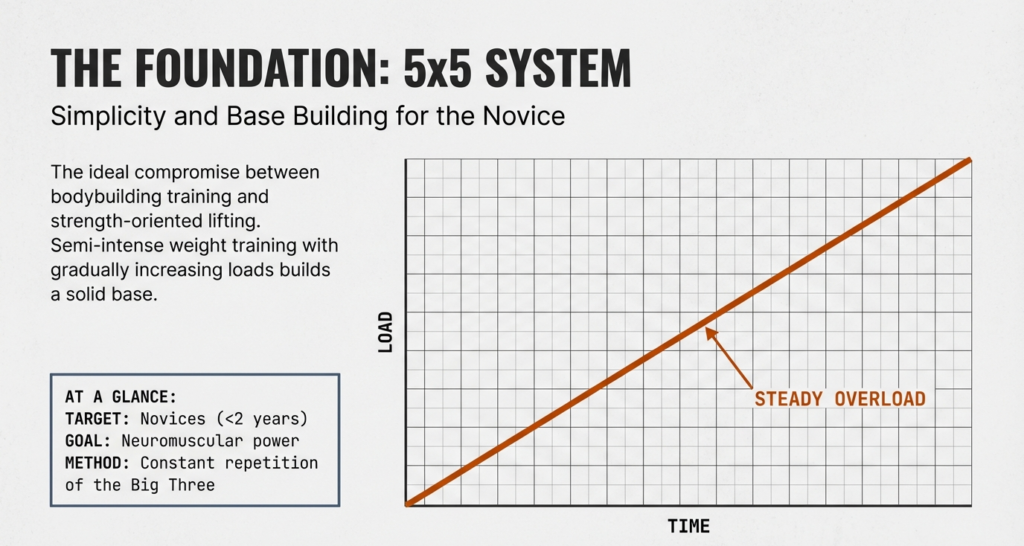
One of the most famous strength-building systems of the world is the 5×5 system. It emphasizes the five repetitions of five sets performed with the help of such compound exercises as squat, bench press, and deadlift. It is powerful because of its simplicity. Semi-intense weight training with gradually increasing weights produces steady strength improvements. It suits perfectly well the first-time users and early intermediates who require a solid base.
How 5x5 Works
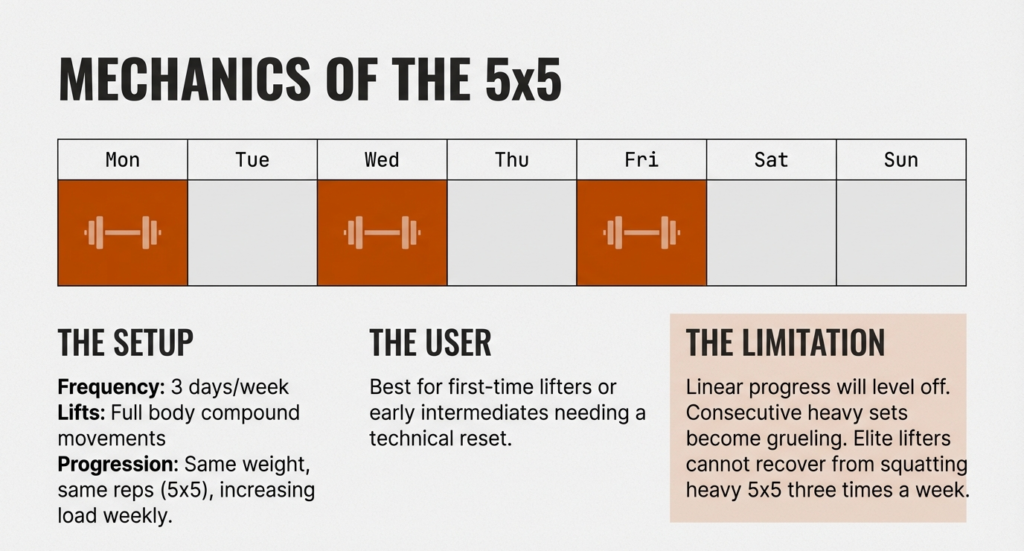
3 days a week means 3 days per week training in a typical 5×5 set up. There are major compound lifts with every session. For example:
Day A: Squat 5×5, Bench 5×5, Row 5×5
Day B: Squat, Overhead Press and Deadlift 5×5.
You increase the weight in small amounts each week. Such consistent overloading develops neuromuscular power and technical expertise.
Benefits of 5x5
- The greatest merit of 5×5 is simplicity.
- You do not have to do complex calculations and programming.
- It grows in size and strength at the same time.
- Since the amount of weight and intensity is equal, natural lifters can manage recovery.
- It also improves the correct lifting technique because of the constant repetition of the big three.
5×5 can be the ideal compromise between a bodybuilding-type training and a strength-oriented lifting in the case of a person who has to go between them.
Limitations of 5x5
- Though it works, 5×5 may ultimately level off.
- Consecutive heavy sets are very grueling as the weights increase.
- Elite lifters could have problems with recovery.
There is also no variation in intensity in the program and this may hamper the progression in the long term. More sophisticated periodization models prove to be handy at that point.
2️. Linear Periodization Explained
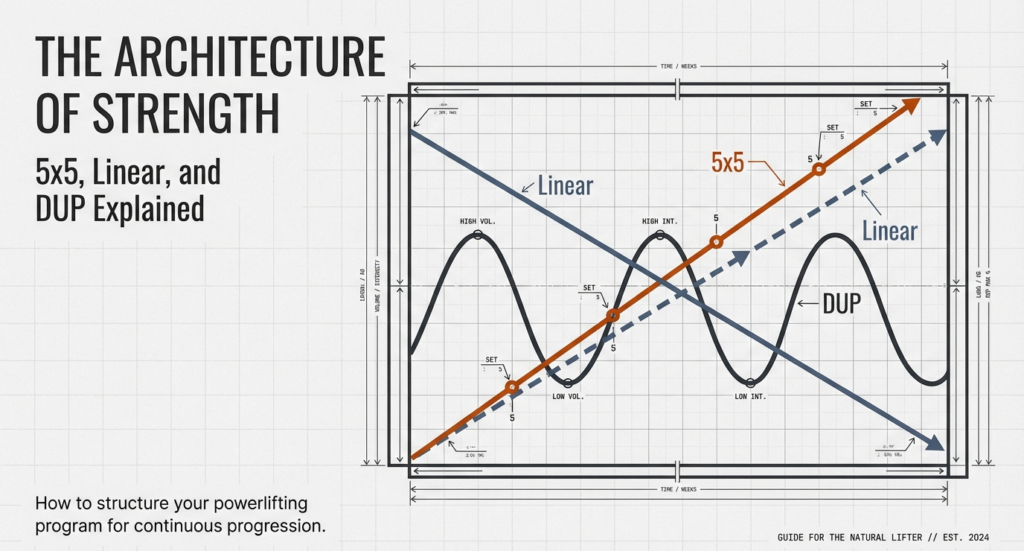
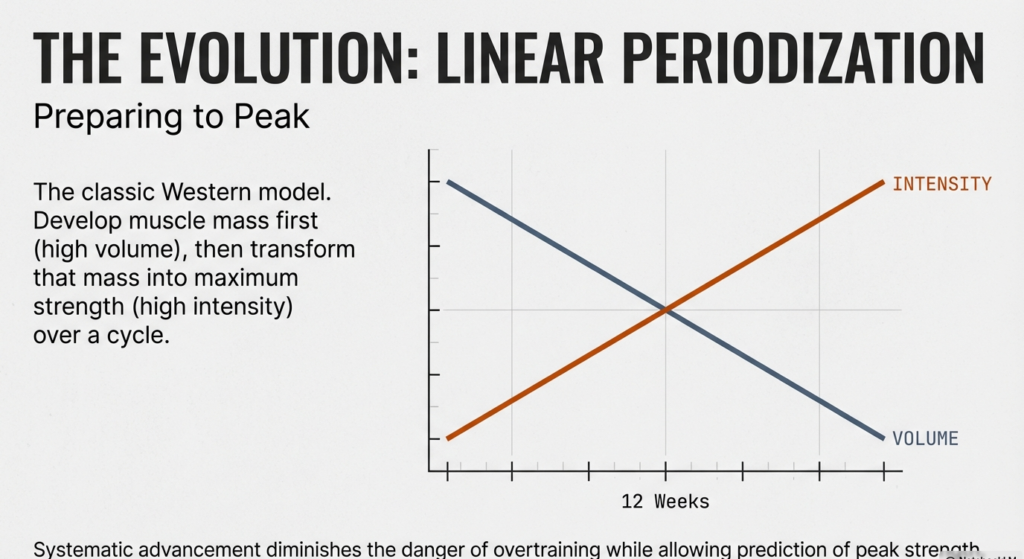
Linear Periodization is a traditional power lifting model that has been used decades. It is quite basic: at first, add intensity, but reduce volume with time. One option would be to warm up a training cycle with greater reps and lighter weights and gradually increase to lesser reps and heavier as competition approaches. This model develops muscle mass and thereafter transforms that mass into maximum strength.
Advantages of Linear Periodization
- Linear periodization is easy to plan and predict.
- It enables lifters to be able to peak competently.
- This progressive change between hypertrophy and strength is the one that guarantees muscle development to serve maximal lifting capacity.
- It also assists in dealing with fatigue, that is, not maintaining volume and intensity simultaneously.
Linear periodization is highly effective to intermediate lifters that prefer to gain larger-scale progress in the long term.
Linear Periodization Shortcomings
- The disadvantage lies in the fact that you exercise some range of reps over an extended duration. Unless one phase of progress is maintained, it becomes more difficult to make changes.
- Also, there is training of strength qualities sequentially and not concurrently. Other lifters are more responsive to variation in intensity that is more frequent and herein lies DUP.
The 12-weeks linear cycle
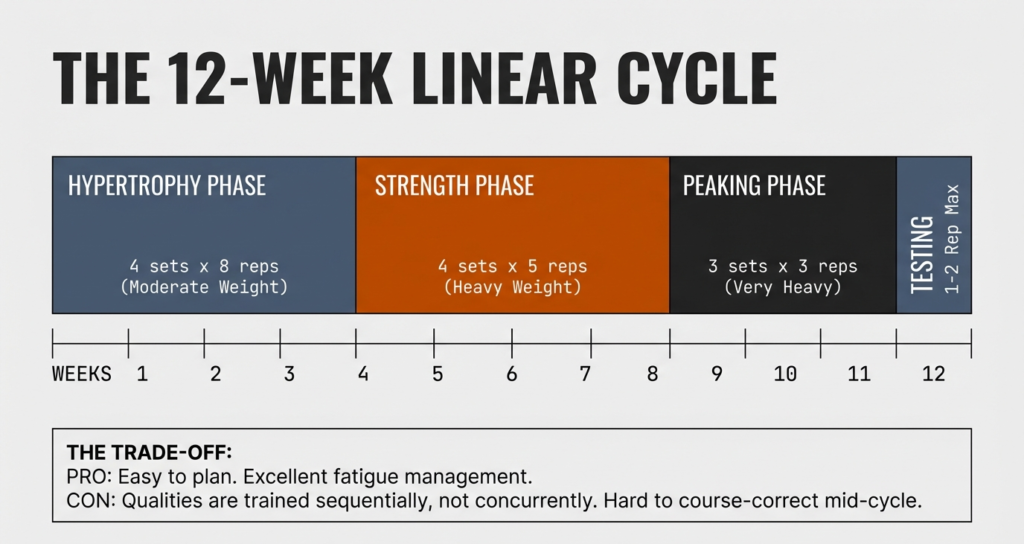
An average 12 weeks of a linear cycle may be as follows:
- Weeks 1–4: 8 reps (moderate weight) in 4 sets.
- Weeks 5-8: 5 reps (heavy weight) sets of 4.
- Week 9-11: 3 rounds of 3 repetitions (heavy weight).
- Week 12: 1–2 rep max testing.
One stage gets you ready to go on to the next. The size is reduced and the strength is increased. Such a systematic advancement diminishes the danger of overtraining.
3️. DUP (Daily Undulating Periodization)
Daily Undulating Periodization also known as DUP, alternates volume and intensity in the same week. You alternate the number of reps in each training day, rather than gradually increasing the intensity over the months.
Benefits of DUP
- DUP works very well in the case of intermediate and advanced lifters.
- Due to changes in intensity, the recovery is enhanced whereas the strength continues to advance.
- It is always observed in research that different rep ranges per week can increase gains in strength than fixed models.
- It also helps in alleviating boredom hence keeping training interesting.
This variation of intensity in control is particular to natural lifters as opposed to pushing maximum weights all the time.
Limitations of DUP
- DUP needs to be more strategic and aware of the percentages. Beginners may be confused by it.
- It may also cause unnecessary fatigue in case it is designed improperly as the lifts are trained more than once a week.
There should be proper auto-regulation and recovery management.
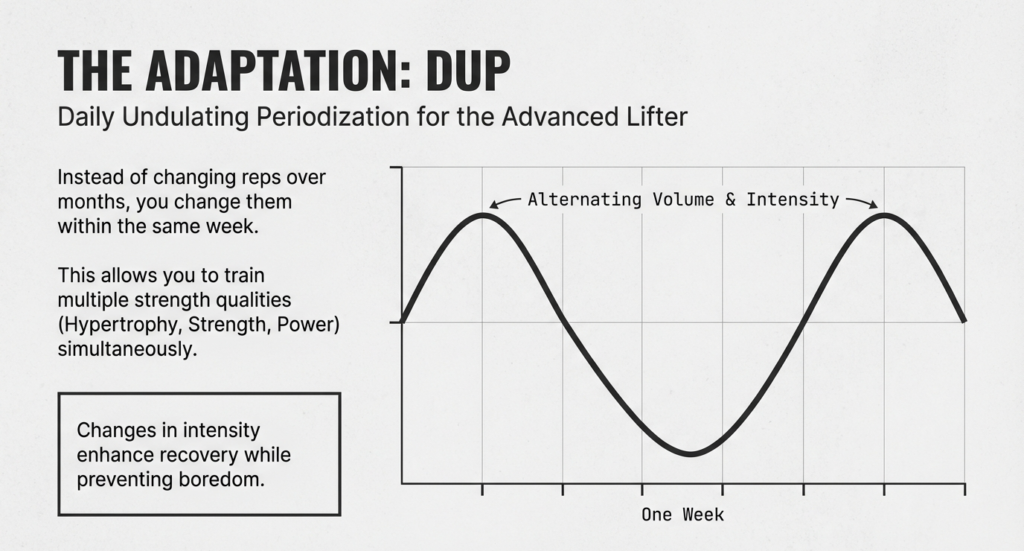
DUP Training Mechanics
How DUP Works
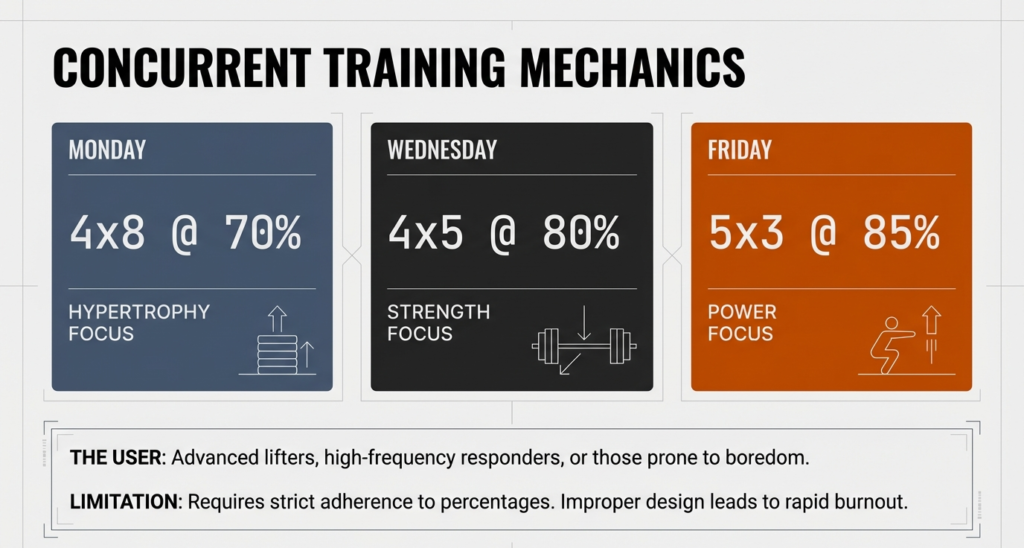
DUP is normally performed with the same lift on varying rep regimes over a number of times per week. An example of a squat would appear as follows:
- Day 1: Squat 4×8 at 70%
- Day 2: Squat 4×5 at 80%
- Day 3: Squat 5×3 at 85%
The difference helps to avoid stagnation and enhances the neural adaptation. It also enables it to be used in higher frequency without a lot of fatigue.
Read more: https://www.muscleandstrength.com/workouts/dup-muscle-growth-workout
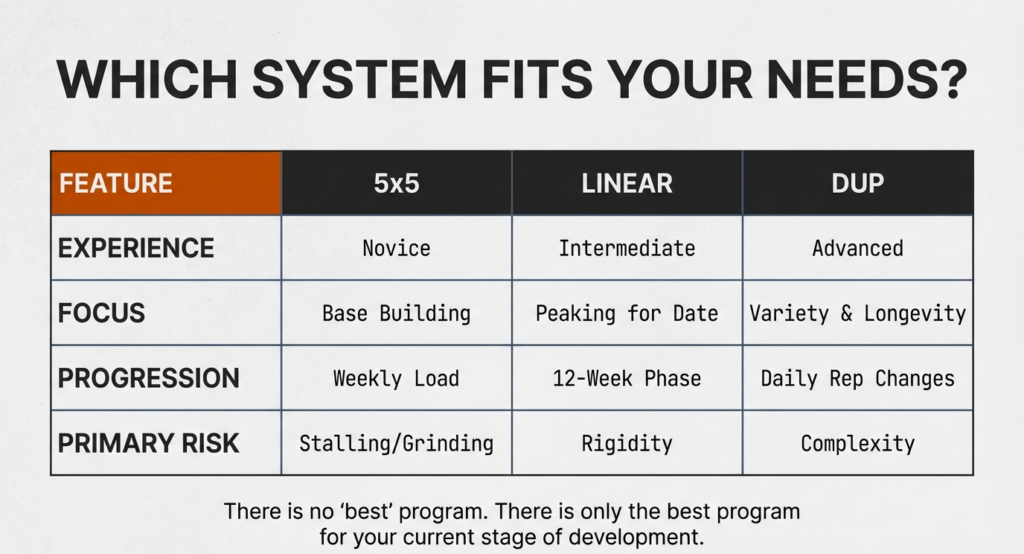
Comparing 5x5 vs Linear vs DUP
The two programs are effective, however, they are efficient in different lifters.
- You should use 5×5 when you are starting to gain strength.
- Linear periodization is appropriate to intermediates who are going to compete in a meet.
- DUP should be used with highly trained lifters requiring a high degree of variation.
The trick is to ensure that you have the appropriate system based on your level of experience. No such thing as an excellent program.
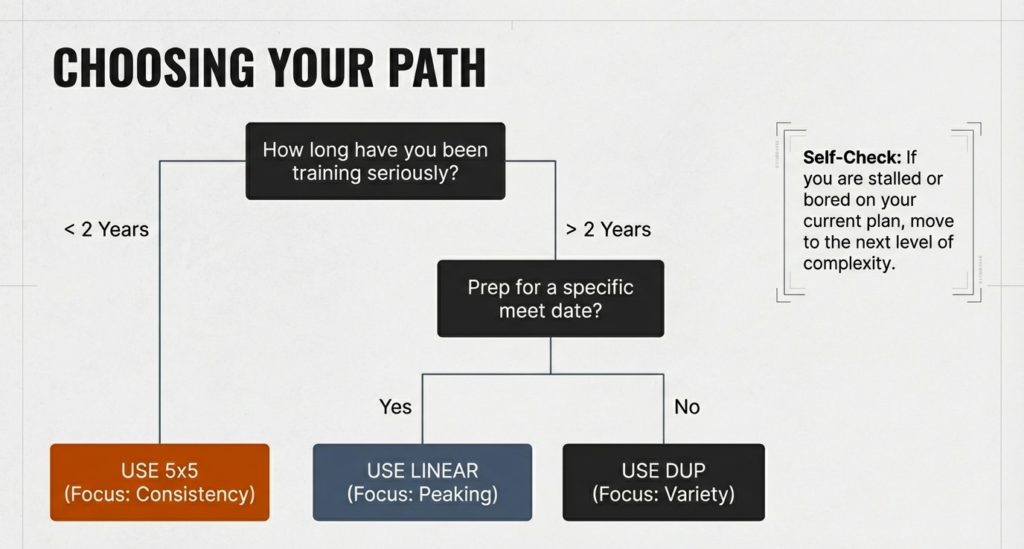
Choosing your path
Ask yourself three questions:
How many years have I been serious in training?
Between the sessions, do I feel well?
Should I be simple or should I be varied?
- Under two years serious lifting go with 5×5.
- Linear periodization should be used in case you are about to compete in a meet.
- In case you are comfortable and flat-out, use DUP.
You should develop your program with your development.
What Is the best Program to Natural Lifters?
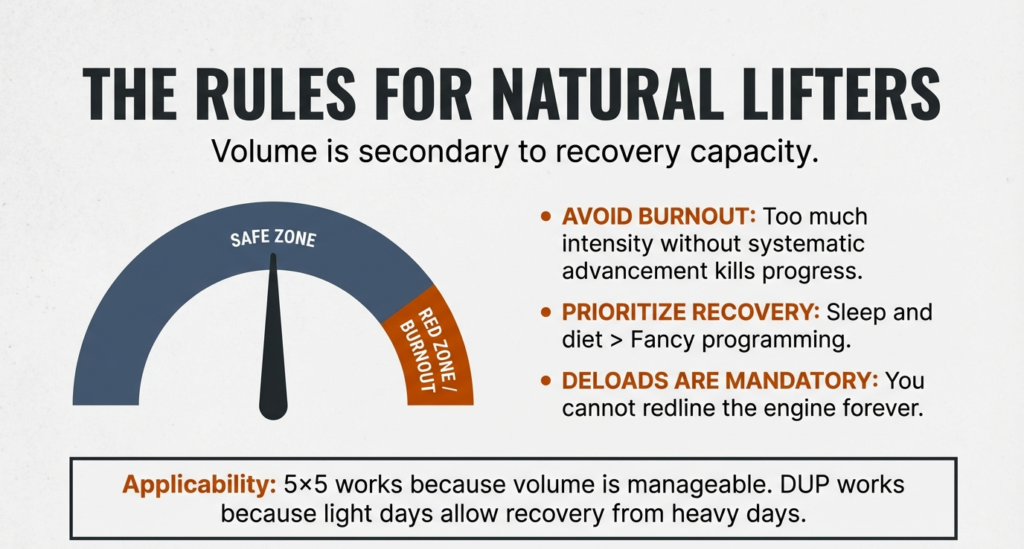
Being a natural lifter, volume is not important as much as recovery capacity. Too much intensity without systematic advancement is a cause of burnout.
- In the case of newcomers, 5×5 offers consistent profits without any complications.
- Linear periodization is a structured progression with fatigue control that is used in intermediate natural lifters.
- Late-term natural lifters are also usually suited to DUP since it is balanced in terms of heavy and volume sessions.
Regularity, rest, diet, and intelligent deloading are more significant than pursuing fancy programming.
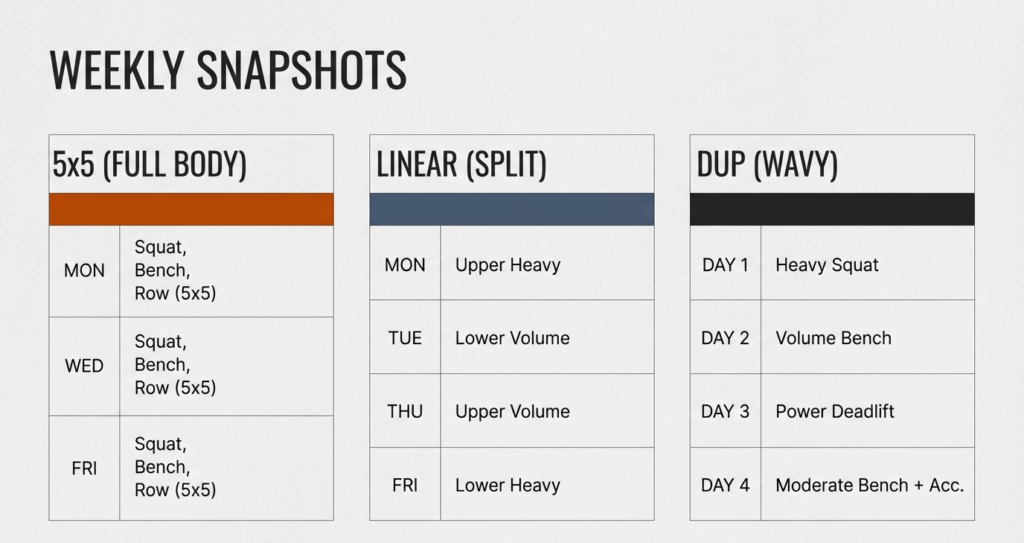
Weekly Workout Training
Following are easy templates due to this reason:
5x5 (Full Body): 3 Days/Week
Mon/Wed/Fri
- Day 1: Squat 5×5
- Day 2: Bench 5×5
- Day 3: Row 5×5
Substitutes Deadlift and Overhead Press.
Linear (Upper/Lower Split): 4 Days/Week
- Day 1: Upper Heavy
- Day 2: Lower Volume
- Day 3: Upper Volume
- Day 4: Lower Heavy
Situated Progressively and gradually intensify every week.
DUP: 4 Days/Week
- Day 1: Heavy Squat
- Day 2: Volume Bench
- Day 3: Power Deadlift
- Day 4: Moderate Situated Bench + Accessories.
Common Mistakes to Avoid
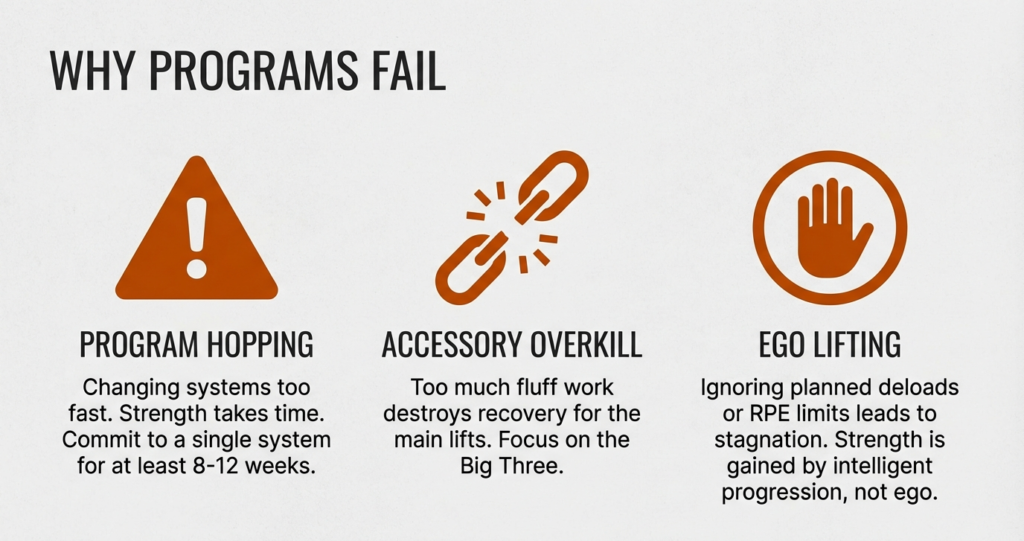
Most program-hoppers change programs too fast. Strength requires time. Use a single system at least 8-12 weeks. Adding excessive accessories that destroy the process of recovery is another error. Powerlifting is concerned with focusing on the big three. Lastly, not taking deload weeks will result in stagnation. Planned recovery is advantageous to every system.
Final Thoughts
All of the systems that are proven to be effective in powerlifting are: 5×5, Linear Periodization, and DUP. None of them are magic. They just arrange overload in an intelligent manner. The program that suits your experience, recovery capacity and long term consistency is the best program. Train, recover, and not forget. – Strength is gained by learning to progress intelligently, not by ego boosting. When these principles can be used in the right place and at the right time, you squat, bench, and deadlift will continually increase without fatigue.

Gearless Physique
Physique Without Gear
Your transformation starts now. Who's with me?