Table of Contents
Toggle5 Proven Ways to Build Muscle Faster & Smarter
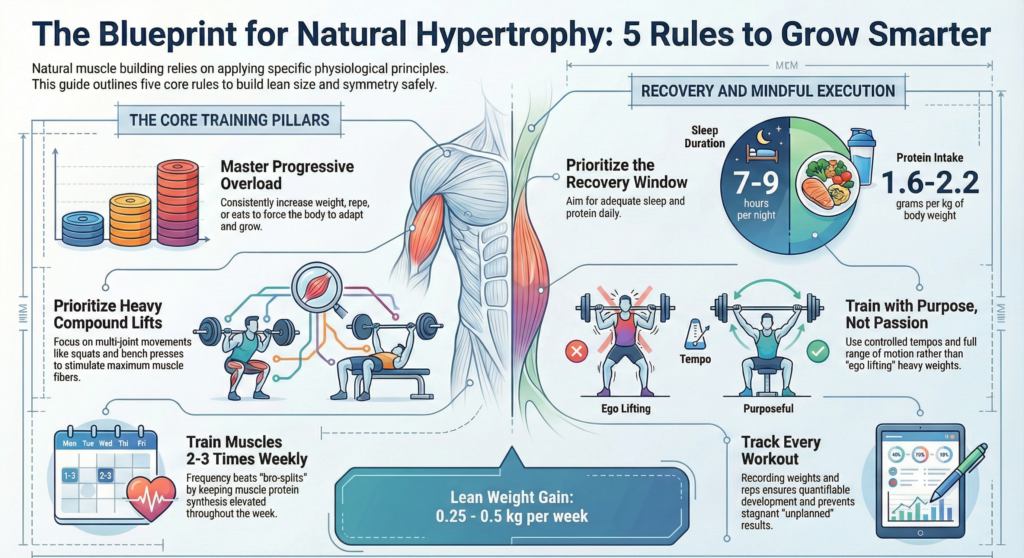
This infographic presents a practical blueprint for 5 Proven Ways to Build Muscle Faster & Smarter strategies to build muscle efficiently. It emphasizes progressive overload as the foundation of growth, encouraging consistent increases in weight, reps, or intensity. The importance of prioritizing heavy compound lifts like squats and presses is highlighted to maximize muscle recruitment. Training frequency is optimized by working each muscle group 2–3 times per week. Recovery plays a crucial role, with recommendations for 7–9 hours of sleep and adequate protein intake of 1.6–2.2 g/kg body weight. The visual also stresses mindful execution, avoiding ego lifting, and tracking workouts to ensure measurable progress and long-term muscle development success.
5 ways to build muscle faster & smarter
Muscle building is not about wasting countless hours in the gym but rather the application of the proper principles. I am a natural lifter and coach, and I have witnessed numerous individuals spending their time on random workouts rather than a planned one. When lean size, strength and symmetry are your aim, you need to train smart and not hard. These 5 science-based rules will ensure that you get the most out of hypertrophy, recover effectively, and gain faster growth without any injuries. Let’s break them down.
The philosophy: train smart, not hard
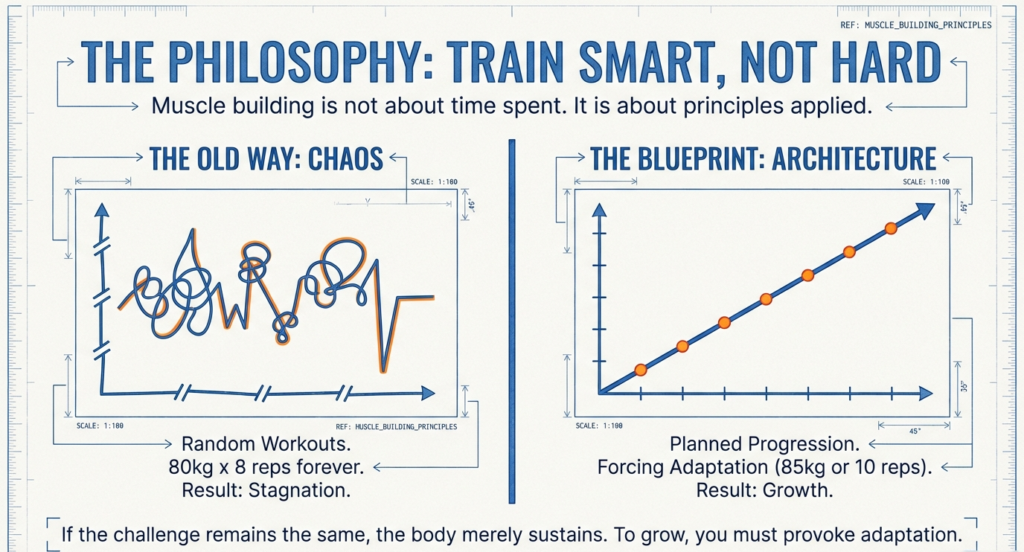
This picture brings out the main philosophy of smart muscle growth: structure is better than chaos. Unplanned exercises and training with the same weight and number of repetitions result in stagnation on the left. On the right, an increase in weight or reps, planned progression, develops consistent growth. The point is simple: it is not the hours spent in the gym that will help people build muscle, but rather the principles that they follow at all times.
The body is maintained when the challenge remains the same. So continue to overload on purpose and you initiate adaptation and stimulate actual hypertrophy. Training is a planned process and not a haphazard one.
Rule 1: Progressive Overload
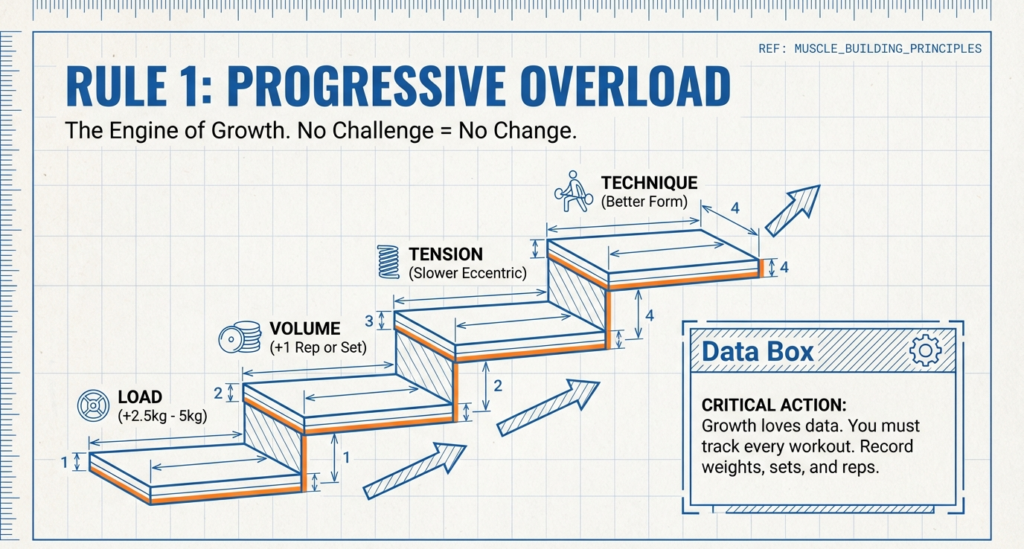
The muscle growth is based on progressive overload. In its absence, your body does not even have an incentive to adapt. In layman language, you need to ensure that you progressively raise the challenge that you put before your muscles. That may include increasing the weight load, increasing the number of reps, increasing the number of sets, or making the movements more precise and regulated.
The development of muscles occurs when you push your limits. Unless you bench press 80 kg x 8 reps per week, every month, your body will not grow but will simply sustain. However, at 85 kg or even 10 reps rather than 8, you provoke new adaptation.
Progressive overload can be used in several ways:
- Gain weight of 2.5-5kg upon achieving your target rep.
- One additional rep every session.
- Extend the eccentric period of tension.
- Enhance mind-muscle relationship and method.
Track every workout. Record weights, sets and reps. Growth loves data.
Rule 2: Prioritize Compound Movements
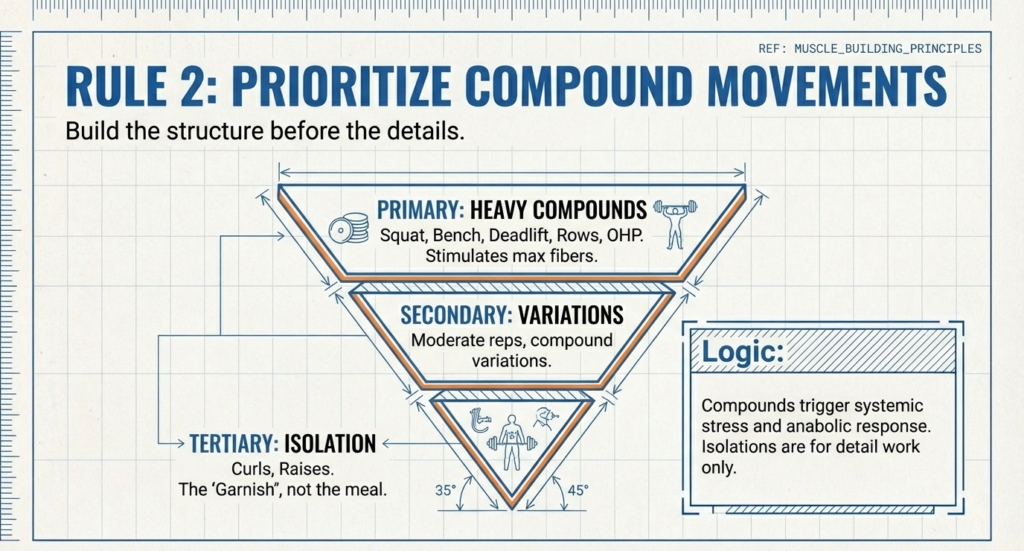
Compound lifts use more than one muscle group and enable one to use heavier weight. This is due to the stimulation of more muscle fibers than isolation movements by exercises such as squats, bench press, deadlifts, rows and overhead press. Your energy is the greatest when you begin with compounds when you are exercising. It indicates improved strength performance, and improved hypertrophy stimulus. Isolation exercises such as curls and lateral raise are essential, but cannot be used as substitutes of heavy compounds.
To build some muscles, a combination of the following sessions will work:
- Strength focus (primary compound lift).
- Secondary lift of the compound (no heavy reps).
- Isolation movements (greater volume of pump and detail).
Compound lifts have another advantage in that they enhance anabolic hormone response and general coordination. They form the bases of a classic physique wide back, thick chest and strong legs.
Rule 3: The Mathematics of frequency
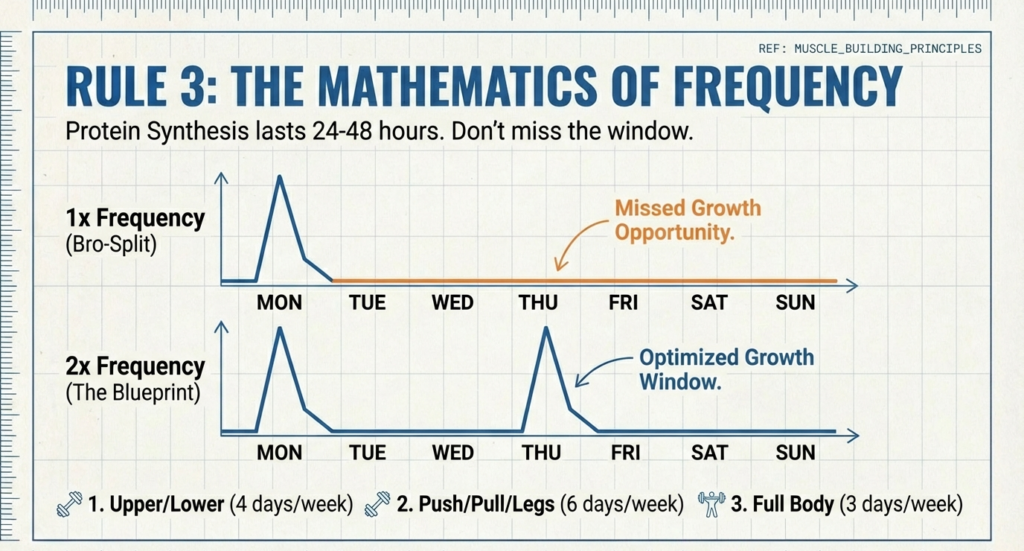
Frequency matters. Studies indicate that once per week is not as effective in training a group of muscles as compared to two times per week particularly in the case of natural lifters.Training chest on Monday and waiting 7 days to repeat it again means that you are missing growth opportunities. The maximum protein synthesis of the muscles occurs during 24-48 hours of training. Subsequently, growth stimulus falls.
A better approach:
- Push/Pull/Legs (6 days/week).
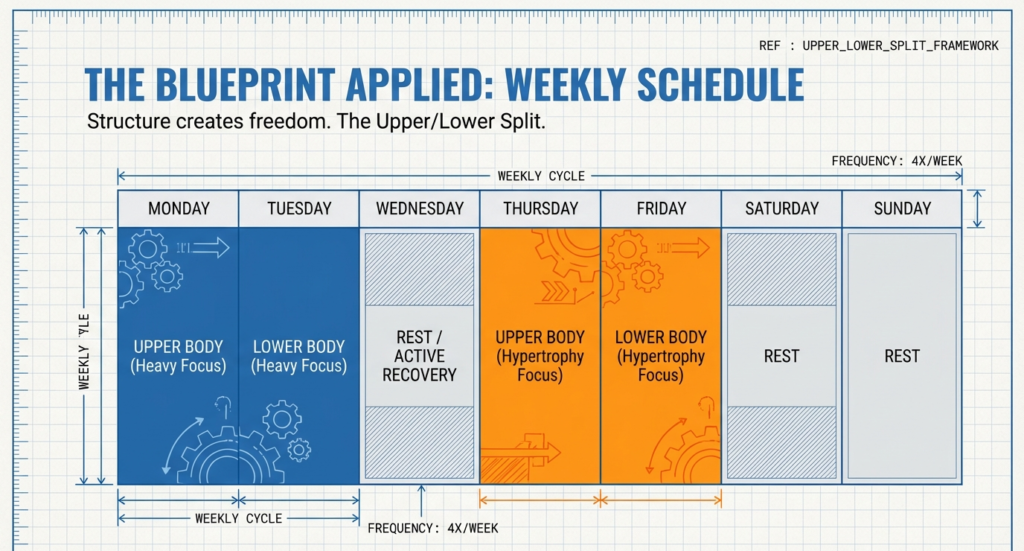
- Upper/Lower split (4 days/week).
- Full-body workouts (3 days/week).
This permits optimal stimulation and recovery equilibrium. This is because instead of 20 sets, which destroy a muscle in a single session, split volume into two moderate sessions. Quality beats junk volume.
As an example, 16 weekly sets of chest may be divided to 8 on Monday and 8 on Thursday. This enhances working and healing.
Rule 4: Recovery is growth
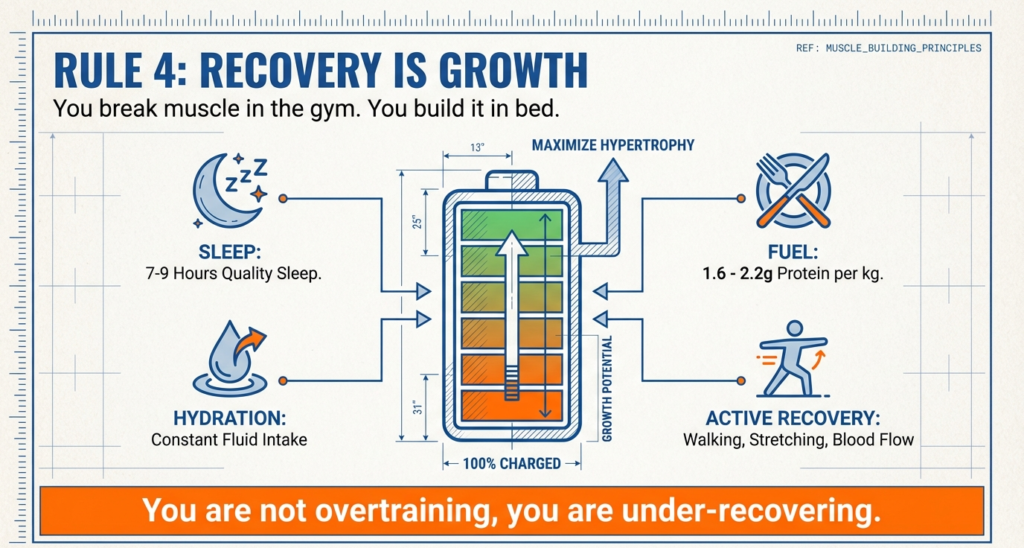
Muscles don’t grow in the gym. They grow when you recover. Exercise deteriorates the muscle structure. It is rebuilt firmer by recovery. There is no way to grow without sleep, nutrition and stress control, even though your workouts may be hard.
Aim for:
- 7–9 hours of quality sleep.
- 1.6-2.2 grams protein/kg body weight per day.
- Proper carbohydrates to a better performance.
- Fluid intake during the day.
Active recovery exercises such as stretching, foam rolling and light cardio are found to enhance blood supply and alleviate soreness. Burnout is also avoided by having deload weeks once every 6-8 weeks. When your strength is decreasing, your joints are aching, and you are not motivated, then you are not overtraining, you are under-recovering.
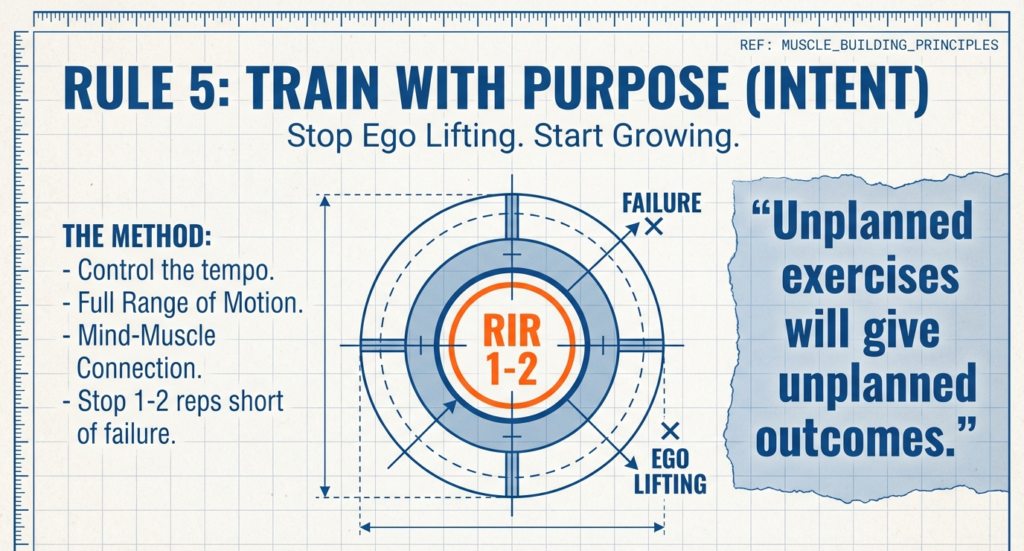
Rule 5: Train with purpose
Among the greatest faults lifters make is to go after heavy weights in poor form. Ego lifting can make others feel impressed yet it decreases the tension in the muscles and more injury can be experienced.
Ways To Build Muscle Faster & Smarter means:
- Controlling tempo.
- Sensing the muscles of the target.
- Using full range of motion.
- Cessation of 1- 2 reps short of failure (RIR method).
Hypertrophy is enhanced through mind–muscle connection. The higher the concentration on using the muscle, rather than moving the weight, the higher the activation becomes. Intent also implies possessing a scheme prior to going to the gym. Unplanned exercises will give unplanned outcomes. Aggregated programming generates quantifiable development.
Bonus: Nutrition & Consistency
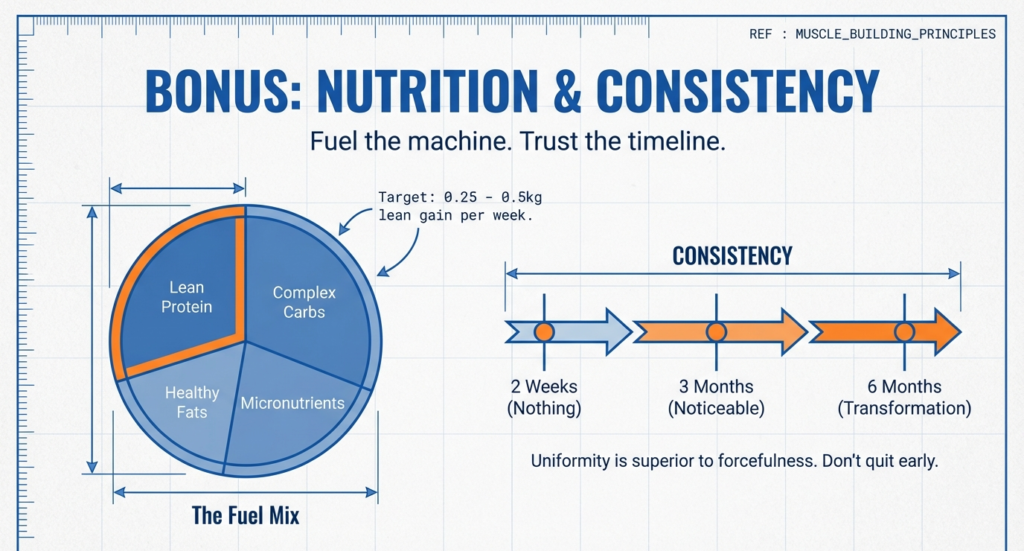
The best training plan cannot work without proper nutrition. To achieve muscle growth, there must be a slight caloric excess, adequate protein and balanced micronutrients.
Focus on:
- Whole food.
- Lean protein sources.
- Complex carbs.
- Healthy fats.
- Consistent meal timing.
Do not bulk up excessively too much. Target lean growth at 0.25- 0.5kg gain per week.
Uniformity is superior to forcefulness. Two weeks of perfect training and quitting will not develop muscle. However, you will change your body in six months of training.
Weekly schedule for build muscle faster & smarter
This picture demonstrates the organized structure of Upper/Lower split weekly workouts plan directed to the development of the balanced strength and hypertrophy. The program operates four days a week with an alternate heavy upper and lower body early in the week followed by hypertrophy-oriented focused sessions towards the end of the week. The active recovery during the midweek and rest on Saturdays are useful in aiding optimal muscle repair and growth.
This way of organization makes sure that every muscle group is trained twice a week and there is also ample time to rest. The plan focuses on the elements of consistency, intelligent frequency, and strategic intensity to facilitate consistent, sustainable muscle gains to natural lifters.
routine: upper body breakdown
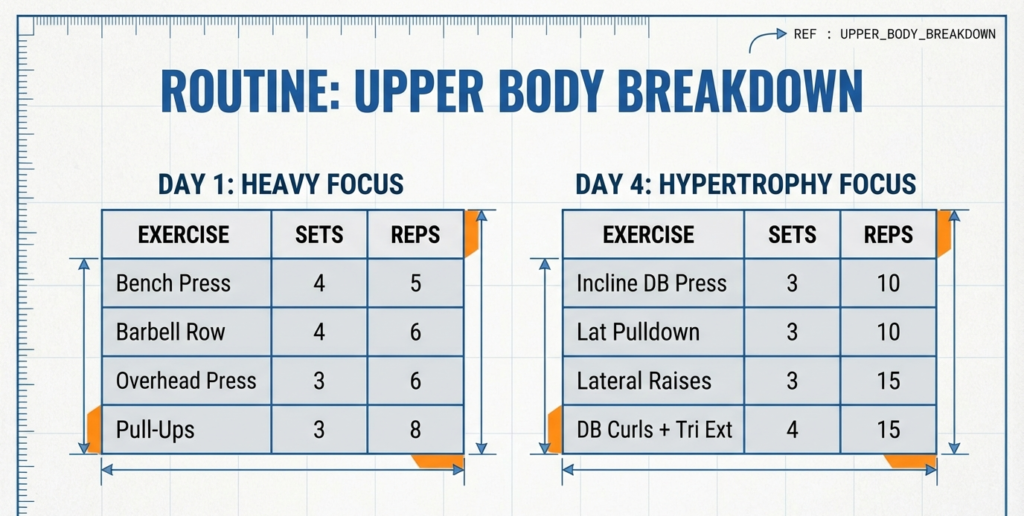
Day 1 – Upper (Heavy Focus)
- Bench Press – 4×5 reps.
- Barbell Row – 4×6 reps.
- Overhead Press – 3×6 reps.
- Pull-Ups – 3×8 reps.
- Accessories.
Day 4 – Upper (Hypertrophy Focus)
- Incline Dumbbell Press – 3×10 reps.
- Lat Pulldown – 3×10 reps.
- Lateral Raises – 3×15 reps.
- DB Curls + Overhead DB Triceps Extension 4×15 reps.
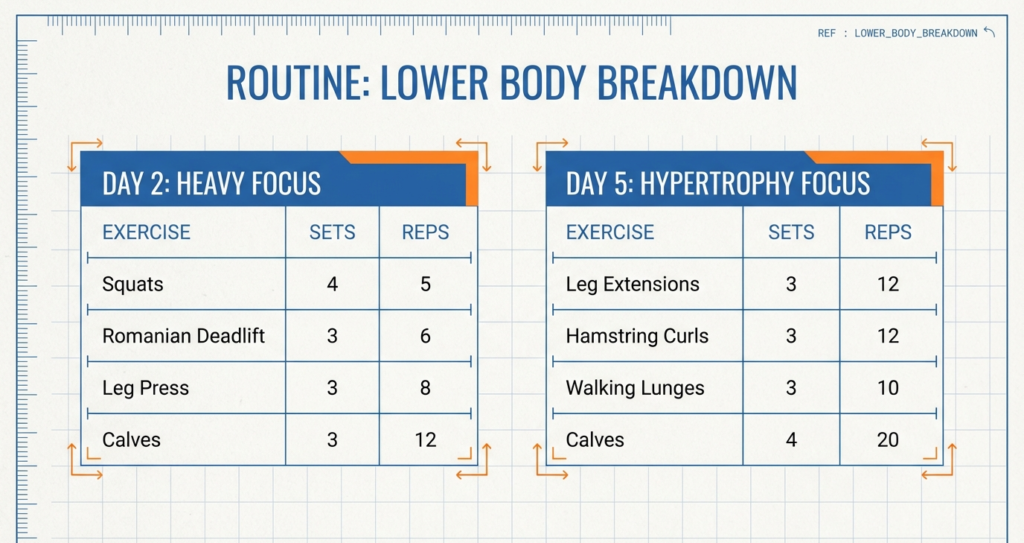
Routine: Lower body breakdown
Day 2 – Lower (Heavy Focus)
- Squats – 4×5 reps.
- Romanian Deadlift – 3×6 reps.
- Leg Press – 3×8 reps.
- Calves 3×12 reps.
Day 3– Rest day
Day 5 – Lower (Hypertrophy Focus)
-
Leg Extensions – 3×12 reps.
-
Hamstring Curls – 3×12 reps.
-
Walking Lunges – 3×10 reps.
-
Calves – 4×20 reps.
Repeat 1 time in a week with overload.
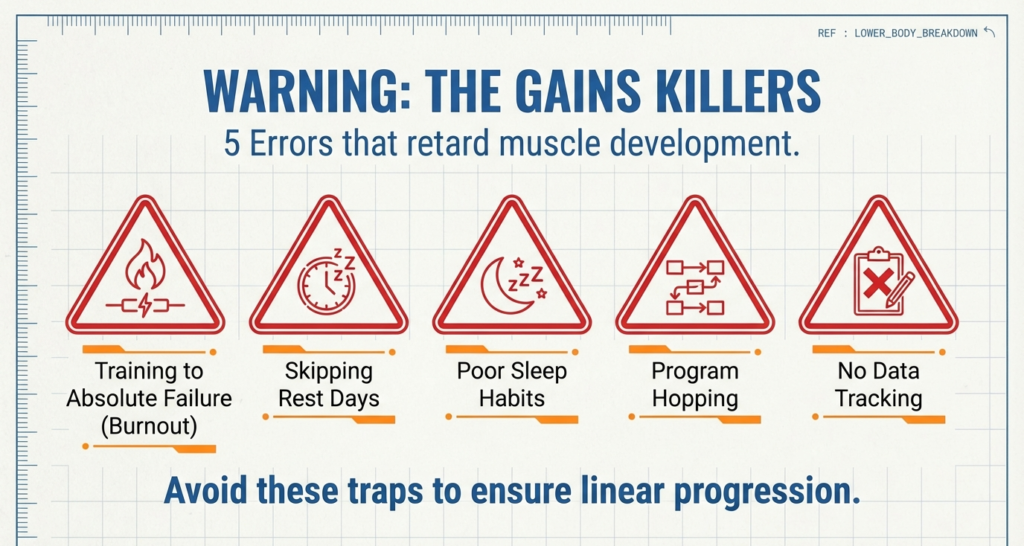
Warning: The gains killers
5 Errors that retard muscle development. The fact that it was trained to failure every set.
- Skipping rest days.
- Poor sleep habits.
- Endlessly shifting initiatives.
- Not tracking workouts.
These are to be avoided and your profits will be faster.
Final Thoughts
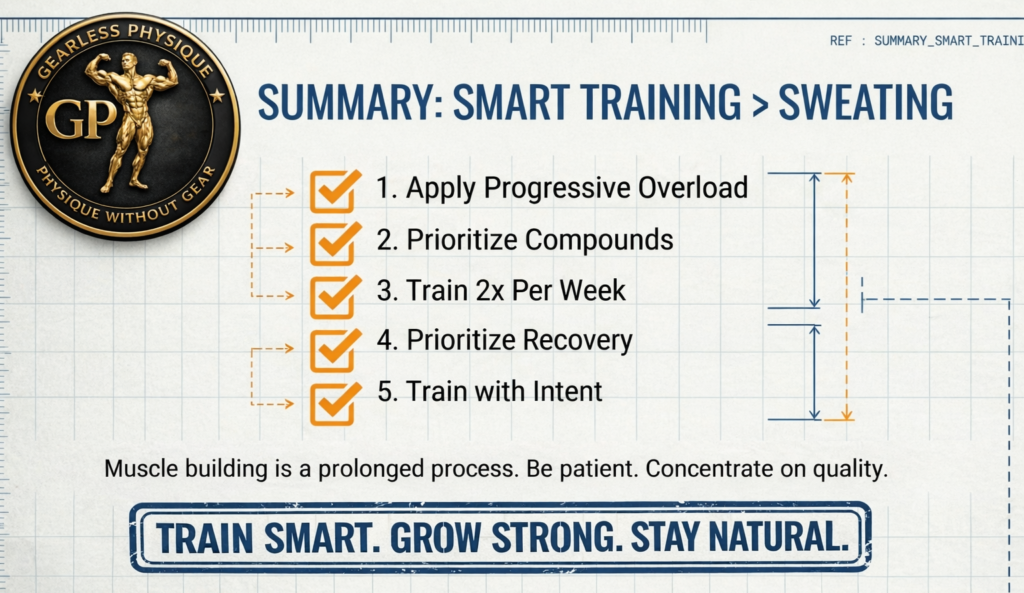
Smart is a question of training rather than sweating. Progressive overload, emphasis on compound exercises, work out 2 times a week, rest, and deliberate. These five principles will change your outcomes. Building of muscle is a prolonged process. Be patient, be consistent and concentrate on quality performance. By adhering to those principles you will not only gain muscle but you will gain it quicker and more efficiently.
Train smart. Grow strong. Stay natural.
❓ Frequently Asked Questions
1. How can I build muscle faster naturally?
To build muscle faster naturally, focus on progressive overload, train each muscle group twice per week, prioritize compound exercises, eat enough protein (1.6–2.2 g per kg bodyweight), and get 7–9 hours of quality sleep. Consistency and recovery are just as important as intensity.
2. What is the best workout split to build muscle faster?
An upper/lower split, push-pull-legs routine, or full-body program performed 3–6 times per week works best. These splits allow optimal training frequency and recovery, which improves hypertrophy for natural lifters.
3. How many sets and reps are best for muscle growth?
For hypertrophy, perform 10–20 total weekly sets per muscle group. Use 6–12 reps for compound lifts and 10–15 reps for isolation exercises. Training 1–2 reps short of failure (RIR method) maximizes growth while managing fatigue.
4. Does training to failure build muscle faster?
Training to failure occasionally can help, but doing it every set increases fatigue and slows recovery. Staying 1–2 reps short of failure allows consistent progression and better long-term muscle growth.
5. How important is protein for building muscle faster?
Protein is essential for muscle repair and growth. Aim for 1.6–2.2 grams per kilogram of bodyweight daily. Spread intake evenly across 3–5 meals to optimize muscle protein synthesis.
6. How long does it take to see noticeable muscle growth?
Most beginners notice visible changes within 6–8 weeks of consistent training and proper nutrition. Significant muscle development typically takes several months of structured, progressive training.

Gearless Physique
Physique Without Gear
Your transformation starts now. Who's with me?