7 Assistance Exercises to Improve Your Big 3
This infographic highlights six powerful assistance exercises designed to improve your squat, bench press, and deadlift by targeting specific weak points. Movements like Romanian deadlifts and deficit deadlifts strengthen the posterior chain and improve pulling power from the floor. Pause squats build explosive strength in the bottom position, while close-grip bench press and floor press enhance triceps strength for better lockout. Barbell rows provide essential back stability, supporting all three lifts.
Instead of relying only on the Big 3, these assistance exercises for big 3exercises help correct imbalances, improve technique, and increase overall performance. When applied strategically, they accelerate strength gains and help you break through stubborn plateaus effectively.

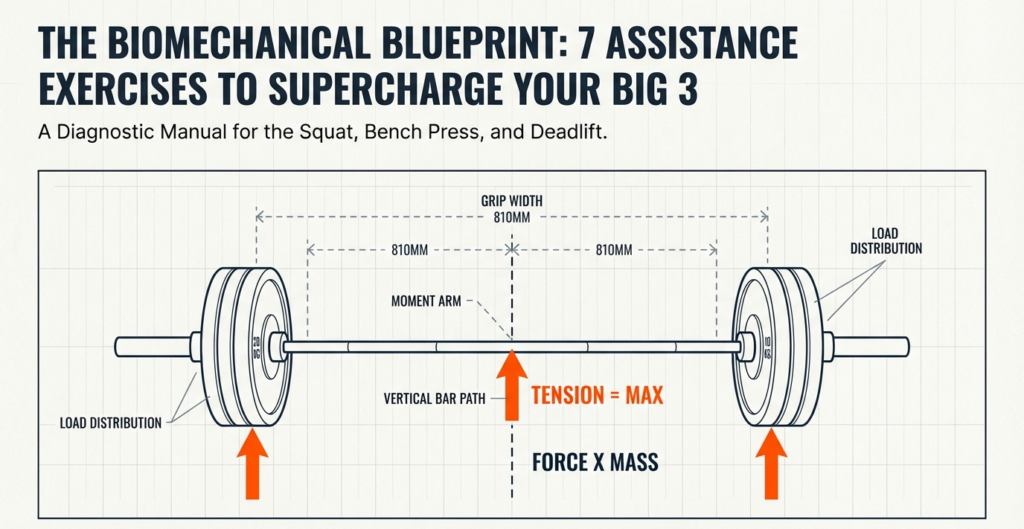
Biomechanical Blueprint for assistance exercises for big 3
Strength in the Big 3 starts with understanding mechanics, not just lifting heavier. This image highlights how bar path, load distribution, and tension influence performance in squat, bench press, and deadlift. Maximum tension occurs when the bar stays in an efficient vertical path, reducing energy leaks. Most lifters plateau because they ignore these fundamentals. When technique breaks down, force transfer becomes inefficient, leading to missed lifts. Mastering biomechanics ensures better stability, stronger execution, and long-term progress. Before adding more weight, fix how you move the weight.
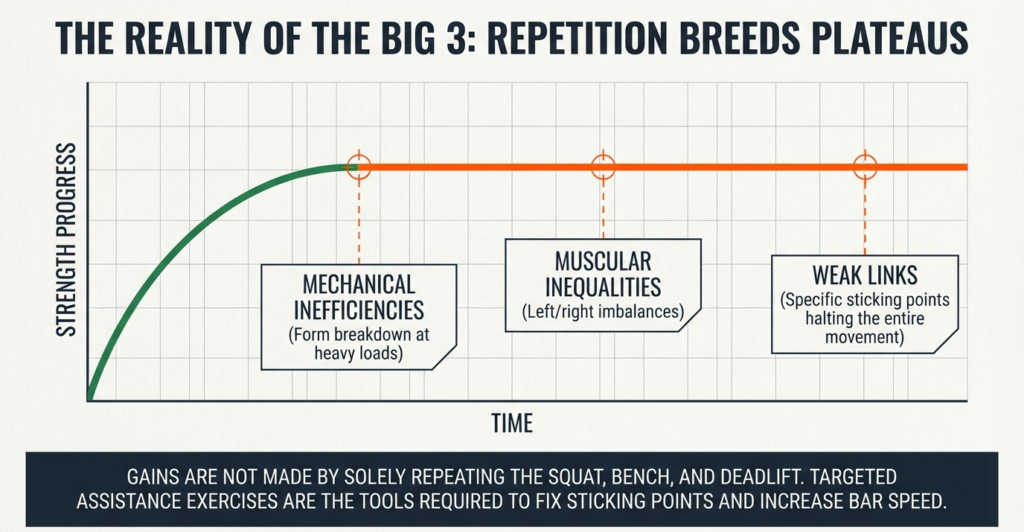
Why Big 3 Strength Plateaus Happen
This image explains why most lifters hit strength plateaus despite consistent training. Initially, strength increases rapidly, but progress slows due to mechanical inefficiencies, muscular imbalances, and weak points. Repeating the same lifts without addressing these issues limits long-term growth. Assistance exercises become essential here, as they directly target sticking points and improve movement quality. Instead of blindly adding weight, smart lifters identify what’s holding them back. Fixing weaknesses allows continued progression and prevents stagnation in the Big 3.
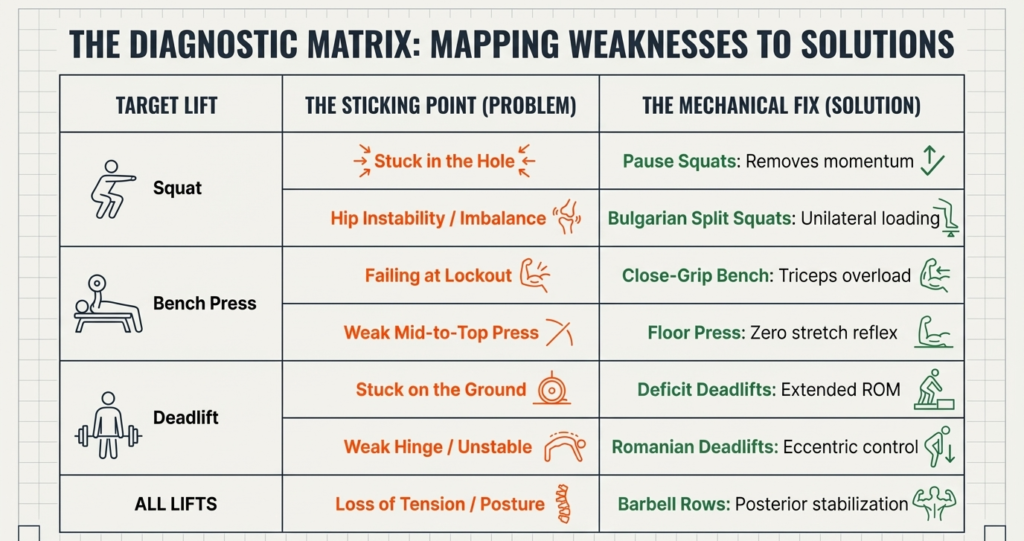
Big 3 Weakness to Solution Matrix
The diagnostic matrix is your roadmap to breaking strength plateaus. It connects specific problems in squat, bench press, and deadlift with targeted assistance exercises. For example, being stuck in the squat hole requires pause squats, while weak lockout in bench demands close-grip pressing. This structured approach removes guesswork and ensures every exercise has a purpose. Instead of random training, you focus on solving real limitations. This is how smart programming transforms effort into measurable strength gains.
Squat Assistance Exercises for Strength and Balance
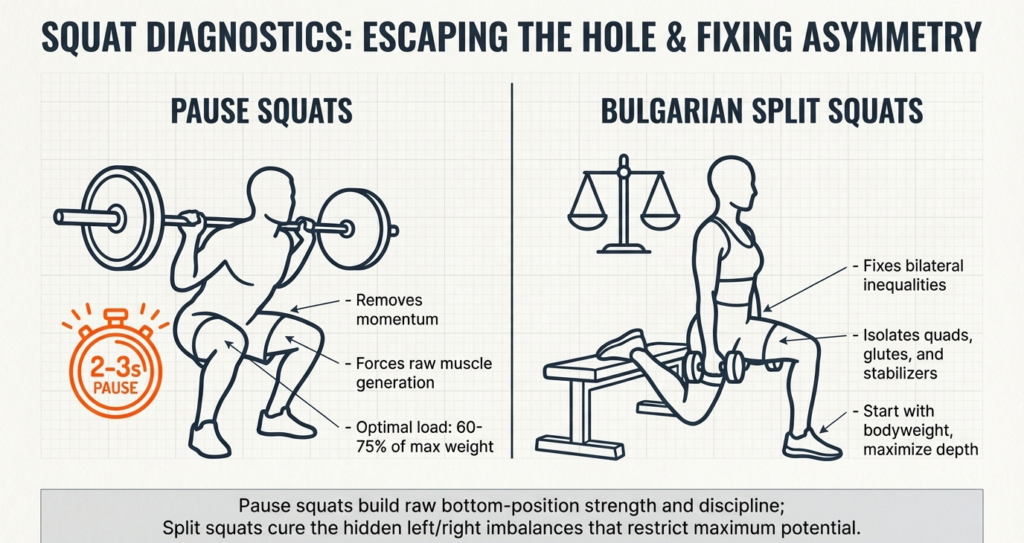
Squat performance often fails due to weak bottom position strength or imbalance between legs. Pause squats eliminate momentum and force your muscles to generate power from a dead stop, building raw strength in the hole. Bulgarian split squats, on the other hand, correct left-right imbalances and improve stability. Together, they create a stronger, more balanced squat foundation. If your squat feels unstable or weak at depth, these exercises directly address the issue and improve overall control.
Pause Squats:
Squats in the form of a pause are savagely practical in developing crude strength and discipline. Stopping at the bottom of the squat in 2-3 seconds, you remove the momentum and explain the fact that your muscles have to generate force since it stops.
This also enhances the weakest point of your squat which is the hole. It also improves core stability and positioning that is reflected in the improved bar control in heavy lifts.
In case you have a problem in collapsing in position of bottom or losing tightness, pause squats will correct that in no time. The control of the pause, the tightness and the intentional explosion are to be controlled.
Bulgarian Split Squats:
This single action movement is a game-changer towards correcting imbalances and strengthening of legs. Bulgarian split squats are individual therapy to the quads, the glutes and the stabilizing muscles.
In case one of the legs is weaker than the other (as it is a very common case), it will restrict your squat and deadlift potential. This practice makes both legs work separately, which remedies asymmetries.
It also enhances stability, coordination and hip stability. These advantages are directly transferred over to your large lifts.
Bring in your torso a little as well, to hit the glutes more, and get as deep as possible to get the greatest muscle activity. Begin with bodyweight (when necessary) this is not as easy as it may appear.
Best Bench Press Assistance Exercises
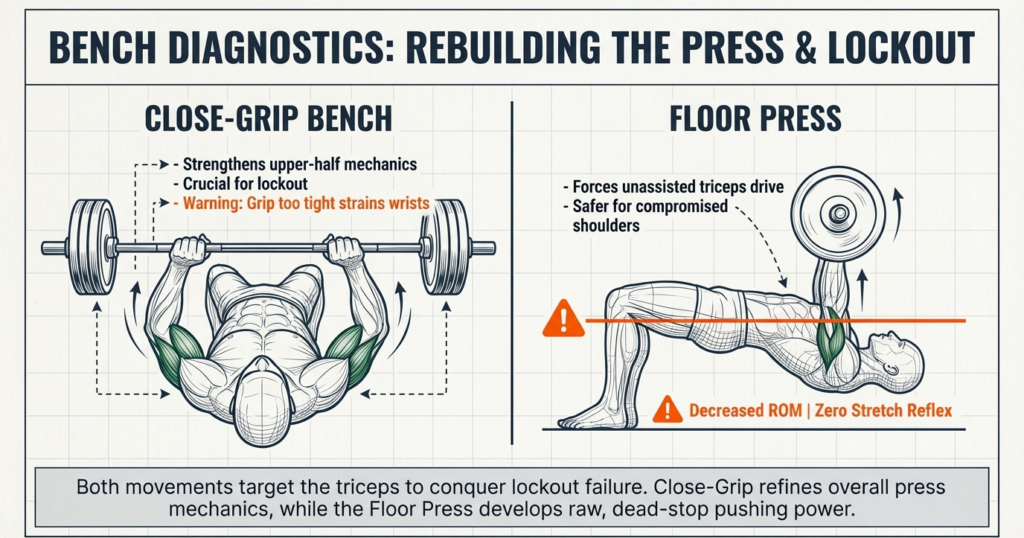
A weak bench press is often caused by poor lockout strength and underdeveloped triceps. Close-grip bench press shifts emphasis to the triceps, helping you push through sticking points at the top. Floor press further enhances this by removing momentum and forcing pure pressing power from a dead stop. These movements build stronger pressing mechanics while reducing shoulder strain. If your bench fails midway or near lockout, these assistance exercises are essential for consistent progress.
Close-Grip Bench Press:
When you get stuck on your bench press at a lockout point, especially close-grip bench press will be your friend. This difference changes the focus on the triceps although the chest and shoulders are involved.
Powerful triceps are required when it comes to pressing. You will never rise above your bench without them. Close grip bench will strengthen the upper half of the lift and enhance the general mechanics of the press.
Hold on to it a little less than shoulder breadth–not too tight, or you will strain your wrists. Keep in control as you descend and push the bar violently upwards.
The addition of this on a regular basis will give your normal bench much more strength.
Floor Press:
The floor press is a not so popular version of the bench press which dwells upon the stage of lockout. With your elbows on the ground, you have a decreased range of motion and you do not have the stretch reflex.
This puts a strain on your triceps and upper body to work without any kind of assistance and is thus a great exercise to enhance pressing strength.
It is very practical to the lifters who will have difficulties with the mid-to-top part of the bench press. It also causes less strain on the shoulders and therefore it is a safer option among people with the joint problems.
Drive down, stand a moment on the floor, and smash. With time you will see a more solid bench press.
Deadlift Assistance Exercises for Power and Stability
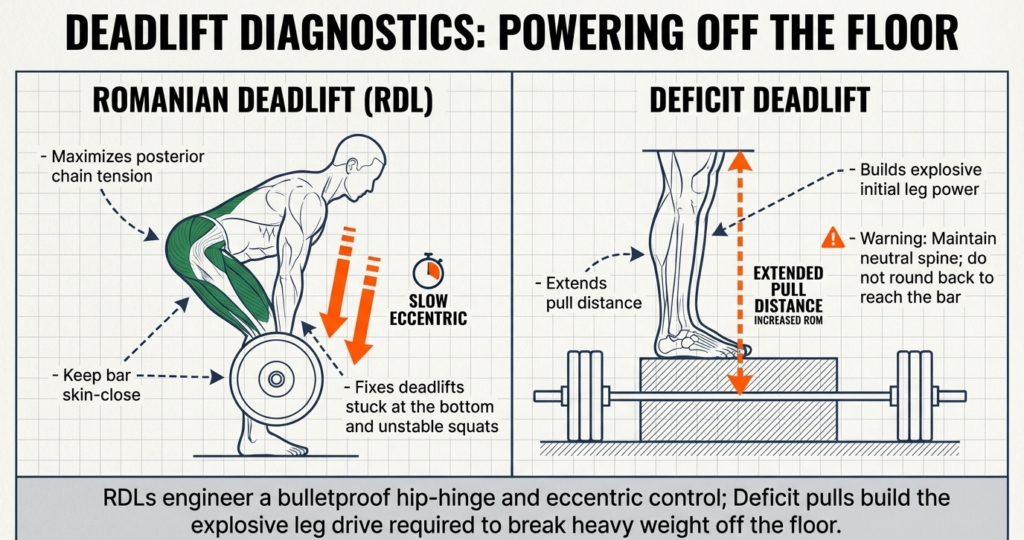
Deadlift struggles usually come from weak initial pull or poor posterior chain strength. Romanian deadlifts improve hamstring and glute control through slow eccentric movement, building a strong hinge pattern. Deficit deadlifts increase range of motion, making the first pull more powerful and explosive. Together, they strengthen the weakest phase of the lift—off the floor. If your deadlift feels stuck at the start, these exercises will significantly improve your pulling power and technique.
Romanian Deadlift (RDL):
Romanian Deadlift is one of the assistive exercises that can best help to develop the posterior chain strength. It mainly works hamstrings, glutes, and lower back which are some of the main muscles during deadlifts as well as squats.
RDLs also focus on controlled eccentric movement unlike conventional deadlifts. This aids in enhancing muscle tension and strengthens good hip hinge mechanisms. When your deadlift is stuck on the ground on the bottom, or when your squat is unstable, it is not uncommon to have weak hamstrings.
Pay attention to slow negatives and keeping the bar as close to your body as possible. Bending your knees too much is not a squat. Against RDLs conformity will also greatly enhance the lockout and minimize risk of injury.
Go with moderate weight (60-75 percent of your maximum weight) and technique and not ego lifting.
Deficit Deadlifts:
The difference between deficit deadlifts and deficit ones is that the former stands on a small platform, which extends the scope of movement. This causes the first pull out of the floor to be more difficult.
This is also one of the best exercises but the ground level deadlift is struggling is giving you a hard time. It develops power in the initial position and enhances power in the leg.
It is all a matter of form, and you can’t hump your back to pick up and carry more. Begin with a light movement and aim at keeping tightness during the movement.
The improvement in your deadlift will result in the overall improvement of your pull as you will observe the improvement in the weakest of your deadlift.
Barbell Rows for Total Back Strength
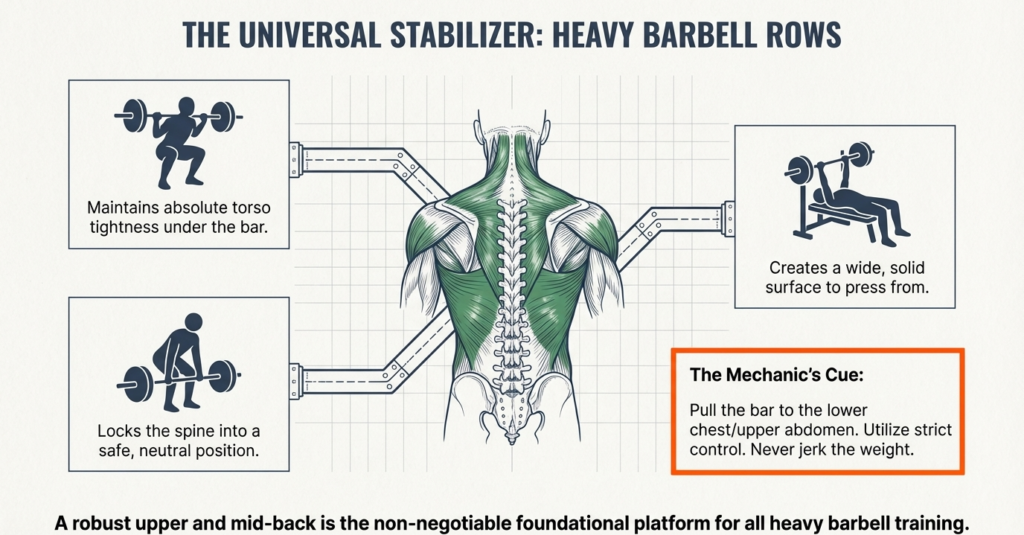
A strong back is the foundation of all Big 3 lifts, and barbell rows play a crucial role in building it. This exercise strengthens the upper and mid-back, ensuring better posture and stability under heavy loads. It helps maintain a neutral spine in deadlifts, improves tightness in squats, and creates a solid base for bench press. Without a strong back, your performance in all lifts will suffer. Heavy, controlled rows enhance overall strength and lifting efficiency.
Smart Programming for Assistance Exercises
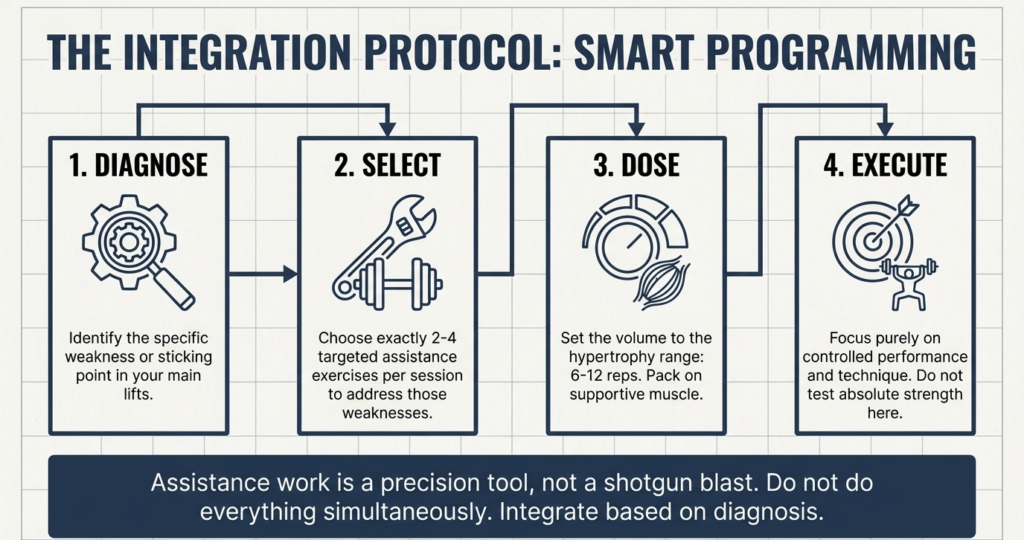
This image highlights the importance of smart programming when using assistance exercises. Instead of doing everything, you should diagnose your weakness, select 2–4 targeted movements, apply proper volume, and execute with control. Training in the hypertrophy range (6–12 reps) builds muscle and supports your main lifts. Assistance work is not about lifting maximum weight but improving technique and muscle development. A structured approach ensures consistent progress without unnecessary fatigue.
Common Assistance Training Mistakes to Avoid
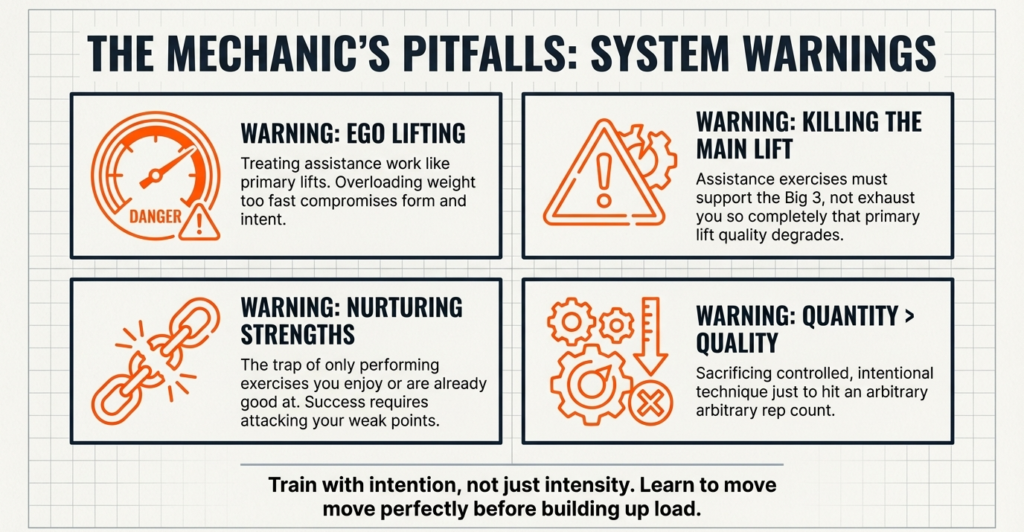
Many lifters fail to progress because they misuse assistance exercises. Ego lifting, poor technique, and focusing only on favorite movements limit results. Assistance work should support your main lifts, not exhaust you before them. Ignoring weak points is another major mistake that leads to imbalances and stalled progress. Quality always matters more than quantity. Training with intention, control, and proper form is the key to long-term strength and injury prevention.
Complete Blueprint to Improve Your Big 3
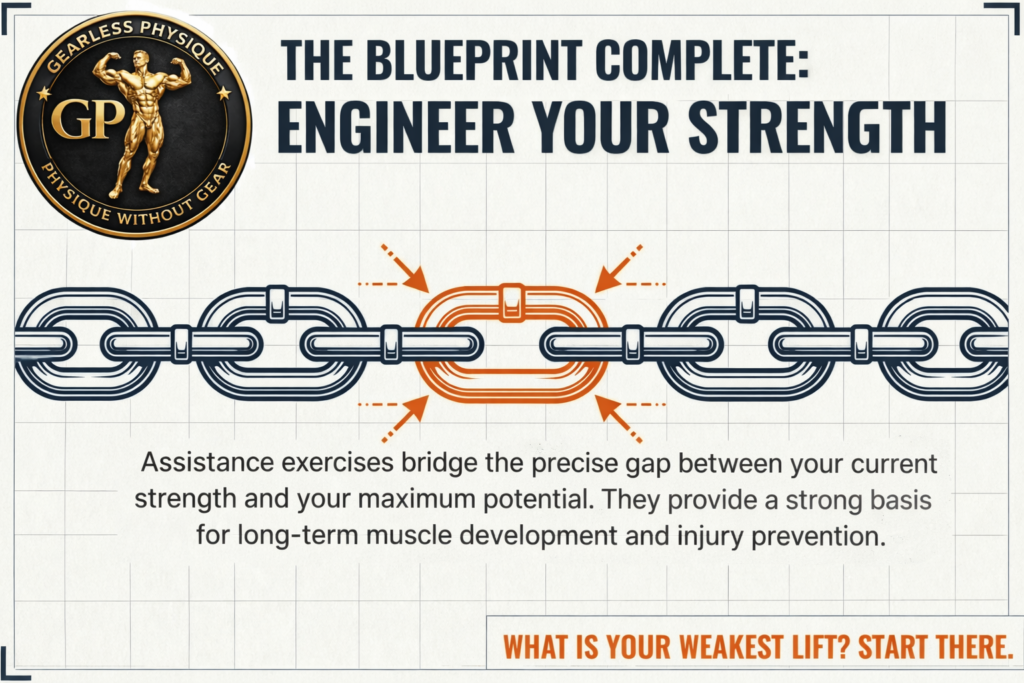
This final image represents the complete strength blueprint—assistance exercises bridging the gap between your current level and peak performance. Each movement plays a role in fixing weaknesses, improving stability, and building muscle. When combined with smart programming, they create a powerful system for long-term progress. Strength is not built by lifting randomly but by training with purpose. Identify your weakest lift, apply the right assistance work, and consistently improve your performance in the Big 3.
Read more: https://www.mensfitness.com/training/lift-big-the-best-assistance-exercises

Gearless Physique
Physique Without Gear
Your transformation starts now. Who's with me?