The 12-Weeks Proven Powerlifting Training Plan for Beginners
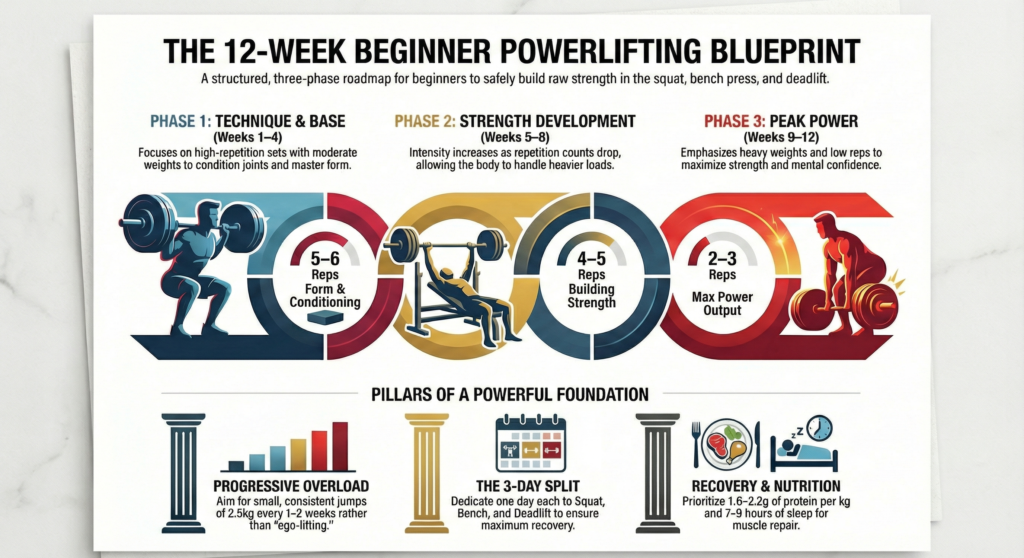
This infographic presents a clear and structured 12-week beginner powerlifting blueprint designed to build strength efficiently and safely. The program is divided into three progressive phases, starting with technique and base strength, followed by strength development, and finishing with peak power training. Each phase focuses on improving performance in the three core lifts—squat, bench press, and deadlift—while gradually increasing intensity and reducing volume. It also emphasizes essential pillars like progressive overload, proper recovery, and balanced nutrition. This visual guide helps beginners stay consistent, track progress, and develop confidence while building a solid foundation for long-term strength and performance.
Foundation of powerlifting
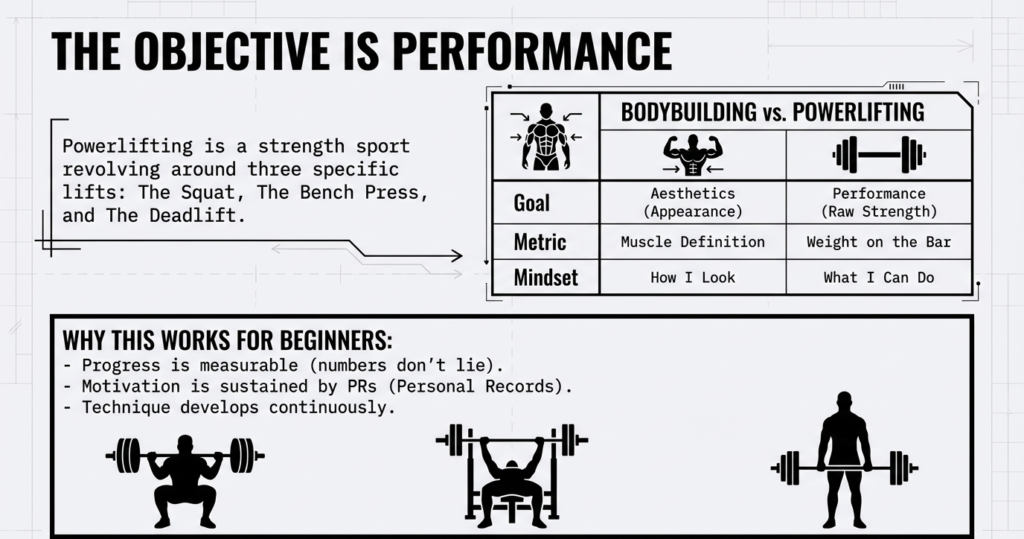
The possibility to gain raw strength and muscle mass and also mental toughness is considered to be one of the most effective ways to gain power lifting. Powerlifting is performance-oriented, as compared to bodybuilding which is appearance-oriented. The objective is straightforward, become stronger in squat, bench press, and dead lift. This is the right approach to start with as a beginner since one can measure progress, motivation will not decrease, and technique will continuously develop.
The 12 weeks of powerlifting training is specific to individuals, who are beginners and wish to gain a strong base without exhausting or injuring themselves. There is no need to have sophisticated equipment or tools, only consistency, patience and intelligent programming.
What Is Powerlifting?
Powerlifting is a strength sport which revolves around three lifts: squat, bench press and deadlift. The athletes are competing on how much weight to lift during a given lift. Training is all about enhancement of strength, technique, and recovery. To novices, powerlifting would not be about pushing to the limit each training session. It is the learning of proper form, strengthening of the joints and the gradual addition of weight as time goes by. Such a systematic development renders powerlifting more tolerable and sustainable as compared to ad hoc training programs.
The Rationale of Training on Powerlifting as a beginner
The biggest mistake people who are starting out make is failing to train in a structured manner. They are lifting heavy one day, skipping workouts the next and doing switch exercises. This causes sluggish development and the likelihood of injury is high.
A training program that follows a methodology eliminates speculation. It dictates what you should raise, how much you should raise and when to relax. It also maintains intensity and volume in a manner that your body becomes used to it. You will gain strength, confidence and discipline and you won’t go through plateaus over a period of 12 weeks.
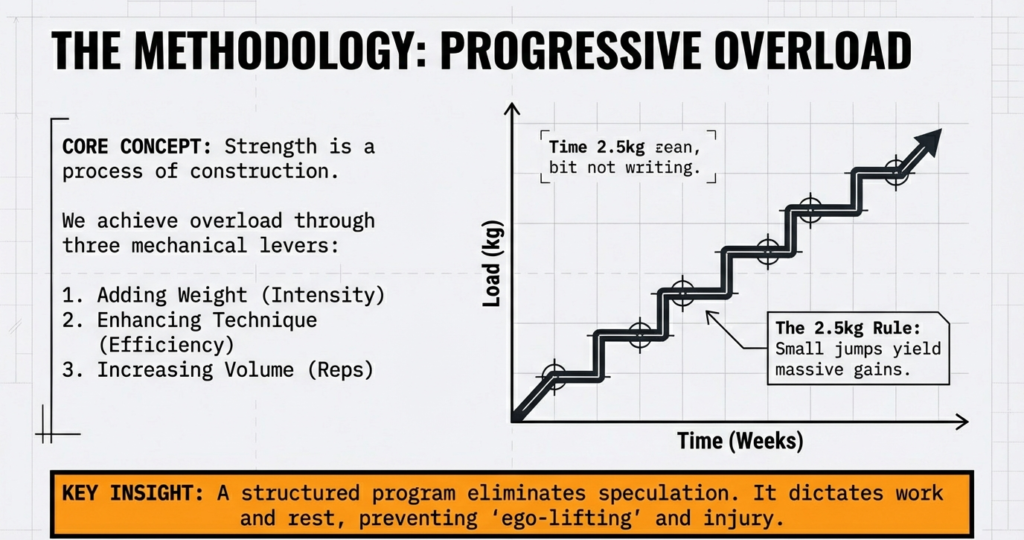
The Methodology: Progressive Overload
The powerlifting relies on progressive overload. It is a process of slowly building up on your muscles. Overload in this program is attained by either adding light weights, enhancing technique or high reps. Novices do not require rough jumps. Adding 2.5 kg to a lift in 1-2 weeks or so makes enormous gains within 12 weeks. The program is broken into stages to ensure that your body does not degenerate.
The master schedule: 12-weeks Timeline
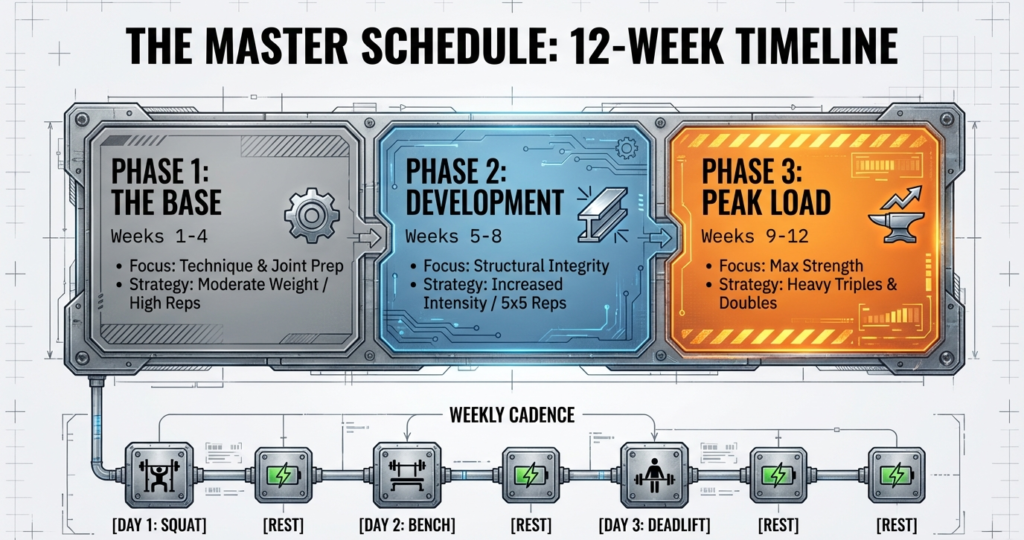
This master schedules a 12-weeks powerlifting plan that is made to gain strength safely and in a progressive manner. The program consists of 3 distinct stages:
- Phase 1 during which the focus is made on technique mastery and preparing the joints with the use of moderate weights and increased reps.
- Phase 2 goes up in intensity to gain strength and resilience in structural form using favorite rep schemes, such as 5×5.
- Phase 3 is focused on peak loading with heavy doubles and triples to maximize the strength and the confidence.
The optimal promotion of performance improvements in beginners includes a balanced weekly routine, squat, bench press, and deadlift days to guarantee the optimal rest and consistency.
This novice powerlifting workout schedule constitutes a 3-day training division permitting sufficient rest between meetings. Every exercise focuses on a primary lift and supplements it with accessory exercises.
Weekly Structure:
- Day 1: Squat Focus
- Day 2: Bench Press Focus
- Day 3: Deadlift Focus
This division makes training easy, no overtraining, and you are not exhausted after heavy compound training. Intervals between sessions are necessary in terms of strength.
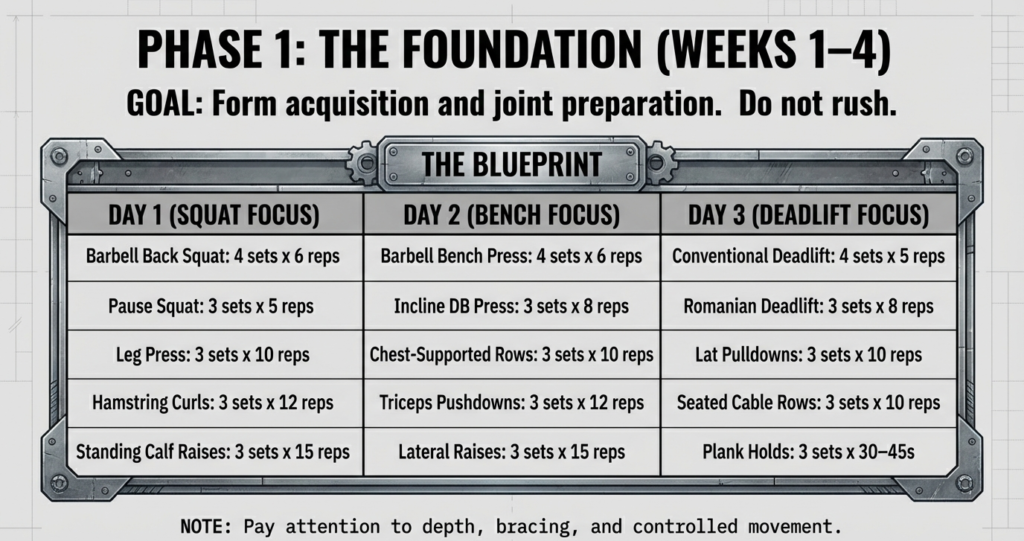
Phase 1: Weeks 1-4 (Technique & Base Strength)
The initial four weeks are devoted to the proper form and the development of the basic strength. The weights are moderate, the number of reps is higher, and the periods of rest are regulated.
This step gets your joints, tendons and nerves ready to carry heavier loads in the future. Novices can always be in a hurry to pass this step, yet, it is a step that can position you towards the long term success.
Day 1 – Squat Focus (Weeks 1–4)
- Barbell Back Squat: 4 sets × 6 reps.
- Pause Squat: 3 sets × 5 reps.
- Leg Press: 3 sets × 10 reps.
- Hamstring Curls: 3 sets × 12 reps.
- Standing Calf raises: 3 sets x 15 reps.
Pay attention to depth, bracing and controlled movement. Do not lose 2-3 reps on any squat sets.
Day 2 – Bench Press Focus (Weeks 1–4)
- Barbell Bench Press: 4 sets x 6 reps.
- Dumbbell Press on Incline: 3 sets x 8 reps.
- Chest-Supported Rows: 3 sets x 10 reps.
- Triceps Pushdowns: 3 sets × 12 reps.
- Lateral Raises: 3 sets × 15 reps.
Take a moment rest on the chest to strengthen the correct technique and control in bench press.
Day 3 – Deadlift Focus (Weeks 1–4)
- Conventional Deadlift: 5 reps x 4 sets.
- Romanian Deadlift: 3 sets × 8 reps.
- Lat Pulldowns: 3 sets × 10 reps.
- Seated Cable Rows: 3 sets × 10 reps.
- Plank Holds: 3 sets × 30–45 seconds.
Maintain a straight back and put more emphasis on the ideal positioning on any dead lift reps.
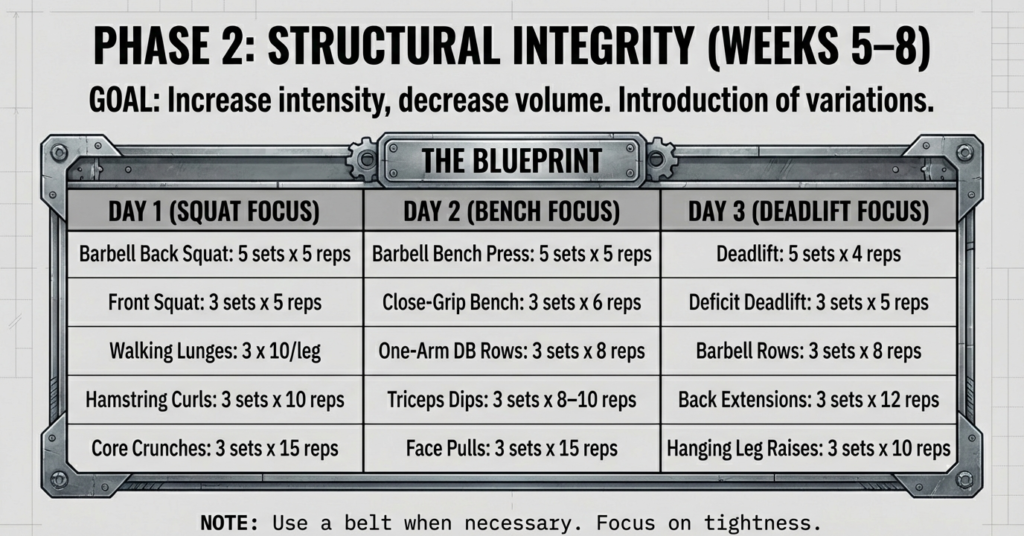
Phase 2: Weeks 5-8 (Development of Strengths)
At this stage, the amount is reduced slightly and the intensity gains. You will be able to move heavier weight using the lesser number of reps and strength will build gradually. The intervals of rest are increased, and the technique is kept in mind. It is here that novices begin to feel much more powerful and relaxed under the bar.
Day 1 – Squat Focus (Weeks 5–8)
- Barbell Back Squat: 5 sets × 5 reps.
- Front Squat: 3 sets × 5 reps.
- Walking Lunges: 3 rounds + 10 reps each leg.
- Hamstring Curls: 3 sets × 10 reps.
- Core Crunches: 3 sets × 15 reps.
Gain weight slowly and never give up on depth or posture.
Day 2 – Bench Press Focus (Weeks 5–8)
- Barbell Bench Press: 5 sets x 5 reps.
- Close-Grip Bench Press: 3 sets x 6 reps.
- One-Arm Dumbbell Rows: 3 sets x 8 reps.
- Triceps Dips: 3 sets x 8–10 reps.
- Face Pulls: 3 sets × 15 reps.
Play the bar circulation and not to bang the bar against your chest.
Day 3 – Deadlift Focus (Weeks 5–8)
- Deadlift: 5 sets × 4 reps.
- Deficit Deadlift: 3 sets × 5 reps.
- Barbell Rows: 3 sets × 8 reps.
- Back Extensions: 3 sets × 12 reps.
- Hanging Leg Raises: 3 sets × 10 reps.
Wear a belt when necessary and concentrate on tightness each time of pulling
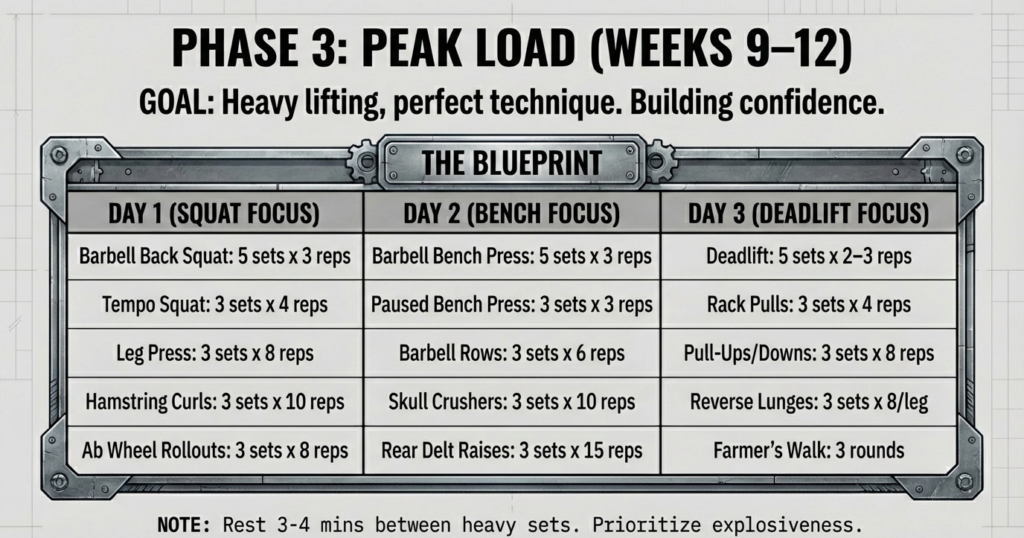
Phase 3: Weeks 9-12 (Peak Strength and Confidence)
The last stage incorporates heavier weights at reduced reps. This creates confidence and they are ready to undergo further stages of testing.
You are not maxing out yet. The purpose is to perform heavy lifting with a perfect technique. This stage entrenches gains of strength and enhances mental concentration.
Day 1 – Squat Focus (Weeks 9–12)
- Barbell Back Squat: 5 sets × 3 reps.
- Tempo Squat: 3 sets × 4 reps.
- Leg Press: 3 sets × 8 reps.
- Hamstring Curls: 3 sets × 10 reps.
- Ab Wheel Rollouts: 3 sets × 8 reps.
The best rest period should be 3-4 minutes between sets of squats.
Day 2 – Bench Press Focus (Weeks 9–12)
- Barbell Bench Press: 5 sets x 3 reps.
- Paused Bench Press: 3 sets × 3 reps.
- Barbell Rows: 3 sets × 6 reps.
- Skull Crushers: 3 sets × 10 reps.
- Rear Delt Raises: 3 sets × 15 reps.
Keep tight on bench and keep steady bar speed.
Day 3 – Deadlift Focus (Weeks 9–12)
- Deadlift: 5 sets × 2–3 reps.
- Rack Pulls: 3 sets × 4 reps.
- Pull-Ups or Pull-downs: 3 sets x 8 reps.
- Reverse Lunges: 3 sets x 8 reps each leg.
- Farmer’s Walk: 3 rounds.
Pay attention to explosiveness without technique.
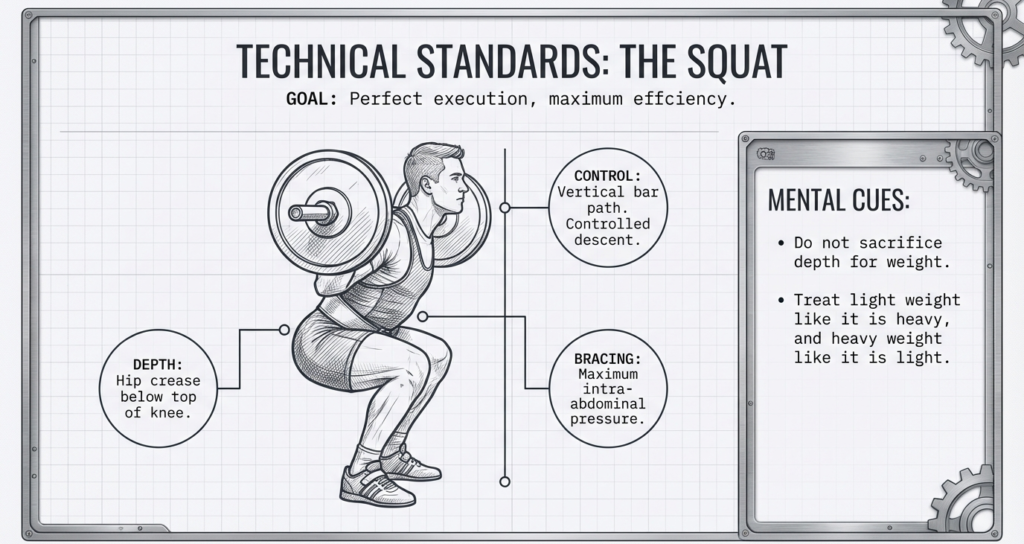
Technical standards: The Squat
This technical standards guide outline indicates the main components that should be involved in the safe and efficient powerlifting squat. When the hip crease goes beneath the top of the knee with proper depth, it is a sign of full range of movements. A downward bar route with vertical movement enhances the balance and consistency. During load, good bracing is beneficial with the provision of good intra-abdominal pressure that stabilizes backbone.
Mental cues are important as they remind the lifters to focus on depth and technique rather than on heavier weights. As one masters these fundamentals, there is confidence, strength transfer and less risk of injury as the intensity of training increases with time.
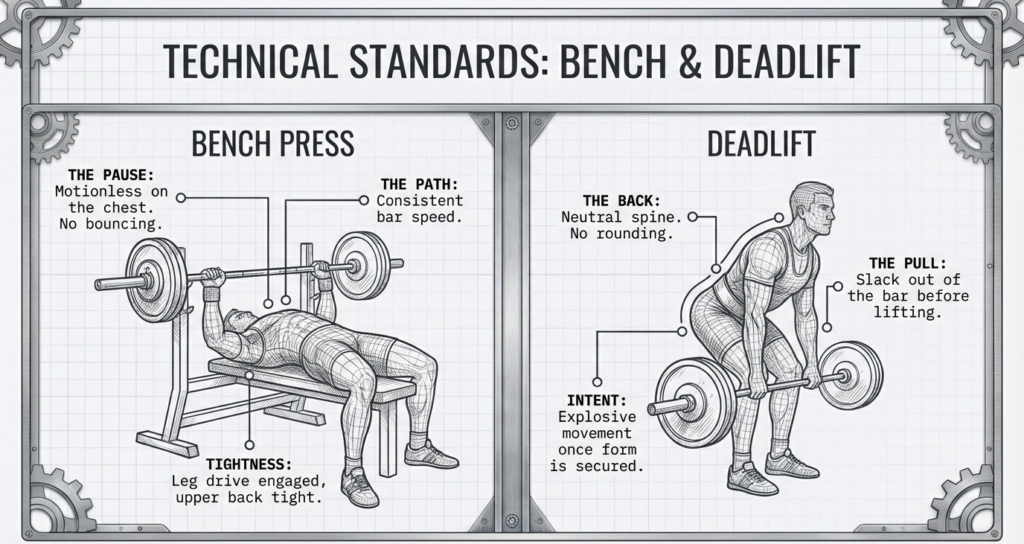
Technical standards: Bench & Deadlift
This is the overview of technical standards of the proper bench press and deadlift to achieve safe and effective gains in strength. In bench press, stopping the bar at the chest without any movement is a way of getting rid of bouncing and developing control, and a steady bar movement is also a way of improving efficiency. Feeling tightness in the entire body with help of the leg drive and upper-back involvement enhances stability at the time of loading.
In the case of the deadlift, the spine should be in a neutral position to ensure the lower back is secured and the most amount of force is absorbed. The tension and power are achieved by removing slack off the bar prior to lifting. A controlled pull, which is explosive, once the form is established, will guarantee development of strength without risking avoidable injury.
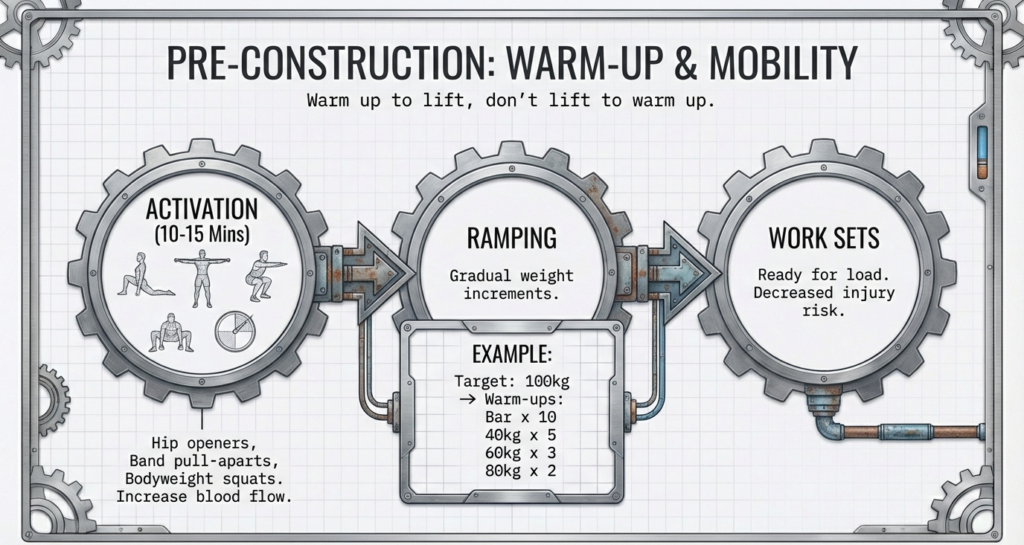
Pre-Construction: Warm-up & Mobility
Warm-Up and Mobility Appendices. Warm up first then lift. Warm-up enhances performance and decreases the risk of injury. Take 10-15 minutes of mobility and activation exercises. Apply dynamic exercises such as hip openers, band pull-apart and body weight squats. Warm-up sets should be gradual increments of weight in your working sets. Do not jump immediately to heavy loads especially when you are a beginner.
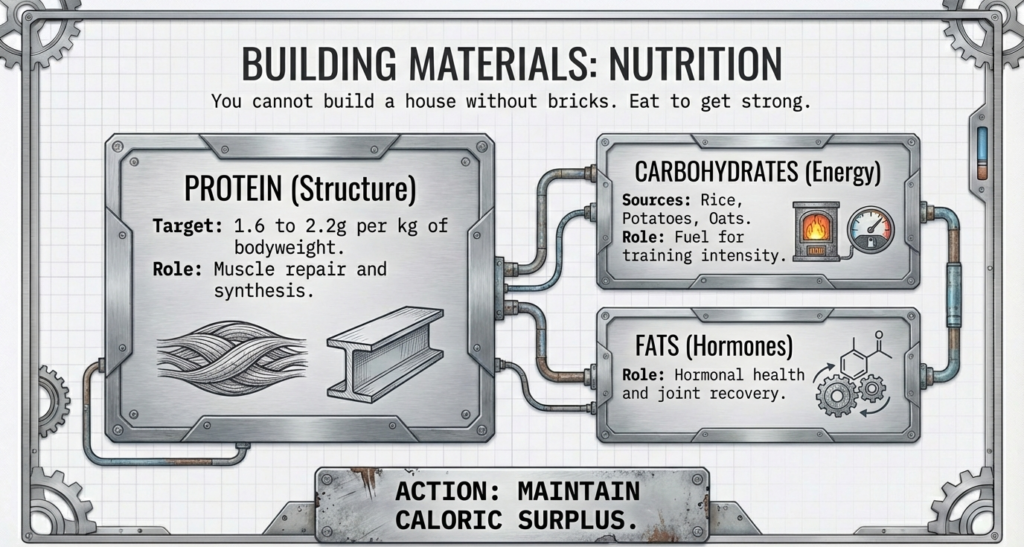
Building Materials: Nutrition
You need to eat enough in order to get strong. Due emphasis on items that are rich in proteins, complex carbohydrates, and healthy fats. Goal of 1.6- 2.2 grams of protein per kilo of bodyweight. Carbs provide energy to training, hence there is no need to be afraid of rice, potatoes, and oats. The right nutrition helps recover faster and build muscles and perform regularly during the 12 weeks.
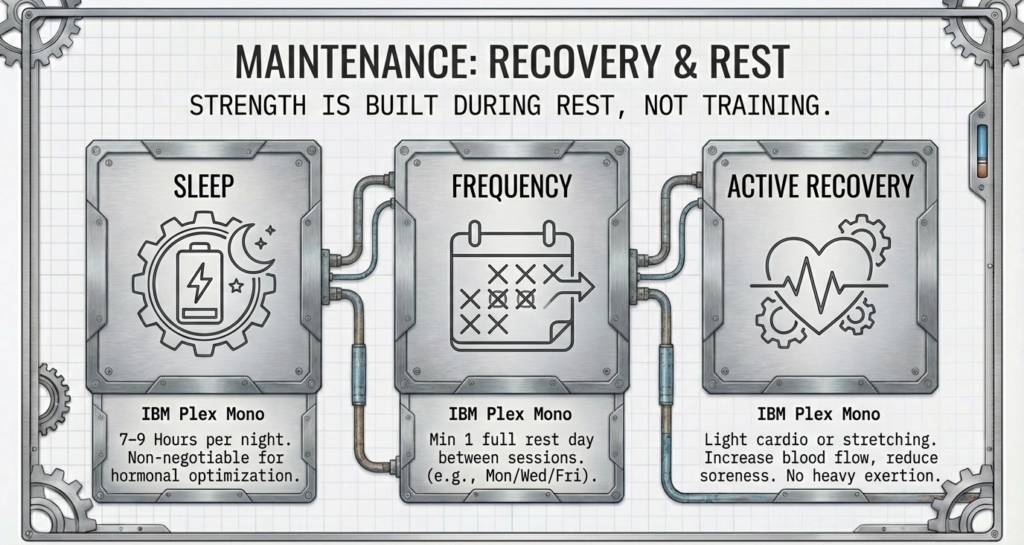
Maintenance: Recovery & Rest
It is during recovery, and not training, that strength is built. The objective should be at least one rest day between sessions. Get 7 -9 hours sleep per night and be well-hydrated. Light aerobic, stretching, or yoga on rest days may enhance the circulation of blood and alleviate pain. Shun strenuous cardio which disrupts recovery. Pay attention to the body and change in case of fatigue.
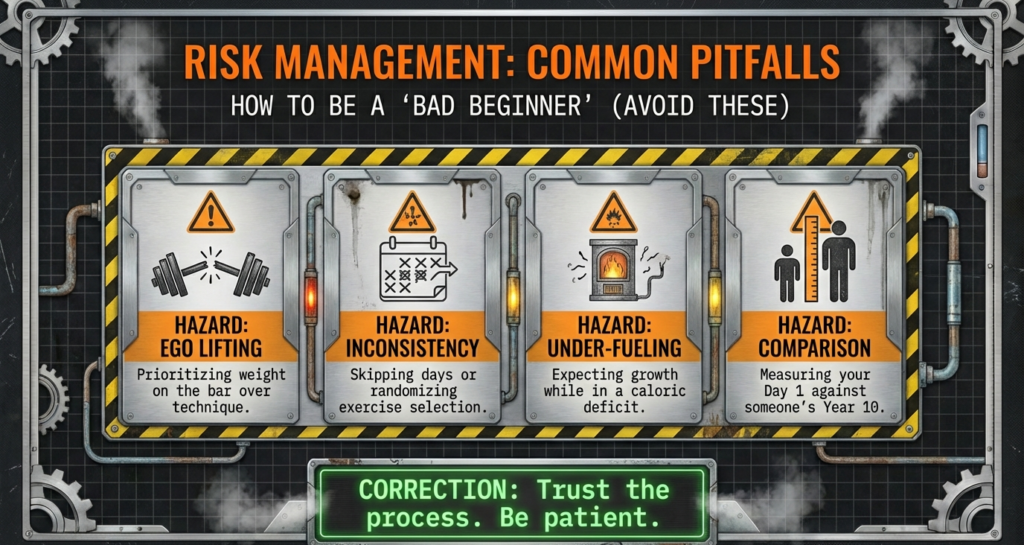
Basic Ways to be a bad beginner (Avoid these)
Numerous amateurs hurry up the progress, ego-raise, or omit in recovery. Don’t over charge your credit card too often and do not compare yourself with the high-level lifters. The greatest killers of progress are poor technique, incomplete training and under-eating. Keep going, have faith in the process, and be ready to be modest in terms of gradual change instead of immediate outcomes.
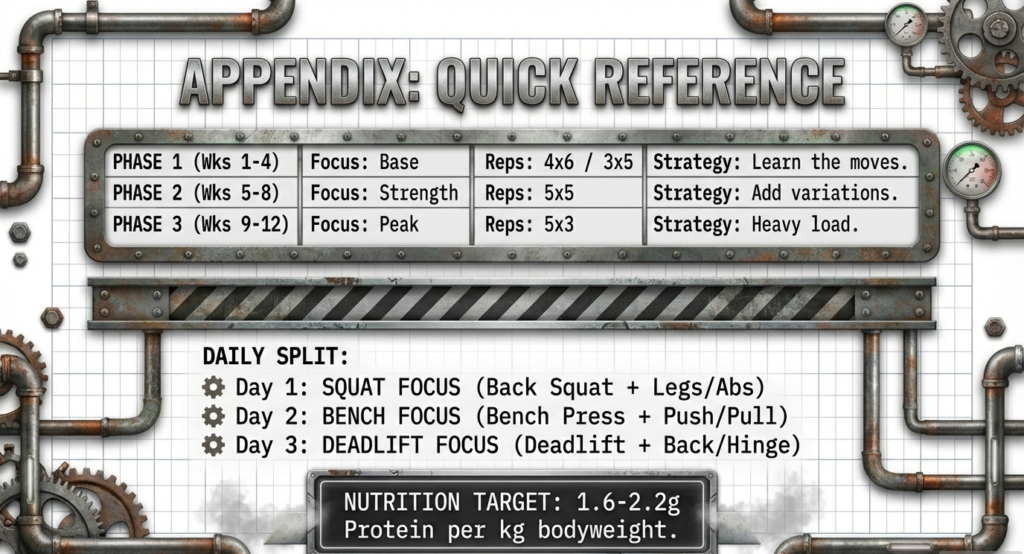
Appendix: Quick Reference
This reference handbook is a concise summary of the whole 12-week beginner powerlifting program in a simplified and easy to digest manner. It divides training into 3 progressions that include:
- Phase 1: that forms a technical foundation,
- Phase 2: that is concerned with developing strength, and
- Phase 3: that targets peak loading that incorporates heavier weights.
The split per day produces a clear division of one primary lift per session such as squat, bench press, and deadlift that provide the possibility of specialized training and adequate rest. Each phase has Rep schemes and strategies as outlined in order to remove the guesswork. Clear nutrition goal reinforces the need to have sufficient protein consumption to promote muscle development, recovery, and long-term strength development.
Final Thoughts
This 12-weeks powerlifting program provides a beginner with an exact map to gain actual strength in a safe manner. With proper basics, gradual advancement and rest, you will come out a confident and permanent lifters. Rewards of powerlifting are patience and discipline. Always stay the same, adhere to simple things, and you will come out of these 12 weeks better and stronger than you were at the beginning, both physically and psychologically.

Gearless Physique
Physique Without Gear
Your transformation starts now. Who's with me?