Table of Contents
Toggle7 -Step Calorie Calculation Guide for Bulking & Cutting (2026)
This infographic presents “Precision Nutrition 2026: The 7-Step Calorie Blueprint,” offering a structured approach to optimizing diet for muscle gain or fat loss. It begins with calculating Basal Metabolic Rate (BMR) using the Mifflin-St Jeor equation, then adjusting for activity level to determine total daily energy expenditure (TDEE). Based on goals, users select a calorie surplus or deficit for bulking or cutting. The plan emphasizes prioritizing protein (1.6–2.4 g/kg) and fats for hormonal health, while using carbohydrates to fuel performance. A two-week audit system helps track progress and adjust intake if needed. Overall, it promotes a data-driven, adaptable strategy for effective and sustainable body composition changes.

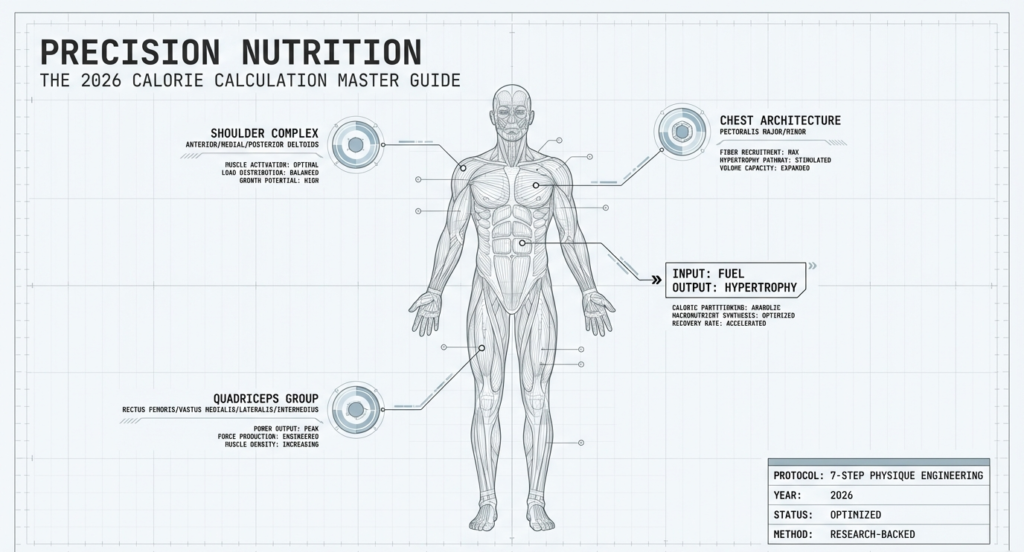
Precision Nutrition
This is an image that gives a scientific roadmap of exact nutrition in 2026 that incorporates anatomical drawing and engineered calories. It is the central human figure that symbolizes the physique as a system, in which the intake of fuel, which has been calculated, has a direct effect on hypertrophy and performance. Technical design elements, labelled muscle groups and structured callouts all help to support a research-based approach not a guesswork. The way of transformation is highlighted in the graphic: input = fuel, output = growth.
The visual communicates that the development of the physique is a calculated process with references to the protocol structure, optimization, and quantifiable outcomes. It points out that a disciplined method of calculating calories and accuracy of macronutrients is the basis of consistent muscle growth and performance enhancement.
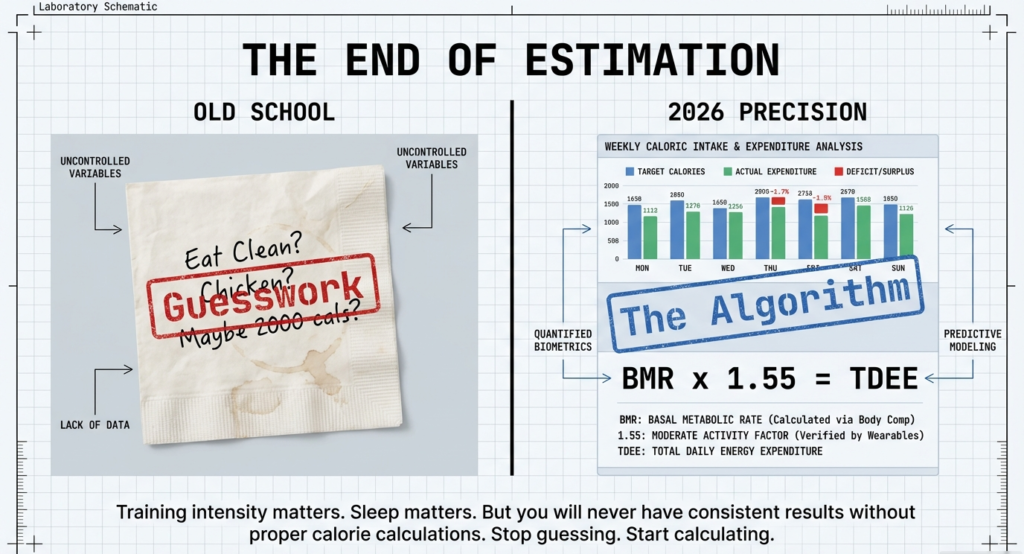
The End of estimation
This picture is the comparison between ancient-calorie guesswork and the present day precision-based nutrition. On the left, the Old School strategy emphasizes variables that are not in control, missing data, and indistinct judgments such as eat clean or maybe 2000 calories in an irregular and randomly changing outcome. To the right, the 2026 accuracy model adds quantified biometrics, weekly intake monitoring, and predictive modeling with systematic formulas such as the product of BMR and activity level to calculate TDEE.
It is easy to understand: the training and sleep are essential, and on the wrong calorie calculations, progress is a randomized affair. The visual underlines that the regular improvement of physique needs data, measurement, and algorithm-based changes instead of assumptions and estimation.
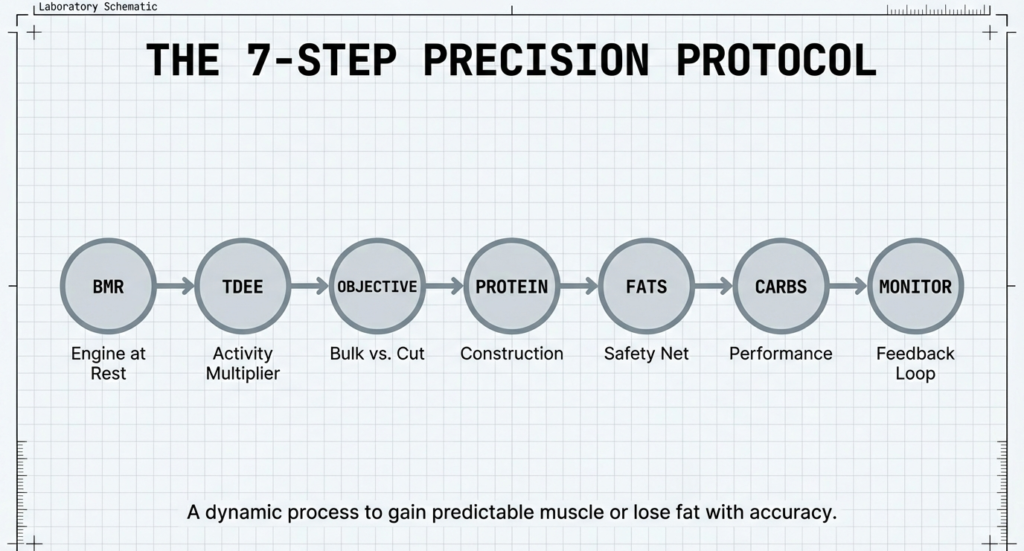
The 7-step precision protocol
This image outlines a structured 7-step precision protocol for calculating calories and optimizing physique results. It visually presents nutrition as a logical sequence beginning with BMR, the body’s engine at rest, followed by TDEE through an activity multiplier. From there, the objective is defined—bulk or cut—before locking in protein for muscle construction and fats as a hormonal safety net. Carbohydrates are then allocated to fuel performance, and the final step emphasizes monitoring progress through a feedback loop.
The design reinforces that physique transformation is not random but systematic, highlighting that consistent muscle gain or fat loss requires calculated adjustments and disciplined tracking.
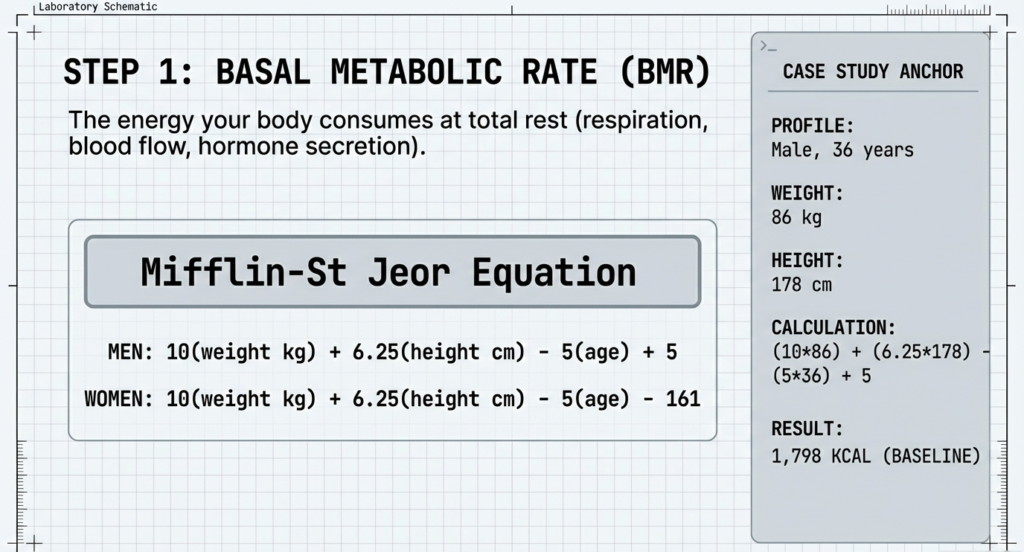
Step 1: Determine Your Basal Metabolic rate (BMR)
The amount of calories your body consumes at total rest is referred to as your Basal Metabolic Rate (BMR). It addresses the fundamental processes such as respiration, blood flow, secretion of hormones, and organism activity.
The most valid contemporary equation is the Mifflin-St Jeor equation that is more precise than older ones on the majority of individuals.
For men:
BMR = 10(weight in kg) + 6.25(height in cm) -5(age) + 5.
For women:
BMR = 10 x weight/kg + 6.25 (height in cm) -5 (age) -161.
This gives you your baseline. However, be mindful of the fact that this is not your total calorie requirement, but only your resting requirement.
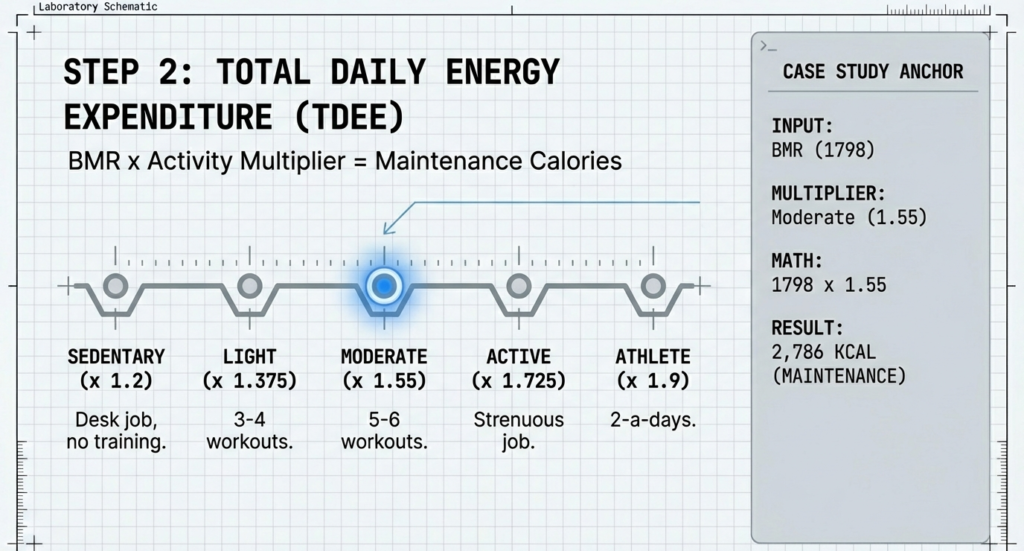
Step 2: Divide by Your Activity Level (TDEE)
This is now the calculation of Total Daily Energy Expenditure (TDEE). These involve physical activity, exercise and normal everyday living.
The following are the activity multipliers:
- Desk (no training, sedentary): × 1.2
- Lightly active (3-4 workouts/week): × 1.375
- Moderately active (5-6 workouts/week): × 1.55
- Active (strenuous training and vigorous work): × 1.725
- Athlete-level (2-a-day sessions): × 1.9
TDEE = BMR x Multiplier of the activity.
It is the level of maintenance calories that you are at, the level of calories at which your bodyweight remains constant.
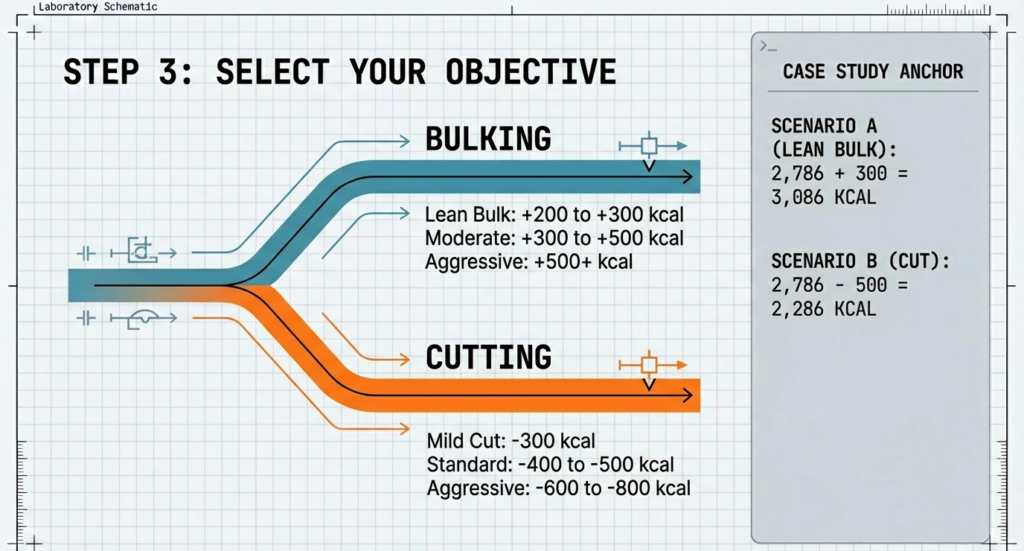
Step 3: Select Your Objective (Bulk or Cut)
Now it is your turn to choose your course.
For Bulking:
- Calorie surplus to your TDEE.
- Lean bulk: +200 to +300 kcal.
- Moderate bulk: +300 to +500 kcal.
- Aggressive bulk: +500+ kcal.
A lean excess is perfect when you desire good muscle, but minimal gain of fat.
For Cutting:
- Minus calories of your TDEE.
- Mild cut: −300 kcal.
- Standard cut: −400 to −500 kcal.
- Aggressive cut: −600 to −800 kcal.
Extreme deficits should not be made unless you are an experienced person and monitoring it closely.
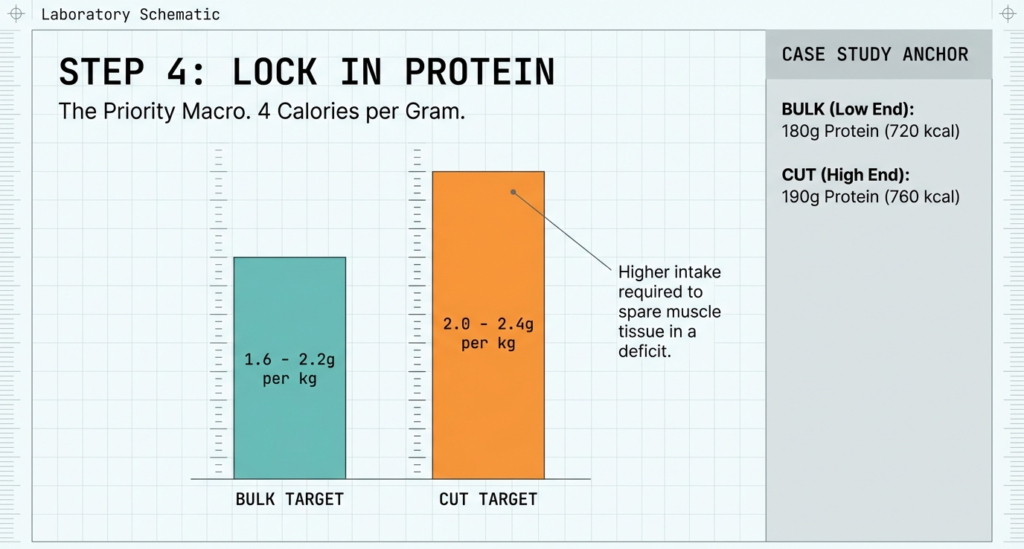
Step 4: Establish Your Introduction of Protein First
Protein is a prerequisite in bulking and cutting.
- Bulking: 1.62.2 grams of bodyweight.
- Cutting: 2.0- 2.4 grams of bodyweight.
In a cut, muscle mass is maintained by increased protein. But when in a bulk, it maximizes muscle protein synthesis.
For example, if you weigh 86 kg:
- Lean bulk protein: 150–180 gm.
- Cutting protein: 170–205 gm.
Divide the grams by 4 and multiply by 4 to get the protein calories.
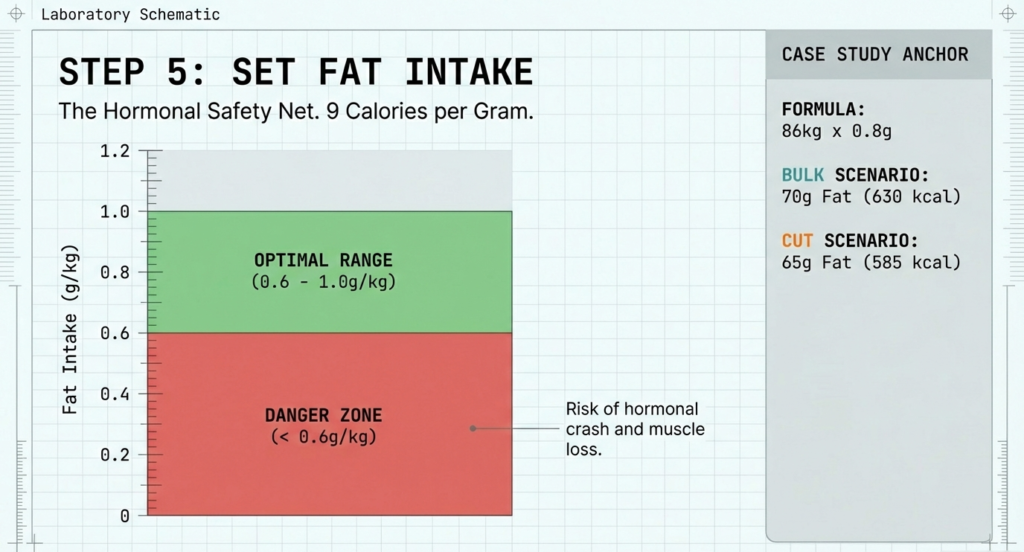
Step 5: Set Your Fat Intake
Fat promotes hormones, testosterone, recuperation, and nutrition.
General guidelines:
- 0.6–1.0 grams per kg bodyweight.
- Or 20–30% of total calories.
Do not get too low on cutting the fat. Crashes in hormones lower performance and retention of muscles.
Considering an example:
- Have a weight of 86kg and select a g/kg of 0.8: 86 × 0.8 = 69 g fat
Fat calories = grams × 9.
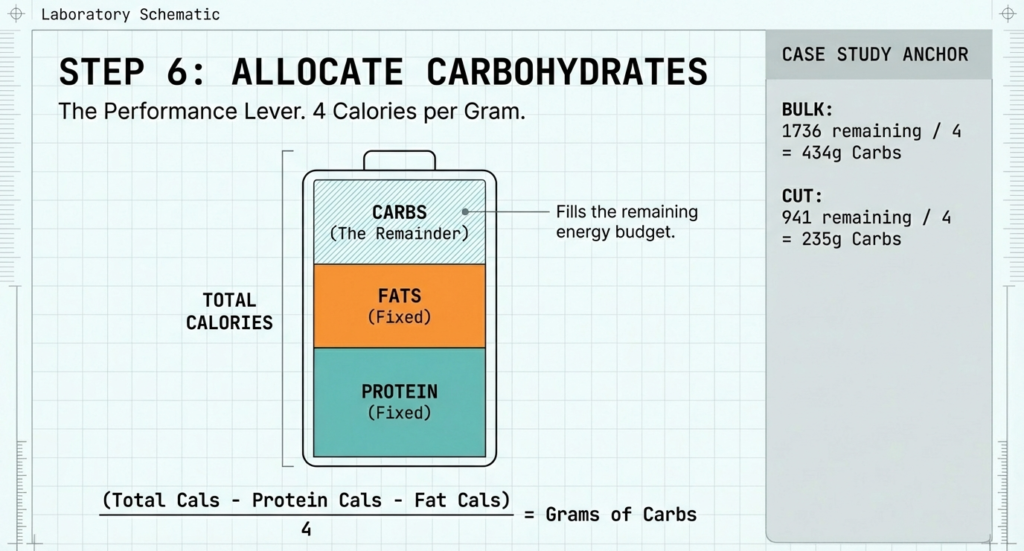
Step 6: Fill the Resting Calories with Carbohydrates
Once protein and fat have been established, the remaining calories are diverted to carbohydrates.
Carbs are critical for:
- Training performance
- Muscle fullness
- Recovery
- Hormonal balance
Carbs = Remaining calories ÷ 4
The bulking phases normally permit more carbs and the cutting phases reduce them in a strategic manner.
You have one lever of performance: carbs. Calorie changes should be made by adjustment at first.
Step 7: Monitor, Revise and Recompute after every 2-3 weeks
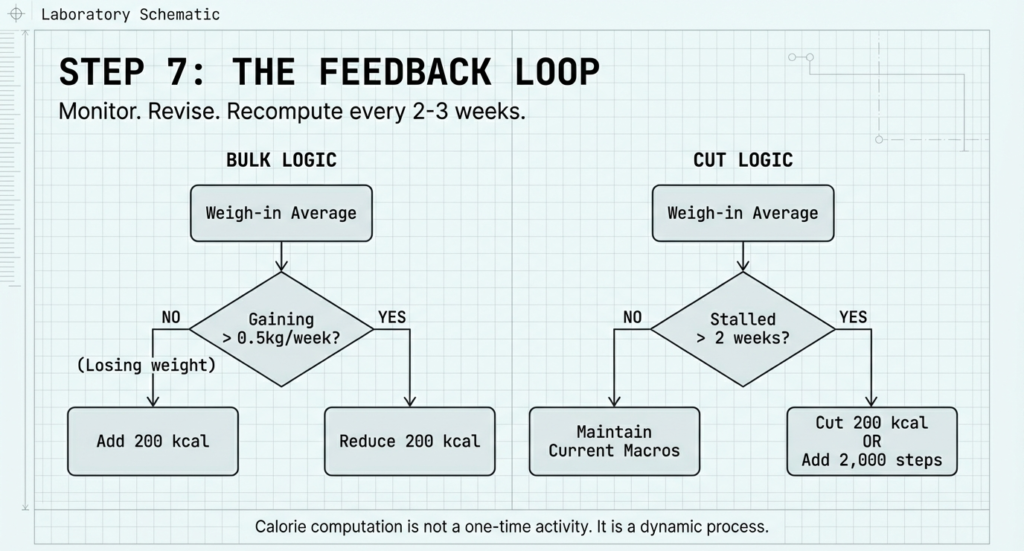
This is where the majority of the people fail. Your metabolism adapts. Bodyweight changes. Activity levels shift.
During a bulk:
- Aim to gain 0.25–0.5 kg per week.
- In case of excessive weight loss, cut 150-200 calories.
- If not gaining, add 150–200 calories.
During a cut:
- Goal 0.5-1 per cent bodyweight loss in a week.
- In case weight does not decrease after 2 weeks, cut 200 calories.
- Or increase daily steps by 2,000–3,000.
Calorie computation is not a one time mathematical activity. It is a dynamic process.
Calculation (Real-World Scenario)
Calculation for both the independent and dependent variables is presented below in Table 1.
Example Calculation (Real-World Scenario).We shall take a practical illustration.
Male:
Weight: 86 kg
Height: 178 cm
Age: 36
Training: 5 days/week
- Step 1 – BMR:
(10×86) + (6.25×178) − (5×36) + 5.
= 860 + 1112.5 − 180 + 5.
= 1797.5 ≈ 1798 kcal. - Step 2 – TDEE:
1798 × 1.55 = 2786 kcal.
Maintenance = 2786 kcal
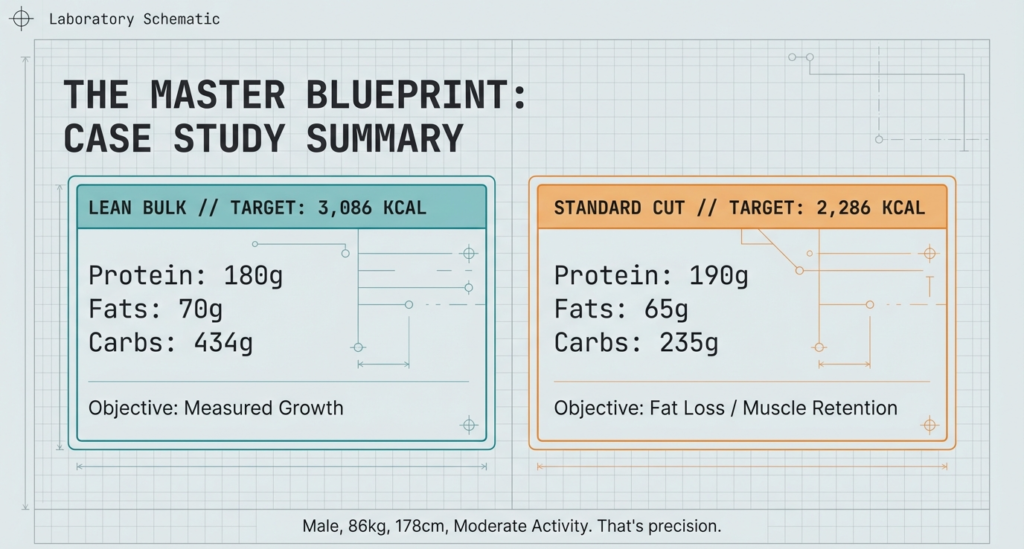
Lean Bulk Target:
- Add 300 kcal → 3086 kcal.
- Protein: 180 g = 720 kcal.
- Fat: 70 g = 630 kcal.
- Remaining calories: 3086 − 1350 = 1736 kcal.
- Carbs: 1736 ÷ 4 = 434 gm.
Cutting Target:
- Subtract 500 kcal → 2286 kcal.
- Protein: 190 g = 760 kcal.
- Fat: 65 g = 585 kcal.
- Remaining calories: 2286 − 1345 = 941 kcal
- Carbs: 941 ÷ 4 = 235 gm.
That’s precision.
Hi-tech 2026 Calorie Plans
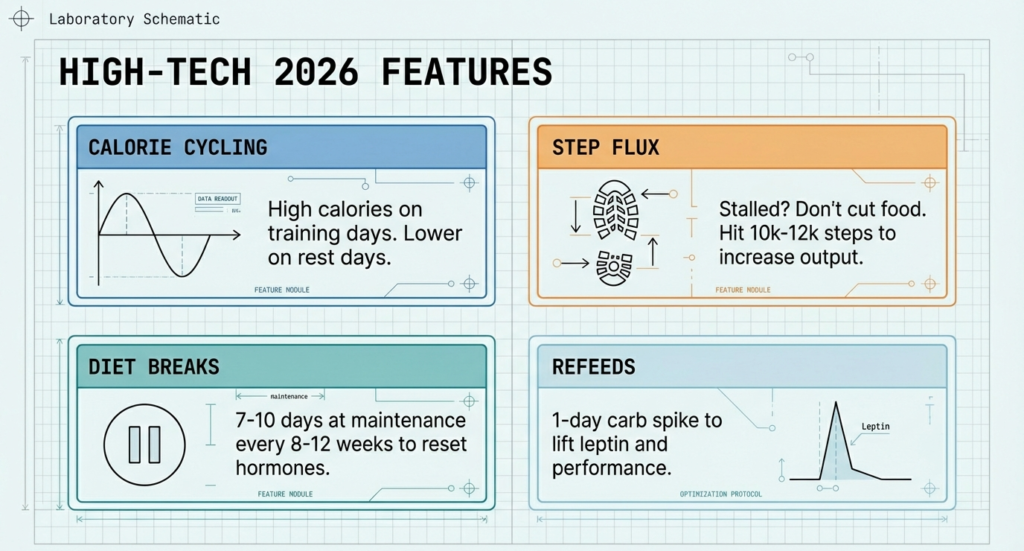
Healthy nutrition in 2026 is not just about the numbers.
1. Calorie Cycling
Training days- more calories, rest days- less calories.
Helping performance and managing on a weekly basis.
2. Step-Based Adjustments
Rather than reducing food on the spot, take 10,000-12,000 steps per day and then decrease calories.
3. Diet Breaks
After each 8-12 weeks of the cutting period, you should rest hormones and metabolism on 7-10 days of maintenance calories.
4. Refeeds
One day ketogenic diets are able to lift training performance and leptin temporarily.
Calorie Calculation errors
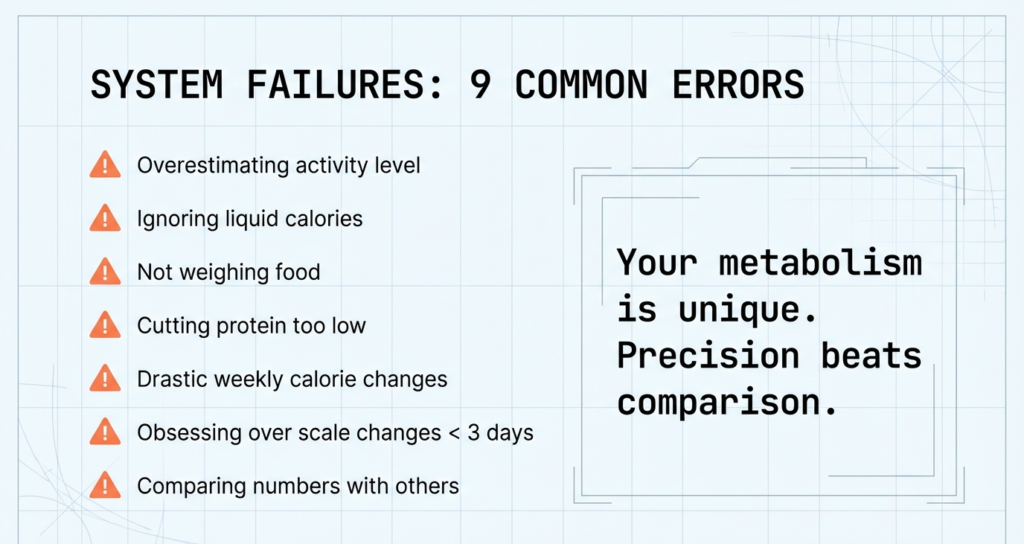
- Ignoring liquid calories.
- Not weighing food.
- Cutting protein too low.
- Changing calorie drastically on weekly basis.
- Posing a prediction of changes in the scale after 3 days.
- Counting your calories against other people.
- Your metabolism is unique. Precision beats comparison.
Bulking vs Cutting: The Intelligent Approach to Change
- Bulking refers to measured development and not mindless consumption.
- Fad dieting is not about starvation but muscle maintenance.
- When you fatten too fast, you take months and months to lose the excess fat. When you cut too hard you lose strength and muscle.
- Intelligent athletes act in systematic stages that have quantifiable goals.
The Way to Know Your Calories are Working.
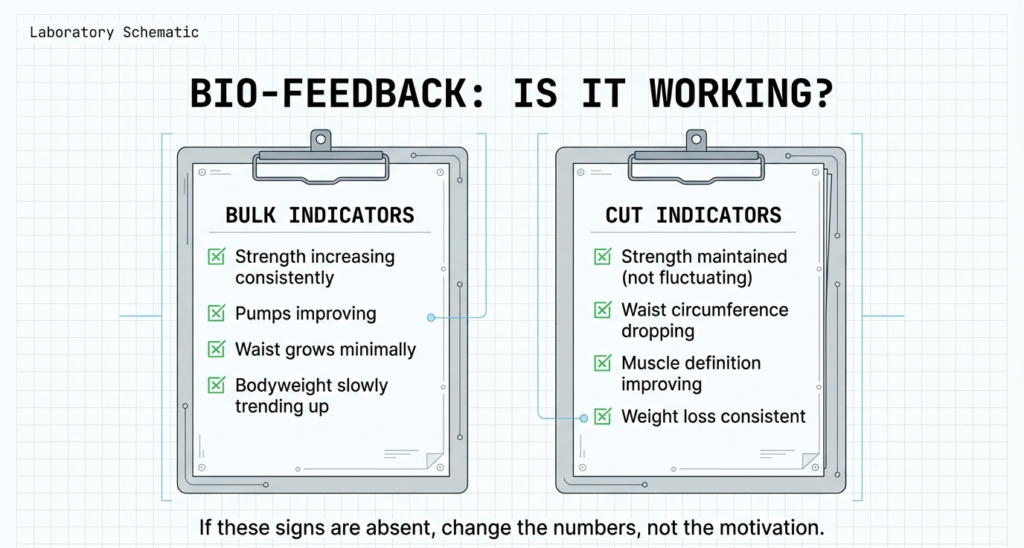
During a bulk:
- The strength gains. continuously.
- Pumps improve
- Bodyweight is increasing slowly.
- Waist grows minimally.
During a cut:
- Strength is not very fluctuating.
- Weight loss is decreased on a regular basis.
- Waist circumference drops.
- Muscle definition improves.
When these signs are not occurring then change numbers and not motivation.
Last Lesson: Learn Numbers, Learn Physique.
Calculation of calories is not complex. It is controlled math that is put into use.
Read more: https://www.muscleandstrength.com/workouts/10-week-mass-building-program.html
Follow these 7 steps
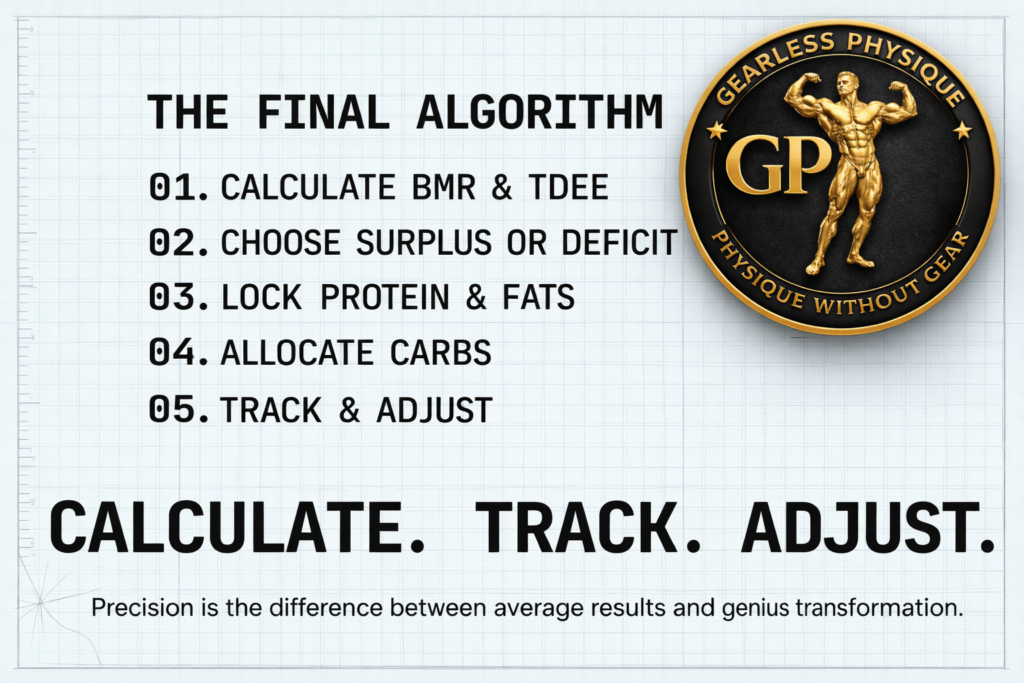
- Calculate BMR.
- Determine TDEE.
- Choose surplus or deficit.
- Lock protein.
- Set fats.
- Allocate carbs.
- Track and adjust.
Be it going on a bodybuilding stage or just attempting to work on your physique, precision nutrition is what will be the difference between average results and genius transformation.
- In 2026, the guess is not justifiable.
- Calculate. Track. Adjust.
What you always supply to your body is what it will react to.

Gearless Physique
Physique Without Gear
Your transformation starts now. Who's with me?