
Mastering the cut: 7 elite strategies to torch fat & keep muscle
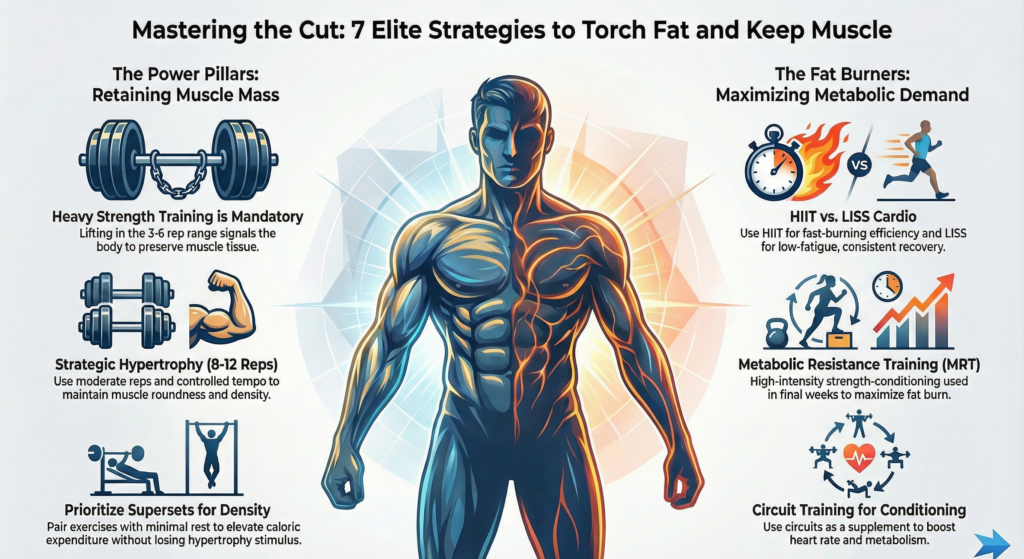
7 Best Training Styles for Cutting Phase
It is not about eating less it is about training smarter. Once the calories are reduced, the recovery capacity is lowered, glycogen stores become smaller and strength may also vary. A cutting phase is expected to be easy; preserve muscle, maximize fat loss, and preserve performance.
As a coach I keep saying that workouts need to be cut in a manner that would maintain the intensity yet strategically raise metabolic demand. The 7 best training styles will enable you to remain full, hard and muscular whilst also becoming lean.
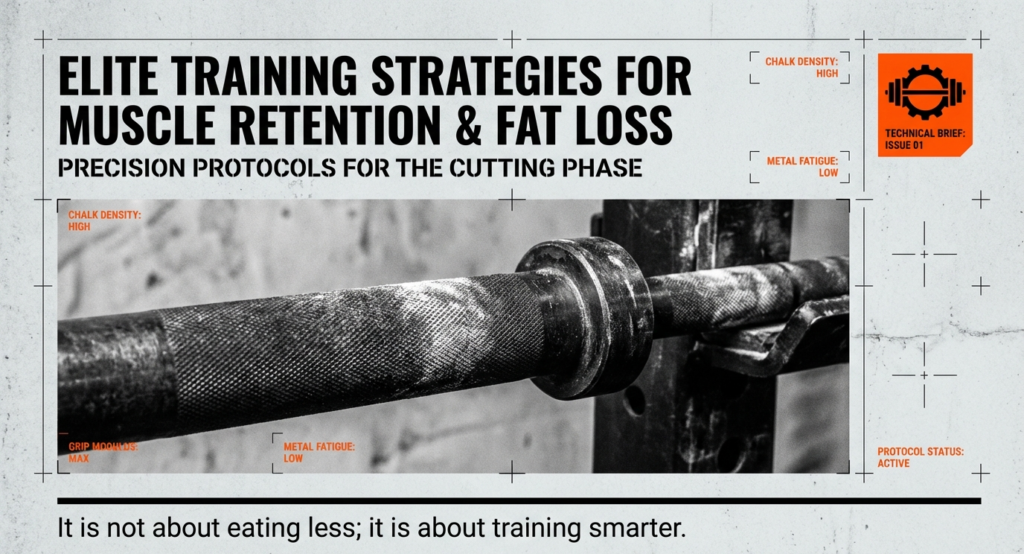
The Cutting Paradox
The irony of cutting is the natural reaction of the body on the decreased calories. When the amount of energy consumed decreases, the recovery capacity reduces, protein synthesis decreases, and glycogen stores become smaller. This generates a catabolic state with the muscle tissue becoming susceptible to degradation. The aim of a cut is to gain as much fat as possible through losing as much muscle as possible; although the body might lose lean mass due to the decrease in training intensity. This is why exercises should not be too easy to indicate that muscle is not needed anymore.
The target is straightforward: to retain muscle mass, perform and stimulate metabolic demand in a strategic way that allows fat as the major source of energy rather than hard-earned muscle.
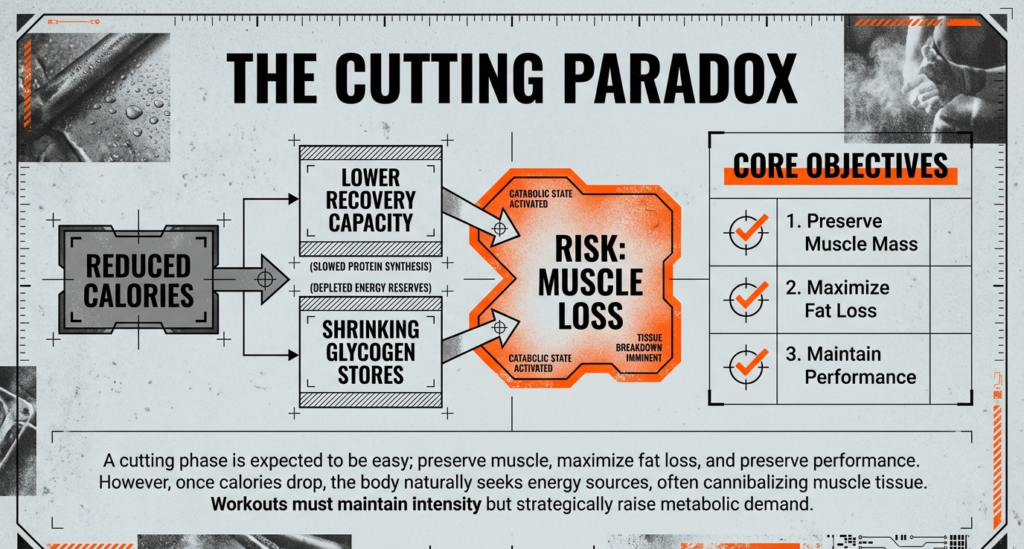
The Golden Rule
The golden rule of an effective cutting phase is straightforward; intensity as opposed to volume. Excessive training volume is therefore ineffective when the calories reduce and therefore recovery capacity suffers. Compound lifts should have heavy loads maintained rather than increasing the sets. Muscle is costly to maintain and the body will dispose of it unless it is provided with a potent motivation to retain. Lifting to 80 -90% of peak strength is an indication that the muscle tissue remains vital. Plateauing should be avoided and burnout should be avoided, although, intensity should be high.
Intelligent programming also maintains strength, muscle mass, and makes fat burning come out of the adipose tissue and not the lean muscle obtained through hard work.
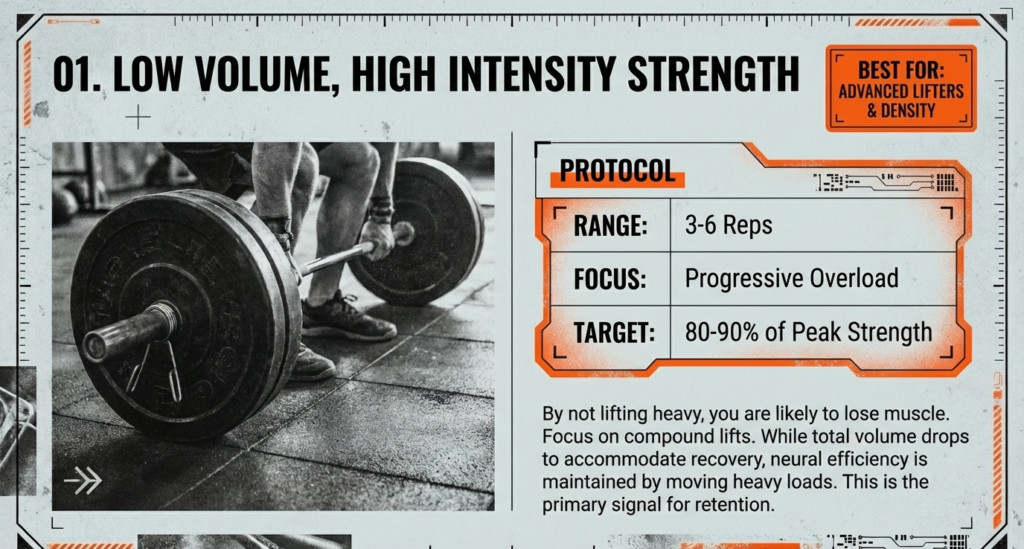
1. Low Volume, High Intensity Heavy Strength Training
Among the greatest errors made in a cut is weight loss that is excessive. Intensive exercise makes your body to store muscle tissues. Low calories mean that your body seeks a source of energy. By not lifting heavy, you are likely to lose muscle.
- Pay attention to such compound lifts as squats, bench presses, deadlifts, and overhead presses. Stay within the 3-6 range and progressively overload where possible. There can be a little drop in volume, although the intensity should remain high.
- Neural efficiency and levels of strength are maintained through heavy lifting. Although number may slightly go down, it is best to keep your peak strength at 80-90%.
Best: For advanced lifters who desire to retain size and density.
2. High-Intensity Interval Training (HIIT)
HIIT is effective in burning fats as it is a fast burning exercise and raises post-exercise oxygen consumption (EPOC).
- Intense short intervals of exercise and rest will promote the burning of fats without many hours of cardiovascular exercises.
- The sessions may take 15-20 minutes and they may consist of sprints, rowing, cycling, or bodyweight circuits. HIIT is better than long-duration steady cardio, at least when planned correctly, in terms of muscle preservation.
- But it is exhausting to the recuperation. Restrict HIIT to 2 to 3 sessions in a week so as not to overtrain particularly when weight lifting.
Best in: Busy people and medium-level athletes who want to achieve an efficient fat loss.
Read more: https://www.menshealth.com/fitness/a25424850/best-hiit-exercises-workout/

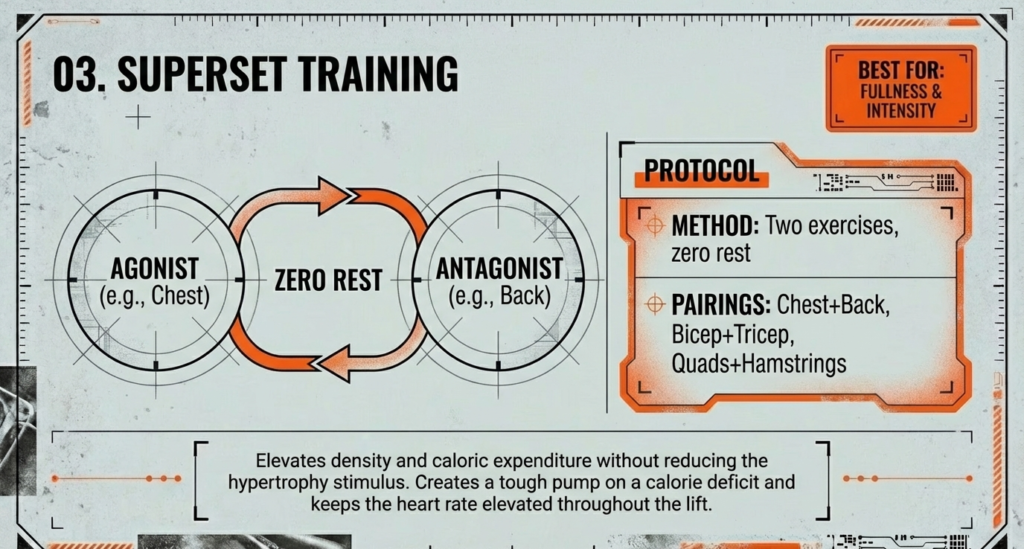
3. Superset Training
Supersets refer to the use of two exercises in sequence with little rests. They elevate the density of training and caloric expenditure and do not reduce hypertrophy stimulus.
Common formats include:
- Chest + Back
- Biceps + Triceps
- Quads + Hamstrings
The effect of this approach is a tough pump on a calorie deficit. It also reduces the time of work outs and increases the heart rate.
Supersets are also superior in the process of cutting since they combine both muscle retention and conditioning.
Best used: Lifters that desire to stay full of muscles and intensify.
Read more: https://www.muscleandstrength.com/workouts/fast-mass-program
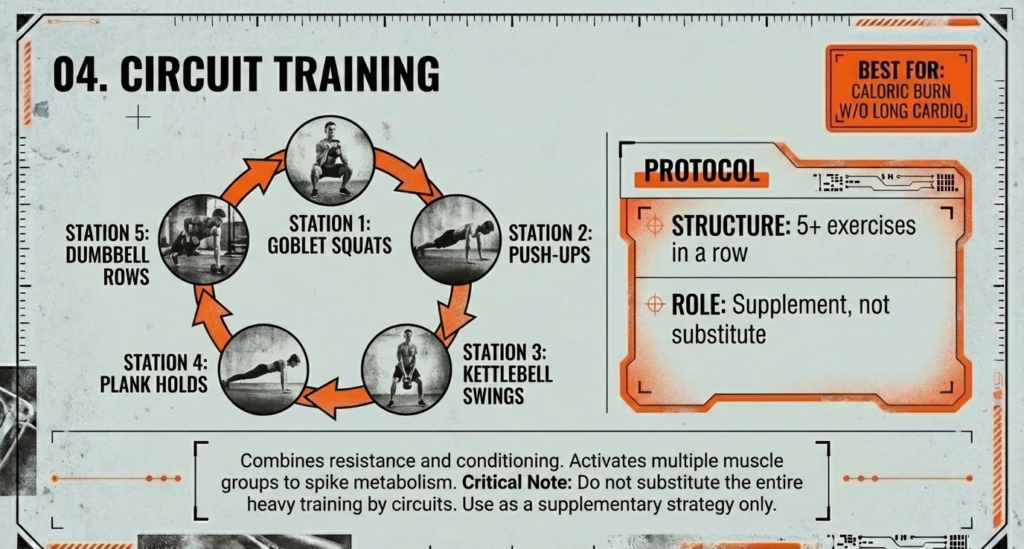
4. Circuit Training
Circuit training is a combination of resistance and conditioning into a single session. You do it in several exercises (alternating the exercises with few intervals of rest).
An example circuit can contain:
- Goblet squats
- Push-ups
- Kettlebell swings
- Plank holds
- Dumbbell rows
Circuits increase the heart rate and activate more than one group of muscles. They are good in the fat burning and metabolism conditioning.
Nevertheless, do not substitute the entire heavy training by circuits. Work on them as a supplementary strategy, not a substitute.
Best: Athletes who want to train to burn more calories without spending hours on the cardio.
Read more: https://blog.nasm.org/circuit-training-everything-you-need-to-know
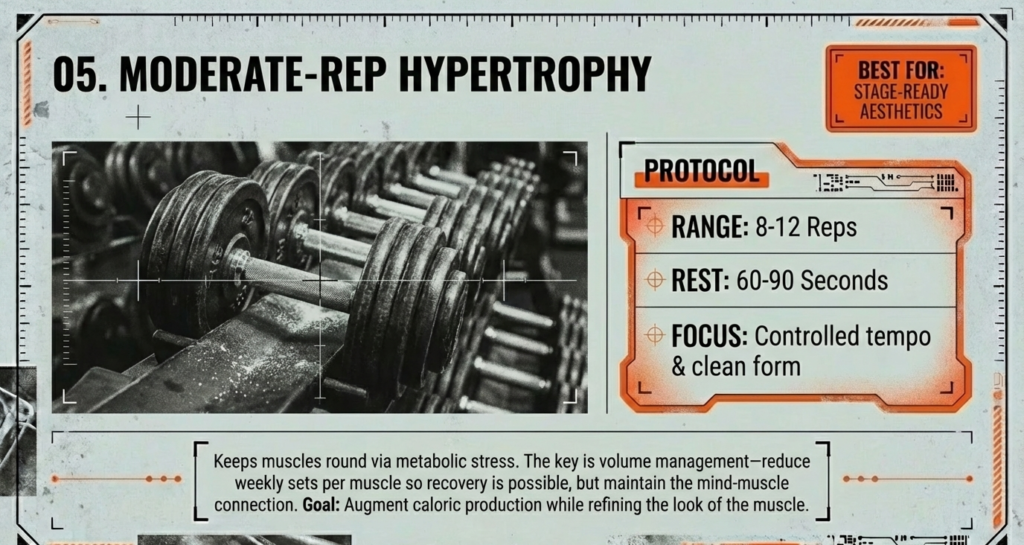
5. Moderate- Rep Hypertrophy Training (8-12 Reps)
The conventional hypertrophy zone continues to cut. Moderate repetitions do not relax the muscles and metabolic stress.
- The key is managing volume. Rather than 20+ weekly sets per muscle, cut it down a little so that it has time to recover.
- Maintain rest periods (60 to 90 seconds) to augment caloric production.
- When working on a cut, mind-muscle connection is more crucial. The quality of muscles is maintained by the controlled tempo and clean form.
- This is a technique of keeping the muscles round and burning the calories gradually.
Best: Bodybuilders who want to be stage ready.
Read more: https://www.muscleandstrength.com/workouts/8-week-hypertrophy-workout
6. Fasted Low-Intensity Steady-State Cardio (LISS)
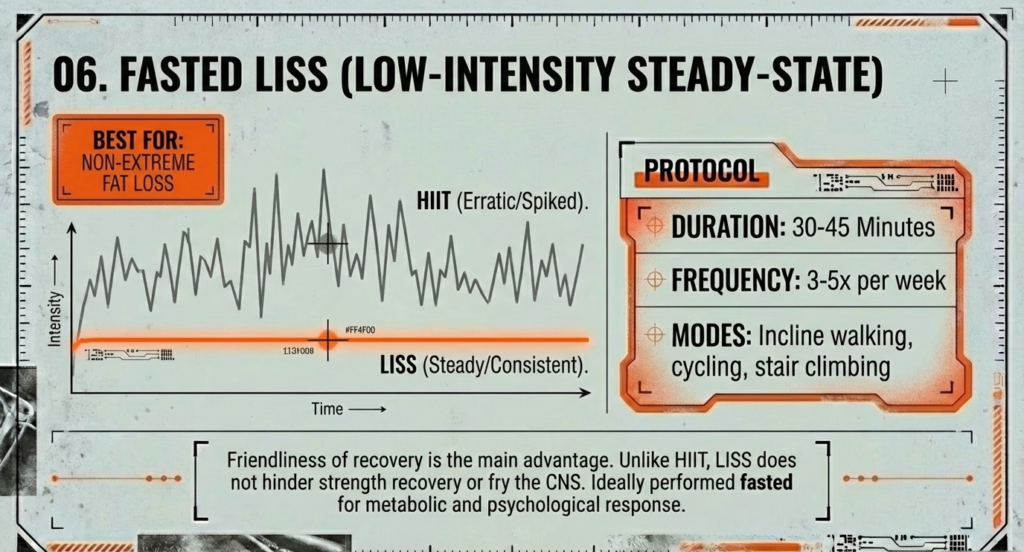
- LISS is 30-45 minutes of moderate exercise, steady, and cardio. They can be such exercises as incline walking, cycling or stair climbing.
- Fasted cardio is controversial but others do respond well both psychologically and metabolically. Friendliness of recovery and consistency are the main advantage.
- LISS does not have a high effect on strength recovery in comparison to HIIT. It is possible to be done 3-5 times a week without much fatigue.
Apply it tactfully so as to maximize energy burn every day without pushing stress hormones to excessive levels.
Best: Personalities who like to fat burn in a non-extreme fashion.
Read more: https://www.muscleandstrength.com/articles/what-you-should-know-about-fasted-cardio
7. Metabolic Resistance Training (MRT)
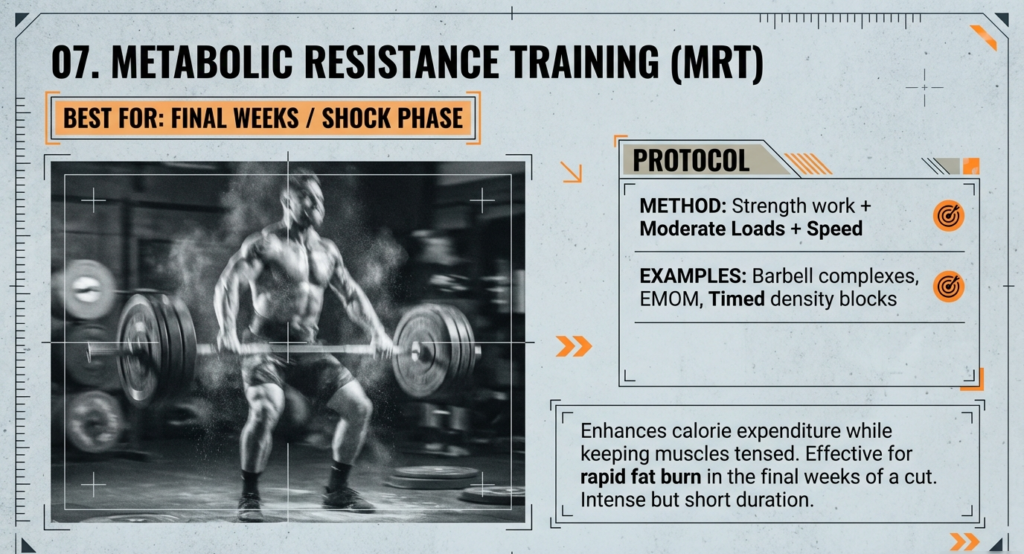
Metabolic resistance training is a combination of both strength and conditioning that will be conducted at the moderate loads with minimal rest.
Examples include:
- Barbell complexes.
- EMOM (Every Minute on the Minute).
- Timed density blocks.
- MRT enhances calorie expenditure and keeps the muscles tensed. It’s intense but structured. The exercises have increased speed and less resting.
This type of training will be effective in the last few weeks of a cut when fat needs to be burned at a rapid pace.
Best: Advanced lifters who need to train before the photoshoots or competitions.
Read more: https://www.muscleandstrength.com/articles/metabolic-training-3-circuits-for-fat-loss
The strategic selection matrix
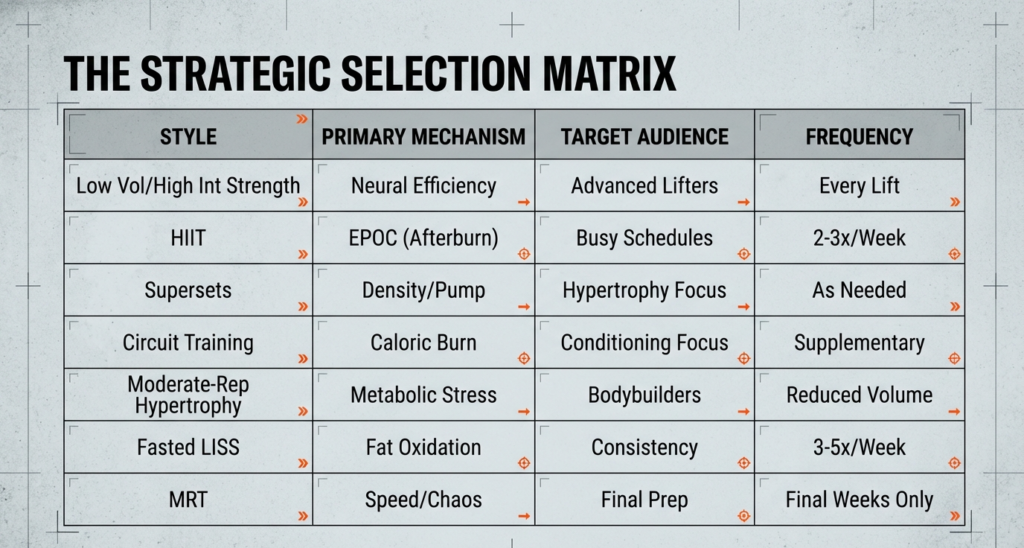
- As pointed out by The Strategic Selection Matrix, not all styles of training are applicable in one and the same way during a cutting phase.
- High-intensity strength work of low-volume will provide the impulse to neural efficiency and must base each lift on muscle-saving.
- HIIT can be used to take advantage of the afterburn effect when the only time to exercise is in the busiest schedules, but needs to be restricted to once a week.
- Supersets increase density and pump against hypertrophy-oriented athletes.
- Whereas circuit training aids caloric burn as an additional but not as a replacement aid.
- The metabolic stress is maintained at a decreased volume in moderate-rep hypertrophy.
- Fasted LISS is known to support regular fat oxidation and easily manage recovery requirements.
- Lastly, metabolic resistance training should be used during the last prep weeks because they will further increase the fat loss without compromising muscle integrity.
Development: How to Organize a Cutting Week
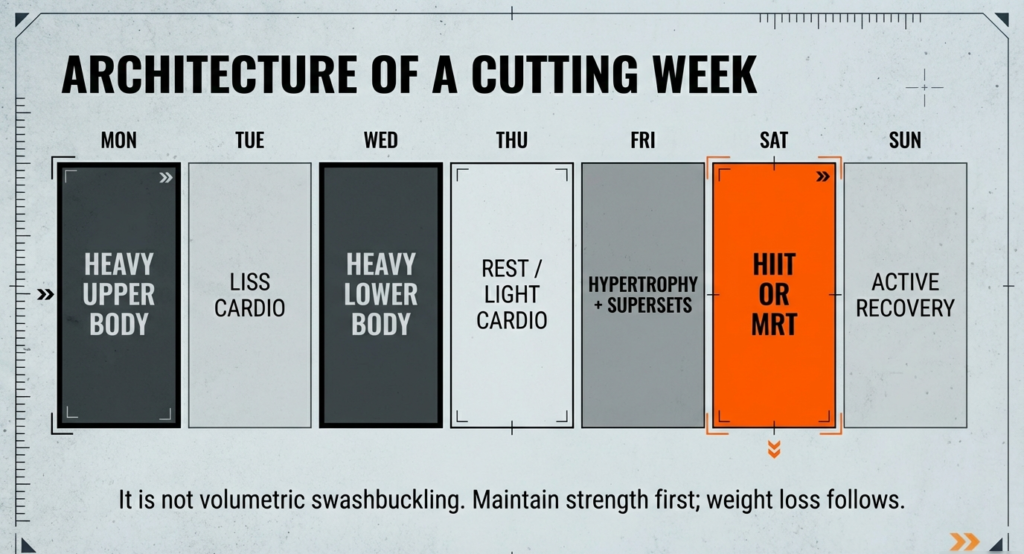
The weekly division can be in the form of a balanced split and it may be as follows:
Day 1: Heavy Upper Body.
Day 2: LISS Cardio.
Day 3: Heavy Lower Body.
Day 4: Rest or Light Cardio.
Day 5: Hypertrophy + Supersets.
Day 6: HIIT or MRT.
Day 7: Active Recovery.
The key is managing fatigue. It is not volumetric swashbuckling in making a cut. Maintain the strength first and the weight loss comes afterwards.
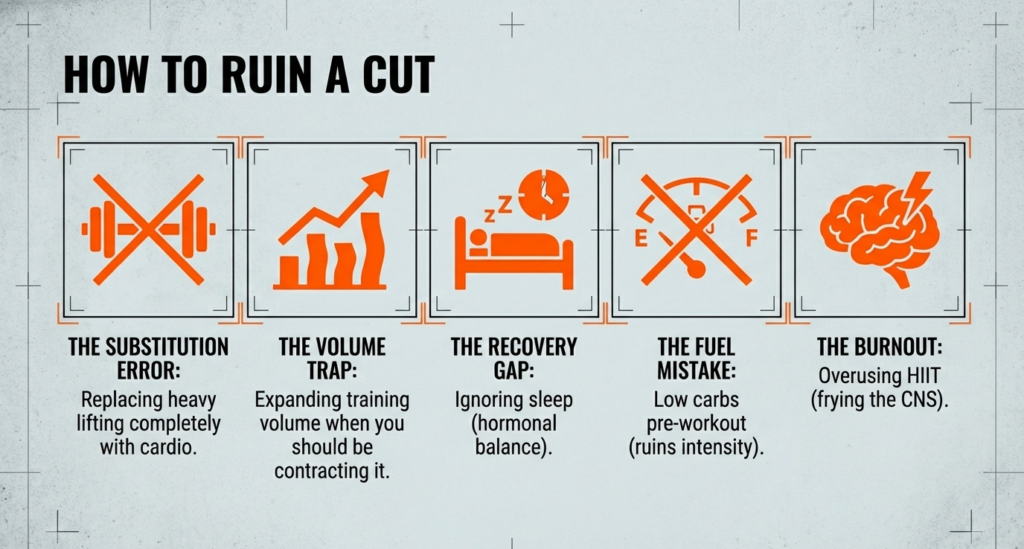
How to run a cut
The strategy is often substituted by emotion, thus causing the ruin of a cut.
- Most of the wrong substitution mistakes that lifters commit are the ones who do away with heavy lifting and replace it with all cardio, which informs the body to lose muscle.
- Some have the volume trap where the volume of training is increased with a lowered recovery capacity.
- Taking a minimal break on sleep causes a recovery deficit that interferes with hormones and fat burning.
- Under-fueling, particularly reducing carbohydrates prior to the training, is the murderer of performance and intensity.
- Lastly, excessive use of HIIT will burn out the central nervous system and burn out.
One needs a balanced cut, which requires accuracy: stay strong, control volume, recovery, performance, and cardio: not too much, not too little.
Final Thoughts
Slicing is not a punishment, it is more of precision. The combination of heavy lifting to retain, strategic cardio to lose fat and smart volume control is the best. No single style works alone. The actual magic lies in the combination of approaches with wisdom. Become strong, get purposeful, recover vigorously, and leave the calorie deficit to its labor. An intelligent cut maintains the body you had developed when you were adding pounds. Train as you still want to develop – only more disciplined.
When you want to be shredded, dense, and stage-ready in your training, these 7 training styles would take you there the right way.

Gearless Physique
Physique Without Gear
Your transformation starts now. Who's with me?